

A revolution makes a difference. For the corporate media, however, what happens to people’s lives and dignity goes by the boards, focused as they often are on stories aimed at casting Venezuela as a pariah state. Under discussion here is the business of a socialist revolution.
The National Institute of Statistics released data recently showing that poverty rates fell from 70 percent in 1996 to 23 percent last year, with extreme poverty dropping from forty to six percent. Venezuela’s Human Development Index, a United Nations tool for composite surveys, advanced from 0. 802 in 2000, one year after President Hugo Chavez took office, to 0.844 in 2007. In one recent year Venezuela moved from 62nd in the world to 58th, from the “medium” range of rankings to “high.”
Venezuela’s Gini coefficient changed over the decade from 0.49 to 0.39. Perfect inequality corresponds to a Gini coefficient of one, while zero represents complete equality. These conclusions were contested in Venezuela, especially by right wing academicians, although the World Bank and the Latin American and Caribbean Economic Commission backed them.
Government spending, indicative of priorities, set the stage for these improvements. The Bolivarian News Agency reported recently that social spending over 11 years on health care, education, food, and more came to $330.6 billion. Total government income during the period was $500 billion. In 1998, social spending represented eight percent of the gross domestic product and is 20 percent now. Investment in education, 3.38 percent then, became seven percent by 2008. Health care outlay rose from 2.8 percent in 1997, to 6.0 percent in 2007, to 10 percent projected this year.
Social missions operating outside ministerial bureaucracies serve as vehicles for programs. The list includes: Missions Robinson, Ribas, and Sucre aimed at literacy and primary education, secondary education, and university study respectively; Mission Miracle, for surgical sight restoration; Mission Smile, dental care; Mission Ché Guevara, job training; Mission MERCAL, food security; Mission Habitat, housing; Mission Zamora, land reform; and Mission Trees; among others.
Food supplementation is one success story. Eleven years ago, 252,000 children received school meals. Now, over four million receive two meals a day in schools. A million people eat at special locations set aside for meals. Another is literacy, with the rate rising from 86 percent in 2001 to 96 percent presently.
Improvements in health care have been remarkable. Beginning in 2003, primary and preventative health care expanded by means of the social mission known as Barrio Adentro (“Inside the Neighborhood”) I. Barrio Adentro II includes specialized medical and diagnostic services, 600 rehabilitation facilities, and 35 “high technology medical centers.” A strengthened network of public hospitals evolved out of Barrio Adentro III, while Barrio Adentro IV calls for the building of specialty hospitals. A new pediatric heart center is already operating.
The presence of 15,000 Cuban doctors working throughout Venezuela fueled these initiatives, particularly Barrio Adentro I and Operation Miracle. The Cuban doctors with Venezuelan colleagues have undertaken to educate new doctors. Some 20,000 medical students studying throughout the country are close to graduating.
The government last month increased funding for Barrio Adentro III by $93 million, for fighting infectious diseases by $21 million, and for hospital improvements generally, $186 million. A campaign to immunize 95 percent of the population against 14 diseases began recently. Members of six million families will be immunized in their homes.
Infant Mortality fell from 21.4 infants dying in 1998 out of 1000 births, to 13.7 percent in 2007. Life expectancy at birth last year was 73.9, up from 72.8 in 1998. High quality primary care is accessible now to 95 percent of the population, at no cost. Only 20 percent of poor people could obtain medical care earlier, reportedly of poor quality. Ambulatory care centers have doubled in number to over 11,000. From 20 doctors per 100,000 people in 1998, the number now exceeds 60.
However, too many mothers are dying during and after childbirth, with rates oscillating since 1998 between 51 deaths per 100,000 women and 65 deaths. Late last year President Chavez announced the creation of the Baby Jesus Mission (Mision Niño Jesus) aimed at promoting maternity and pre-natal health care for the sake of safe birthing.
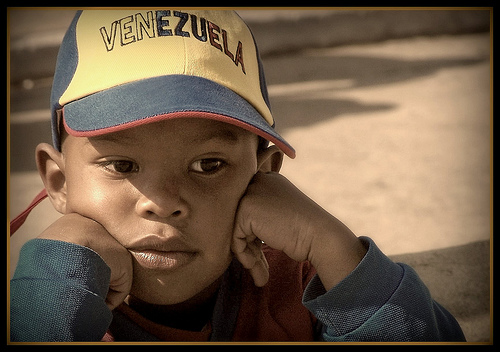
Photo:Daniel Zanini H./http://www.flickr.com/photos/zanini/ / CC BY 2.0
CONTRIBUTOR


Comments