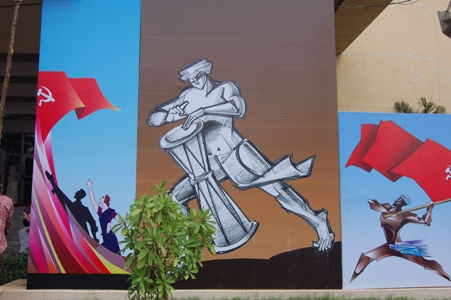
The following are remarks made by Communist Party USA Vice Chair Scott Marshall to the 11th International Meeting of the Communist and Workers Parties hosted by the Communist Party of India (Marxist) and the Communist Party of India in New Delhi on Nov. 20 – 22. The main theme of the international meeting was, “The international capitalist crisis, the workers and people’s struggle, the alternatives and the role of the communist and working class movement.” Representatives of 56 parties from 48 countries attended.
In this terrible time of global economic crisis it is most timely that the communist, left and workers parties seek ways to expand and broaden our slogan “workers and oppressed peoples of the world unite.” While our slogan has been around for many generations, today it has more meaning than ever. Today global economic integration has reached new incredible levels. Today global finance capital roams the world pillaging and profiteering on a scale unimaginable in Marx’s day.
First let me say a few words about how the crisis is affecting working people in the United States. Just this month the percentage of workers in our country who are long-term unemployed has reached levels not seen since the Great Depression of the 1930s. In the beginning stages of this crisis we were losing 700,000 jobs or more a month. Today, when some mainstream economists are declaring the recession over, when obscene banking profits are on the rise again, when the stock market is rising again, when finance capital is returning to its unregulated predatory ways with a vengeance, we are still losing around 200,000 jobs a month.
Among young people in the U.S. the unemployed figures are staggering. In the age group of 16 to 24 less than half have jobs. And that number is much worse for African American, Latino and other racially and nationally oppressed youth. Racism in the U.S. takes an even more terrible toll in this kind of an economic crisis. In the communities of the racially and nationally oppressed the crisis strikes with a particular violence and vengeance.
At the same time, experts who follow the housing markets, say that 2010 will see a whole new rash of home foreclosures with workers and their families being evicted and thrown into the streets.
Forty million people are without health care and every month that number rises because in the U.S. many people get their health care through their employer.
In what is supposed to be the richest country in the world, because so much of the world’s finance capital is centered there, hundreds of thousands of children go to school hungry every day.
In many hard hit working class communities, the schools and medical clinics are crumbling and closing. The streets and bridges, the sewage and water systems, the basic infrastructures are neglected and decaying. And vital public services at all levels of government are being cut back and stopped.
The list of capitalism’s failures in this crisis is very long. And of course we know that the crisis hits many in the developing world much harder than it hits the developed countries.
There are always two sides to the class struggle. Two major events are now turning the tide of working class struggle in a more militant and fighting direction in my country. The first is the rise of the movement that defeated the ultra-right Republican Party in the 2008 election and elected Barack Obama. That same movement also defeated many ultra-right members of the U.S. Congress. I know that internationally there are some mixed feelings about the role of President Barack Obama. Let me be clear, he is not a communist, he is not a socialist, and on some issues he is quite a moderate liberal. At the same time, after eight years of George Bush, the worst warmongering president and administration in U.S. history, the election of Barack Obama opens a whole new terrain of struggle for the working class in the U.S. and in the world. And after 30 years of vicious neoliberal attack on the U.S. labor movement, on the working class and on the people’s movements, the election of Barack Obama opens the door for a whole new fight for economic justice, peace and equality.
Barack Obama, as I said, is no revolutionary – it’s true. But he doesn’t have to be a revolutionary to do some pretty important things to support labor and the working class. I won’t go into a whole domestic list but it is significant for those of us who work for a living in the U.S. He did inspire a movement and mobilize a broad coalition of democratic forces to defeat McCain and the ultra right. And, more importantly for our meeting here – he has taken some steps to curb some of the worst features of the international policies that he inherited from the previous administration. As on the domestic scene, in international affairs it will be the mobilization of the peoples forces and labor that will be decisive in shifting U.S. policy even more – the people’s forces had very little affect on the Bush administration – but it can help move the Obama administration in a better direction.
The movement that elected Obama was, and continues to be, a broad coalition of social forces including even some sectors of capital. But at its heart is what we like to call the core social forces, the working class and its organized sector the labor movement, the racially and nationally oppressed, women, youth and the gay rights movement.
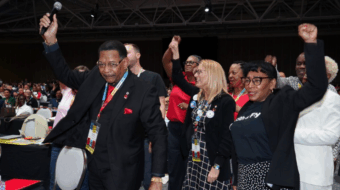
The other major event that is helping to turn the tide was the September 2009 convention of the AFL-CIO, the largest labor federation in our country. I believe history will record that convention as a major turning point for our working class. This convention was the culmination of changes and developments that began in the mid-1990s. The AFL-CIO convention in 1995 was a major break with some of the worst features of class collaboration and the Cold War that began with the anti-Communist witchhunts of the early 1950s. In the mid ’90s the labor movement began to develop a more class struggle approach. After the 1995 convention U.S. labor began to develop its own independent political apparatus. It became more militant in the economic struggle. It increasingly began to see the global nature of capitalism. Further it even began to understand that the labor movement had to be more than just the defender of its own members, it had to become the voice and movement of the whole working class.
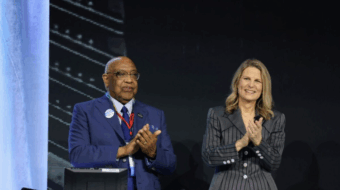
The 2009 convention of the AFL-CIO deepened these trends and was remarkable in many ways. It elected a new leadership, militant and rooted in the fighting industrial union traditions of my country. Richard Trumka the new president comes out of the militant traditions of the Mineworkers Union. On the day after his election at the convention he went straight to Wall Street and blasted the banking and insurance industries for causing the economic crisis both at home and abroad. He called for strong new regulatory steps to curb their reckless speculation and for breaking up those banks deemed “too big to fail.” The federation has vigorously pursued a “break up the big banks” policy and mobilized it’s member unions to fight for sharp new limits on finance capital. In another first for our labor movement the convention also elected two women, one of whom is African American, to the other two top leadership positions of the AFL-CIO.
There are way too many examples of labor’s new policies for me to list now but I would like to mention one that I think is important to our international movement and illustrates a new direction and new possibilities for international labor solidarity. I have with me a letter, well publicized in the labor press in the U.S. from Richard Trumka to Secretary of State Hillary Clinton. In it he says that the AFL-CIO believes that the coup government in Honduras to be totally illegitimate. The letter says the coup’s repression of the trade unions and democratic movements in Honduras make it impossible for there to be free and fair elections this November. And the letter strongly calls on the U.S. State Department to stop all aid to Honduras until the coup is overturned and President Zelaya is returned to power. The letter also says that the position of the AFL-CIO was taken in consultation with the Honduran labor unions.
This is but one dramatic example of the new thinking in U.S. labor on international questions. U.S. labor also strongly opposes the wars and occupations in Iraq and Afghanistan. The convention also passed a resolution calling for an end to travel and monetary restrictions against Cuba and for better relations. These are examples of U.S. labor breaking with the State Department and U.S. imperialism on international issues for the first time since the Cold War began after WWII. We think this opens a whole new world of possibility for rebuilding and strengthening world labor and working class solidarity.
And we think that communist and workers parties have a critical role to play in helping to take advantage of the new possibilities. It is really time for labor, on all sides of the old Cold War political divide to reconsider and rethink labor unity.
Comrades, in our opinion the global economic crisis continues unabated. According to the World Bank and the International Monetary Fund the world nation’s produce somewhere in the neighborhood of $65 trillion in goods and services each year. At the same time, according to the International Bank of Settlements, over $515 trillion is speculated in derivatives, credit default swaps and similar forms of exotic finance schemes. Think of it – such incredible imbalance. It’s staggering – think of the stolen surplus value represented in this deadest of all parasitic finance capital. Think of the problems of the world’s people that could be solved with that kind of money.
We think it is also important to look at the splits in capital in this period. In the U.S. there is growing evidence of splits between manufacturing capital and banking capital. This is not just splits between big and small business. It may open up serious lines of attack for regulating and reigning in some of the most predatory practices of speculative finance capital around the world.
We have much to discuss and think about. But I would like to end with a paraphrase of something Fredrick Engels once said, “an ounce of action is worth a pound of theory,” something to that effect. We are most interested in how our parties can play a concrete role in helping to bring about real organized struggle along the lines of “workers of the world unite.” This needs to begin with what we can do to help unite and broaden the global labor movement. Marx and Engels did not say, “Workers of the World – unite to share information.” It was clear that they meant workers of the world unite for struggle. How can we make that a reality in today’s real world. What are our first concrete steps. We hope our meeting and deliberations can move us closer to making it happen.
CONTRIBUTOR