President Donald Trump, head of state of the wealthiest and most powerful country in the world, has taken aim at a small African country, which he claims to have never heard of, the little independent Kingdom of Lesotho. He is threatening to slap a 50% tariff on everything Lesotho exports to the United States, and Lesotho’s government, understandably, sees this as an existential threat.
Land-locked Lesotho, entirely surrounded by the Republic of South Africa, has had a dramatic history and has faced powerful enemies before. Will it be able to face down the United States this time?
The revered founder of Lesotho was King Moshoeshoe I (1786-1870), who established the country and fended off a whole series of more powerful forces to keep it going. The disrupted state of early 19th-century Southern Africa, caused by the pressures of Dutch, British, and Portuguese colonialism, and the rise of the powerful Zulu state, set in motion many wars and large-scale population movements.
Moshoeshoe managed to pull together pieces of communities which had been disrupted and displaced, and forge unity among them, protecting them by utilizing a natural fortress (similar to the “mesas” of the Southwestern United States) called Thaba Bosiu, near Lesotho’s present capital, Maseru.
His people, who came to be called the Basotho (white people called them Basutos), also became militarily proficient: The country’s cool climate and high elevation made it possible for them to raise horses without having to worry about insect-borne diseases, which, before vaccines were available, killed the animals in the hotter areas of Southern Africa.
Thus, Lesotho was able to raise and employ light cavalry forces in its battles with its neighbors. Lesotho showed it could hold its own in battles, not only with other African nations, but with the fighters of the Afrikaans speaking Boers of the adjacent Orange Free State. A high point came in 1852, when Moshoeshoe’s horsemen managed to defeat a British invasion led by a senior officer, General Cathcart, at the Battle of Berea.
Couldn’t hold out forever
But Moshoeshoe and his advisors realized that they could not hold off the power of the British Empire forever, so they made a diplomatic approach to the British, asking to be made a protectorate. In the process, they lost a lot of land to the Orange Free State, but at least never came under South Africa’s apartheid system. In 1966, the protectorate arrangement was ended, and Lesotho became a fully independent country, though a very tiny and impoverished one.
Fast forward to the present day: Lesotho is completely surrounded by the Republic of South Africa and has close economic ties with that country. South Africa’s mining industry has traditionally attracted laborers from less prosperous neighboring countries, including Lesotho.
For more than a century, young men from Lesotho have crossed over the border to labor in the gold mines of the Witwaterand region in South Africa, very often returning with a small amount of cash and a deadly case of tuberculosis, silicosis, or some other occupational disease of mine workers (my late father, a medical doctor who worked with miners, called this simply “murder”)
Today, Lesotho, which is very high above sea level and has significant snowfall in winter, sells considerable quantities of water to irrigate South African farms and to meet other needs of its larger and more developed neighbor. There is a small tourism industry, partly based on the fact that Lesotho is the only sub-Saharan African country that has enough snow on its hilly terrain to provide for skiing enthusiasts.
Many families in Lesotho cultivate the soil and keep small herds of cattle, as well as the beloved horses. But these things are not enough to make ends meet. And Lesotho’s infrastructure, especially mountain roads, is in serious need of upgrading.
So Lesotho, with its population of only 2.31 million, is forced to depend on trade and aid relationships with much larger and wealthier countries, including the United States. And such trade inevitably has “strings attached.”
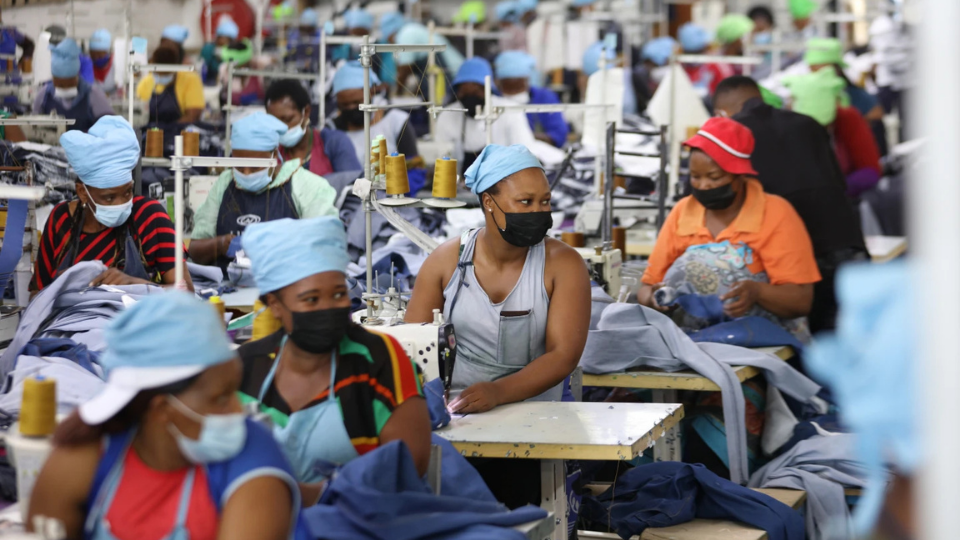
One option that Lesotho has been relying on up to now is the manufacturing of clothing for export to the United States and other countries. This is done to a large extent with the cooperation of the U.S. African Growth and Opportunity Act, AGOA.. Materials are shipped to Lesotho from the United States, and Basoto workers, many of them women, then convert the materials into various clothing items, which are shipped out, including to the United States, duty-free.
This has been a major U.S. economic aid program designed to help African development, not just Lesotho. And U.S. textile manufacturers profit from this too, since the workers in Lesotho are paid far less than U.S. workers would be.
Enter Mr. Trump, who is always ready to try to convince his MAGA base and anybody else who will listen to him, that the United States is being exploited by tiny impoverished countries like Lesotho. AGOA is up for renewal in September, and Trump is on record as talking about African countries like Lesotho in very vulgar, hostile terms. The mildest thing he has said about Lesotho specifically is that he didn’t know it even existed.
This mentality explains, perhaps, why Trump has threatened Lesotho with the huge 50 percent tariff. If AGOA is cancelled and the tariff is so drastically increased, the 35,000 textile workers in Lesotho will be in dire straits. They will get solidarity from South Africa and other African countries, perhaps, and maybe some help from China, but Lesotho already has a huge unemployment rate, especially among youth.
We owe workers in Lesotho our solidarity. Let’s get on our horses, emulating Moshoeshoe’s intrepid cavalry (metaphorically, of course) and defeat the MAGA dragon.
As with all op-eds published by People’s World, the views reflected here are those of the author.
We hope you appreciated this article. At People’s World, we believe news and information should be free and accessible to all, but we need your help. Our journalism is free of corporate influence and paywalls because we are totally reader-supported. Only you, our readers and supporters, make this possible. If you enjoy reading People’s World and the stories we bring you, please support our work by donating or becoming a monthly sustainer today. Thank you!
CONTRIBUTOR