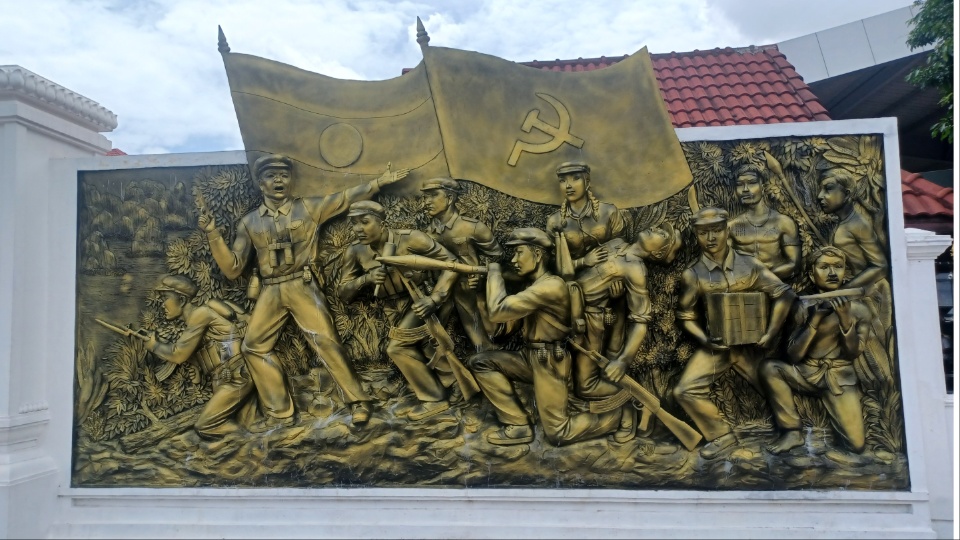
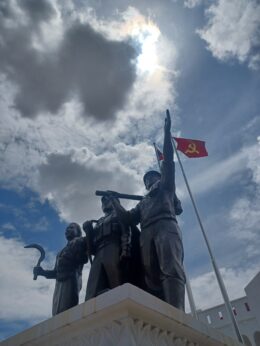
VIENTIANE, Laos—Three figures stand atop a raised pedestal, their eyes fixed on the distant horizon: a young woman in traditional dress, raised sickle in hand, and a rifle slung over her shoulder; a young man sporting a laborer’s uniform, with a hammer resting on his shoulder, gesturing into the distance. Front and center to both, in the unmistakable uniform of the Lao People’s Army, stands the figure of a young soldier, holding firmly to the rifle slung over his right shoulder as he leads them onwards.
Rising up from behind appear two flags—the red-white-and-blue of the free Lao people and the golden hammer-and-sickle emblazoned on a red field, representing the Lao People’s Revolutionary Party (LPRP). They flutter in the hot summer sun, accenting the crest of the Lao People’s Army that proudly adorns the entryway of the grand building further behind. This is the sight that greets visitors to the Lao People’s Army History Museum, setting the tone for what lies in store within.
Before entering, most guests will immediately be drawn towards the museum’s first and most iconic exhibits: a hulking Soviet Mi-8 transport helicopter, an aged MiG-21 jet fighter, and an antique Antonov An-2 biplane. From there, flanking the entrance to the museum on either side, are multiple field cannons and two tanks: one Soviet and one Chinese. Giving testament to the small nation’s hard-fought road to freedom, all of these exhibits saw extensive combat experience in the previous century.
The recently remodeled two-story museum, aside from being a welcome respite from the tropical midsummer heat, is arranged, generally, by historical period and specific topic. The first floor is primarily a showroom for military vehicles—trucks, tanks, and armored vehicles that once ferried the People’s Army to victory over Royalist, Thai, French, and American forces in a continuous period of war spanning from 1945 to 1975.
There are likewise three special presentation rooms, featuring scale models of specific campaigns fought by the People’s Army over the course of the war, including the decisive battle to defend the ancient Plain of Jars in the rainy season of 1972, a critical breaking point in the war that saw the People’s Army emerge triumphant over the shattered remnants of the CIA-directed Royalist coalition.
As one gazes upwards at the ornate central pillar of the museum, one feels as though the museum is intentionally designed to impart on the visitor a clear vision of the People’s Army, and its role as a central pillar in Lao society. Its base is clad in a bronze relief, depicting scenes of the mythical birth, ancient life, and early struggles of the Lao people. It then transitions into a lit display of photographs of the army in action—the war of resistance against French colonialism and U.S. imperialism—transitioning gradually into modern scenes of humanitarian relief, high-tech military drills, medicine distribution in rural areas, and even sporting events.
The pillar thrusts upwards—from the polished granite floor to a bright white ceiling decorated with recessed lights—as if to emulate the Lao people’s own journey, from the hard struggle to survive and achieve freedom to the modern period of rapid whole-society development.
Outside in the courtyard is an even more striking display dedicated to a very different set of artifacts.

The first, a towering monument constructed of deactivated U.S. bombs, memorializes the nine-year indiscriminate bombing campaign unleashed against Laos by the United States from 1964 to 1973, and its enduring effects on the Lao people. In total, over 270 million bombs were dropped on Laos during the “secret war”—roughly 100 lbs. of explosive munitions for every single person living in the country at that time. Of those bombs, around 81 million (30%) did not detonate on impact and have remained dormant since the war concluded.
During that “secret war,” the U.S. oversaw training and funding for the corrupt Royalist military, for more than 10,000 mercenaries from Thailand (Operation Unity), and for a “secret army” of more than 30,000 Hmong guerillas. Codenamed “Operation Momentum,” the effort was allegedly funded, at least partially, by the CIA through the region’s lucrative heroin trade.
In total, around 30,000 Lao civilians were directly killed by the U.S.’ illegal bombing campaign, and around 20,000 more have been killed since 1975 by the unexploded bombs that remain scattered throughout the country. Some 750,000 Lao people were displaced by the war, including 400,000 injured—out of a total pre-war population of only around three million. The cluster munitions used against Laos, specifically designed to scatter smaller “bomblets” over wide areas, remain a part of the U.S. military arsenal, despite decades of international pressure to never repeat the generational destruction and terror inflicted on the Lao people.

The second, a collection of seized and destroyed U.S.military equipment, including an American Bell UH-1 Iroquois (“Huey”) helicopter as well as a McDonnell Douglas F-4 Phantom, and a Republic F-105 Thunderchief, shot down by the Lao People’s Army in 1965 and 1968, respectively. The information displayed with the latter specifies that it was “shot down by militia women led by Comrade Bouasy, using a 12.8 mm gun.”
Deactivated bombs lay everywhere in heaps in the courtyard. More than merely scrap metal, these macabre trophies commemorate the devastation inflicted on the Lao people, and, more importantly, their defiant resistance.
Beneath the bright faces and sabai sabai culture of modern Laos’ drive for development and prosperity, the stories and memories of those dark times live on. The museum displays the names, photographs, and testimonies of many who were directly impacted, including a number of documentary photographs of the innocent civilians—men, women, children, and even Buddhist monks—who continue to limbs and lives to U.S. imperialism’s secret war.
An underlying theme of resistance and perseverance permeates the museum: that the Lao people refuse to be defined by the war and its brutality and that they choose to define themselves, instead, by their national pride and dedication to building a bright future of prosperity and joy for all.
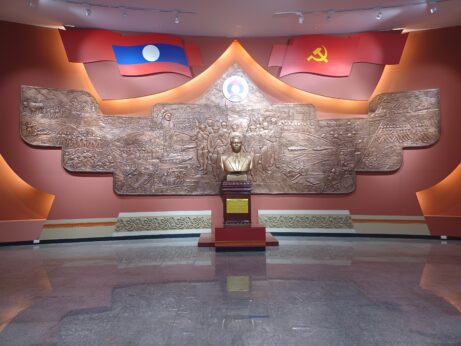
Returning inside the museum and ascending to the second floor, the first display is a no less confronting image: a large, open space, displaying only the polished bust of one man, sitting atop a small pedestal. On the wall directly behind him is arranged another sprawling bronze relief displaying images of Laos’ long history of struggle for freedom and independence. Crowning this depiction shines the emblem of the Lao People’s Army. Slightly higher, reaching up towards the bright starry ceiling, unfurl the flags of the free Lao people and the People’s Revolutionary Party, respectively, as if reaching up to the heavens.
The scene appears as if intentionally framed to represent a singular encapsulation of the story of Laos’ past, present, and intended future. The man at the center of those carefully-arranged images, whose bust stands intentionally at their focal point, is the late President Kaysone Phomvihane. His images appear throughout the museum, often in pride of place: alongside world leaders like Vietnam’s Ho Chi Minh, the DPRK’s Kim Il Sung, and Leonid Brezhnev of the Soviet Union; with party leaders, such as Prince Souphanovong and Khamtay Siphandone; and at public events in cities and villages throughout the country.
As a foundational leader of the Lao Issara (lit. “Free Lao”)’s left-wing forces, which would form the Lao People’s Army in 1949, as well as the founding General Secretary of the Lao People’s Revolutionary Party and the founding Prime Minister of the Lao People’s Democratic Republic (est. Dec. 2, 1975), this placement and celebration of “Uncle Kaysone” is neither coincidental nor out of place.
In many ways, the story of Laos’ resistance and revival, its rebirth and revolution, all find their common thread in the life of that one half-Vietnamese man, born in Savannakhet, which was officially renamed in his honor in 2005.
From there, the second story of the museum is organized more directly as a retelling of the Lao people’s centuries-long struggle to establish and maintain independence and development in a region that has remained fractured for millennia. This history, for the Lao people, dates back over a thousand years, beginning with the legendary king Khun Lo (???—780 CE), who established the first Lao kingdom around what is today the city of Luang Prabang. While the waves of history would continue to ebb and flow for the next thousand years, Khun Lo’s lineage would rule the Lao people, generally, until 1975, when the last king peacefully stepped down, and the Lao People’s Democratic Republic was born.
As presented at the Lao People’s Army Museum, the history of the Lao people may be understood as a continuous struggle against oppression. For the Lao People’s Army, then, theirs is a historic duty: to safeguard their independence, and play a direct role in the development of the Lao nation under the direction of the People’s Revolutionary Party, safeguarding and nurturing the People’s Democratic Republic.
This historic vision of the Lao People’s Army, thus, draws deeper than its formal establishment in 1949, from the remnant progressive forces of the exiled Lao Issara under the leadership of the Red Prince and Kaysone Phomvihane. Its birth, on Jan. 20, 1949, is presented as a moment of historic fulfilment that had been in the making for over a thousand years. Tracing its roots in this way, the People’s Army makes a clear case: that its formation and continuation is a historic necessity of the Lao nation’s struggle for “peace, independence, democracy, unity, and prosperity,” as the national motto puts it.

It is from this position that the role of the People’s Army in modern Lao life becomes clearer. It is more than just a traditional military; it was established as a movement to fight for Laos’ freedom, oriented under the political leadership of the People’s Revolutionary Party, and then as the official armed forces of the People’s Democratic Republic. Notably, the leading figures in each of these achievements overlapped; primarily led by the Red Prince and Kaysone Phomvihane. In this way, the People’s Army plays a special role that touches the very heart of Lao society.
Among the plethora of military hardware on display at the museum are also great treasures of political, scientific, industrial, educational, and cultural significance: textbooks, cameras, trophies, tokens of Laos’ devotion to the international socialist movement, and representations of the Lao people’s intangible cultural heritage. In one display, a small bust of the revolutionary leader V.I. Lenin peers ever-onwards beneath a scarlet banner, emblazoned with golden lettering proclaiming (in both Lao and Russian) the eternal friendship of the Lao and Soviet peoples.
Another such red banner, emblazoned with the golden hammer and sickle in the style of a Communist Party, rests, folded neatly, under another display; the museum claims this flag to have been used by the people of Vientiane when they proclaimed the nation’s independence under the Lao Issara movement on Oct. 12, 1945—some ten years prior to the official founding of the LPRP.
The Lao People’s Army makes no mistake, however, that its primary role is to safeguard the Lao nation. A large red plaque spells this out directly, reading (in Lao):
The Lao People’s Army, founded, educated, and trained by the Lao People’s Revolutionary Party, is a people’s army, born from the people, fighting for the rights and interests of the working people of all ethnic groups, and is a potent tool of the People’s Party and the working class….
The Lao People’s Army is the main force in safeguarding the fruits of the revolution, ensuring that the country’s development is on the right track, improving and perfecting the people’s democratic regime, safeguarding the independence, sovereignty, and complete territorial integrity of the nation, ensuring political stability, order, and social peace and security, safeguarding the people’s democratic regime, protecting the people of all ethnic groups, and the nation’s beautiful culture.
It is thus that the army, in many ways, may be said to function as a core pillar of modern Lao society, and the Lao People’s Army Museum serves as a monument to its vital historic and ongoing role in safeguarding and leading the nation’s development, while simultaneously supporting and remaining loyal to the vision of internationalist Marxism-Leninism. As this museum shows, it is the force that defends, supports, and nurtures the continued journey of the Lao nation towards peace, prosperity, and freedom.
We hope you appreciated this article. At People’s World, we believe news and information should be free and accessible to all, but we need your help. Our journalism is free of corporate influence and paywalls because we are totally reader-supported. Only you, our readers and supporters, make this possible. If you enjoy reading People’s World and the stories we bring you, please support our work by donating or becoming a monthly sustainer today. Thank you!
CONTRIBUTOR