WASHINGTON—The AFL-CIO’s latest report on the obscene gap between CEO pay and worker pay points out that the median Starbucks worker would have had to start at the coffee company in 4643 B.C. and work until now to earn an amount equal to the 2024 pay of the company’s CEO.
The report puts that starting date in the Stone Age. Reference books say 4643 BC is 2,000 years before the Egyptians built the Great Pyramid.
The section of the capitalist class that financed Donald Trump’s successful run for the White House always knew it was going to cash in when he retook the Oval Office. Now, AFL-CIO’s annual Paywatch report of a corporate financial bonanza discusses just how much.
And that’s even though CEOs by the hundreds were raking it in even before Trump won and before the GOP-run Congress genuflected this year to the Republican president and pushed through his $4.5 trillion 10-year tax cut for corporations and the wealthiest 1%.
Congress is only partially paying for it with enormous cuts that slam Medicaid, SNAP, education, and other programs that help workers. The tax cut will throw a small section of workers only pennies, while adding $3.4 trillion to the federal debt, the report adds.
Now, the bosses will reap even more: More than 90% of that entire tax cut will go to the top 1%, each of whom makes more than $900,000, Paywatch calculates. Each of the CEOs it lists will get an average tax cut of about $500,000. And some are already cashing in off Trump’s largesse.

Using federal Securities and Exchange Commission data, Paywatch reported that last year, the average CEO at a Standard & Poor’s 500 company—the largest firms in the nation—took home $18.9 million in total compensation, 7% more than the year before.
For CEOs, most of that “compensation” was in stock options and other sources available only to the richest of the rich, thanks to the tax code. That includes rising value of the CEOs’ stock in their own firms as a result of buybacks—which weren’t even legal until the Reagan years.
By contrast, the median pay for a U.S. worker last year was $49,500, 3% more than the year before, AFL-CIO Secretary-Treasurer Fred Redmond told a press conference on July 23. Put the two pay figures together and you get a CEO-worker ratio of 285-1. A worker would have to toil from 1740—35 years before the American Revolution began—until now to earn as much as that average CEO did last year.
Want to share in profits
“Workers want to help share in the profits they create every day,” said Redmond. “And 285-1 is not a fair ratio.”
Even that ratio understates the chasm between the CEOs and the rest of us. The largest earner of all was Brad Jacobs, CEO of QXO, Inc., formerly Beacon Building Products, described in Wikipedia as “one of the largest distributors of commercial and residential roofing materials” in the U.S.
Jacobs’ compensation last year totaled $189.37 million. Suffice it to say the average member of the United Union of Roofers and Waterproofers earned nowhere close to that.
“As far as CEO pay is concerned, they should be paid what they’re worth,” Redmond said, without putting a number on it. “But a high pay ratio at a company” between the CEO and its workers shows something is significantly out of balance.
“And these companies treat their workers as disposable commodities.”
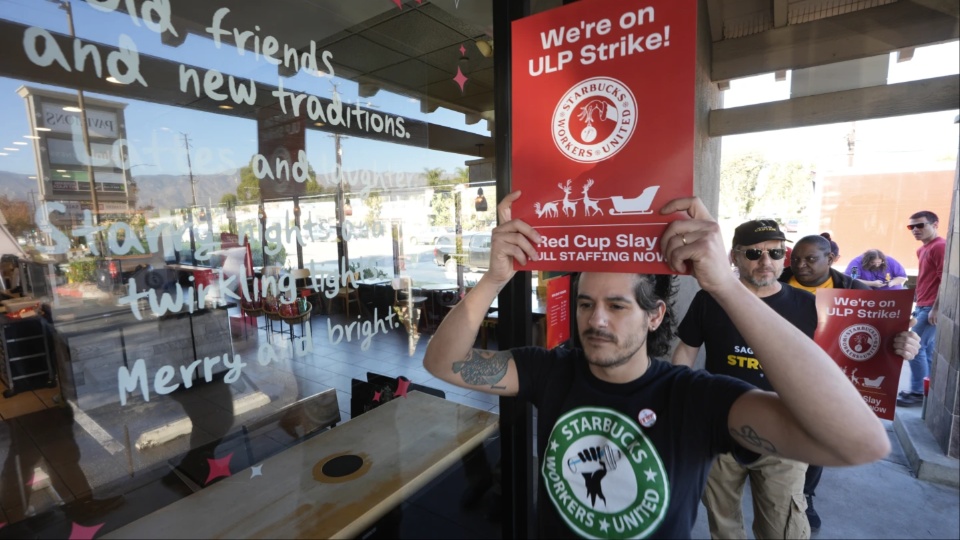
Which is where Starbucks comes into the picture, thanks to its continuing war against its baristas, who are unionizing. It has committed 300-plus labor law violations ranging from nasty discipline to illegal firings to sudden store closures just before or after union wins.
QXO’s CEO Jacobs beat out, among others, Brian Nicol, the mid-year successor to union-hater Howard Schultz as the head of Starbucks. Nicol earned, on an annual basis, $97.813 million last year. That’s 6,666 times the median pay of a Starbucks worker, which the AFL-CIO reports at just under $15,000. The median is the point where half the workforce is above and half below. No other firm had a ratio of even half that.
Where Trump really enters the picture, though, is in the cash the CEOs forked over to finance his campaign and his inauguration. Trump’s one-time partner, Elon Musk, who chain-sawed tens of thousands of federal workers out of their jobs, spent and donated $288 million to Trump’s campaign and $1 million, at least, to pay for his inauguration. So did others.
In return, Musk, whose total compensation was listed in the report as zero, will receive tax breaks worth millions of dollars and confidential personal information on everyone in the country. Trump let Musk’s computer minions of the so-called Department of Government Efficiency, rummage through—and copy—files from the IRS and several other federal departments, including the Labor Department.
And Musk’s firms, Tesla and SpaceX, have reaped billions of dollars in federal contracts for electric vehicle charging stations and space exploration, respectively. Ironically, the charging station funds may dry up, due to other provisions in the tax cut bill, officially called a “reconciliation” law. The measure virtually wipes out all electric vehicle subsidies, as Trump and the GOP deny the existence of global warming—which the EVs are meant to help combat.
Scratched Trump’s back
“We’re also calling out firms who have scratched Trump’s back,” Redmond said. “A number of CEOs of Big Tech, including Amazon, Meta and Palanitir each gave a million dollars to his inaugural committee.” In return they got the tax break, lucrative contracts, and—for those in labor law trouble—Trump’s firing of National Labor Relations Board member Gwynne Wilcox, depriving the board of the three-member quorum it needed to do business. Palanitir also got Trump’s vice president, J.D. Vance.

The firm’s co-founder, major Republican donor Peter Thiel, was a big presence in Vance’s Ohio U.S. Senate campaign in 2022. Now Palantir’s reaping rewards from Trump, the report says: “More than $113 million in federal spending to help implement Trump’s executive order to collect data across government agencies, including “a contract to help Immigration and Customs Enforcement agents track immigrants in real time,” a writeup of the firm says. “And in May 2025, Palantir also received a $795 million contract increase to develop an artificial intelligence system for the Department of Defense.”
Just to make sure the capitalist class can run amok, Trump appointed former SEC commissioner and corporate buyout specialist Paul Atkins to head the Securities and Exchange Commission. The SEC regulates public companies and discloses the pay data—and the ratios—the AFL-CIO uses. Wikipedia describes Atkins as “a vocal supporter of free-market principles in regulatory policy.”
“Meanwhile, Mark Zuckerberg’s company, Meta Platforms, and Jeff Bezos’s company, Amazon, contributed $1 million each before claiming their front-row seats at Trump’s 2025 inauguration,” the report adds. It includes a picture of the duo at that event.
Neither Meta nor Amazon finished in the top 25 in executive pay standings, but Microsoft’s Satya Nadella finished 12th, at $79.1 million, just ahead of Apple’s Tim Cook ($74.6 million), and Joseph Bae, the second Wall Street financier and gambler on the list ($73 million). Bae heads Kohlberg, Kravis, & Roberts, subject of the book Barbarians At The Gate, about ruthless takeover tactics.
Bae’s presence points up one problem with the data the SEC and the AFL-CIO use, though. They’re all publicly traded companies, which must file frequent and detailed SEC reports. Private firms, such as “vulture capital” Alden Global Capital, which makes a habit of chewing up and spitting out newspapers, leaving news deserts and broken careers and lives, don’t have to file anything.
Four CEOs garnered more than $100 million each in 2024, led by Jacobs. One of the more interesting was #4, Sridhar Ramaswamy, CEO of Snowflake, Inc., an artificial intelligence data storage and analysis company headquartered in Bozeman, Mont. Ramaswamy garnered $101.3 million.
Using the S&P 500 list and splitting up the firms by states, Ramaswamy all by himself gave Montana, which has just over a million people, the most-lopsided ratio between executive and worker pay of any state in the continental 48: 746-1. No other state saw a ratio of more than 475-1.
Proposals have been floated in Congress and in the states over the years to put curbs on CEO pay and compensation. Given how much compensation comes from stock options and buybacks, National Nurses United and Sen. Elizabeth Warren, D-Mass., both push a small stock transfer tax on each transaction. It would curb both pay and unwarranted speculation, they say.
And years ago, the late Rep. James Oberstar, DFL-Minn., proposed a large surtax on any CEO making over a million dollars. His idea went nowhere.
Portland, Ore., has imposed an extra tax on any CEO earning outlandish pay and compensation. That’s squarely aimed at Nike, whose CEO, John Donahoe II, earned $29.18 million last year—the third-highest compensation in his own state. His pay ratio, compared to that average U.S. worker’s $49,500, was 759-1.
CONTRIBUTOR