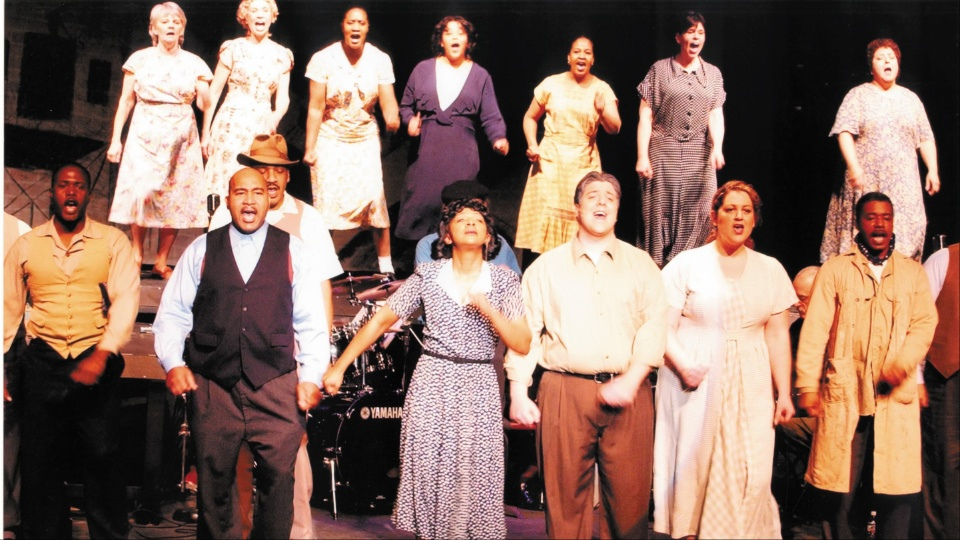
One night in November 1937, just six months after the notorious Battle of the Overpass at the Ford Rouge plant, Ford worker Lewis Bradford was found seriously injured in an isolated section of the plant. A few days later, he died.
Bradford’s voice was well known in Detroit. He hosted a radio show on WXYZ called “The Forgotten Man’s Hour,” where he interviewed jobless and homeless workers. It was a counterpoint, he felt, to the right-wing antisemitic priest Father Charles Coughlin, whose “Hour of Power” radio show on WJR was beamed nationwide.
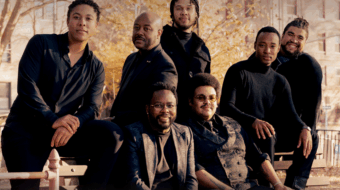
Now, nearly 90 years later, the story of Bradford’s mysterious death and the struggle of workers to organize unions during The Great Depression will be told on stage in the jazz musical Forgotten: The Murder at the Ford Rouge Plant. It will run for three days at Marygrove Theatre in Detroit, Oct. 10-12, with a cast of more than 20 actors, singers, and musicians. 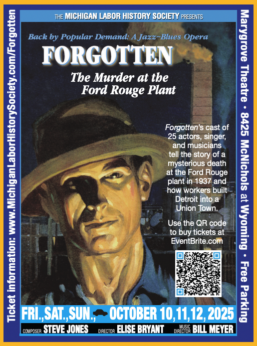
The show, with 22 original songs, focuses on the life and death of Lewis Bradford, who was also an assistant pastor at Detroit’s Central Methodist Church. Bradford had taken a job at the Rouge to pay for medical care for his young daughter, Ella, who was seriously ill. There was no health insurance in those days, and a pastor’s salary alone couldn’t pay the bills. While at the Rouge, Bradford tried to interest Henry Ford in developing better relationships between workers and management. Ford rejected his overtures; indeed, earlier that year, Ford security guards had attacked UAW (United Auto Workers) organizers at the Battle of the Overpass.
For years, Steve Jones, Bradford’s great-nephew, had listened to family stories of his great-uncle’s life and mysterious death. In 2001, he traveled from his home in Maryland to Detroit to find out more. Weeks of research led to the discovery of Bradford’s 1937 autopsy report. Jones took it to the Wayne County Medical Examiner, who reviewed it and said Bradford’s death should likely have been classified as a homicide—not an accident.
That became the genesis for Forgotten. Jones, an accomplished composer and a member of the American Federation of Musicians in Washington, D.C., wrote 22 songs for “Forgotten” that tell the stories of the Ford Hunger March, the Battle of the Overpass, the Flint sit-down strike, and the struggles of workers like Bradford to organize.
When the show returns to the stage in October, Elise Bryant will return to direct the show, and Bill Meyer, a noted Detroit jazz musician, will return as music director.
In 2004, the Michigan Labor History Society sponsored the premiere of the show and revived it in 2005 and 2010 to sold-out audiences. This fall will bring another opportunity for Detroit-area audiences to see it.
Tickets for “Forgotten” are $35, all-inclusive, and are available through Eventbrite.
We hope you appreciated this article. At People’s World, we believe news and information should be free and accessible to all, but we need your help. Our journalism is free of corporate influence and paywalls because we are totally reader-supported. Only you, our readers and supporters, make this possible. If you enjoy reading People’s World and the stories we bring you, please support our work by donating or becoming a monthly sustainer today. Thank you!
CONTRIBUTOR