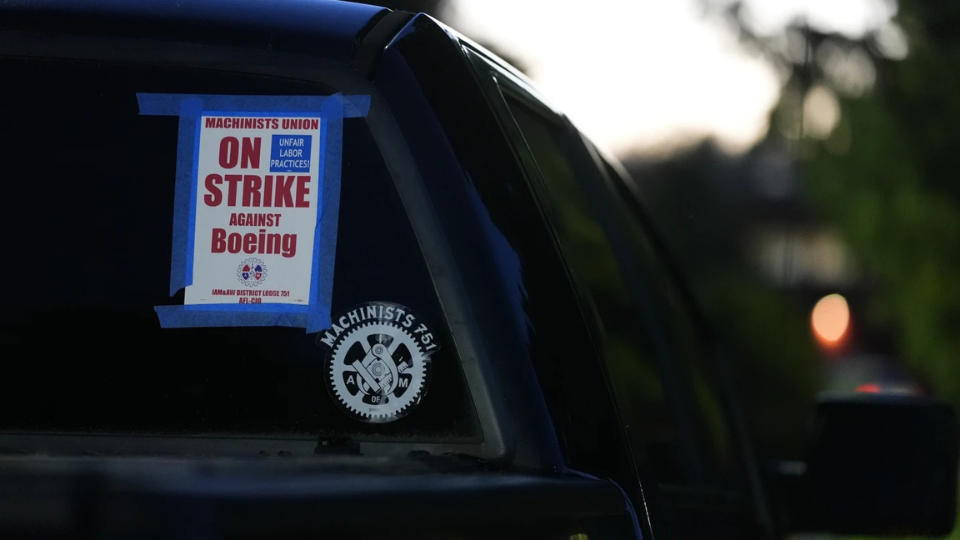
ST. LOUIS—More than 3,200 Boeing fighter jet workers at three plants in Missouri and Illinois walked off the job early Monday morning. This strike, the first in nearly three decades for the International Association of Machinists and Aerospace Workers (IAM) District 837, comes after workers overwhelmingly rejected Boeing’s contract offers on July 27 and again on August 3.
“Our members have every right to demand a contract worthy of their contributions,” said IAM International President Brian Bryant in a statement. “We will be there on the picket lines, ensuring Boeing hears the collective power of working people.”
Boeing’s most recent proposal included a 20% wage increase over four years, in spite of the fact that over the last four years, the Consumer Price Index showed an inflation rate of 21.2%, a $5,000 ratification bonus, and very modest improvements to benefits.
However, workers argue that the offer disproportionately favors newer hires while enforcing wage freezes for workers with seniority, particularly in the later stages of the offer. For many workers, the proposal fails to make up for decades of stagnant pay and deteriorating benefits.
A decade of experience
Keith Gallup, a machinist with a decade at Boeing, told KSDK News that the proposed 20% raise primarily benefits new hires, while long-term workers face years of frozen wages.
“It still takes me another five years to top out,” he said. “That’s 15 years total.” For workers who risked their health to keep production running during the pandemic, the latest offer demonstrates how little loyalty the company shows in return.
“They could go to McDonald’s or Costco and make more than they do out here—and we’re building military aircraft,” said Earl Schuessler, a 37-year Boeing veteran and union representative, in an interview with KSDK News.
Schuessler noted that in 2014, workers accepted a meager 2% raise and pension concessions under the guise of keeping the company “solvent.” Now, with Boeing reporting $22 billion in revenue last quarter—including an 8% increase in military sales—workers refuse to accept another raw deal. Their resolve is strengthened by last year’s strike in Seattle, where 32,000 Boeing machinists won some major concessions after a seven-week strike.
The strikes lay bare the contradiction of capitalism: a system that depends on workers’ labor while funneling the profits to private interests and shareholders. Despite Boeing’s billions in so-called defense contracts—funded by taxpayer dollars—the company is still fighting tooth and nail to suppress wages and benefits for its workers.
The strike drew a message of international solidarity from the All-Workers Militant Front (PAME), a communist-led labor federation in Greece. In its statement, PAME condemned Boeing’s exploitation and praised the strikers for confronting corporate power head-on.
“At a time when multinational corporations amass profits on the backs of workers, your struggle proves that power lies with those who produce the wealth,” the federation declared. They framed the strike as part of an international struggle against a system that enriches monopolies at workers’ expense.
This solidarity underscores Boeing’s role not just as an employer, but as a pillar of the U.S. military-industrial complex. The F-15s and F/A-18s built by these workers are deadly tools of imperialism used to enforce U.S. supremacy abroad—most horrifically in Israel’s U.S.-bankrolled genocide in Gaza. Yet the workers who assemble these weapons struggle to afford basic cost of living expenses.
The strike also raises urgent questions about war and peace. Boeing’s military sales division depends on international conflict, with its profits tied directly to arms sales and increased militarization. But while the corporate executives and shareholders cash in, it is the workers and their communities who bear the costs—not only through exploitation, but through the destruction of their fellow workers around the world.
The labor movement has a long tradition of linking workplace struggles with the fight for peace. In the 1970s, the IAM President William Winpisinger called for the economic conversion of military to civilian production. Today, as U.S. military spending reaches nearly $2 trillion annually, workers have the power to demand not only better contracts, but a fundamental shift away from endless war toward a peace economy that prioritizes human needs over capitalist greed.
For now, the immediate struggle is over wages and benefits. But the deeper lesson is that workers do hold the power to disrupt the war machine’s profits. And in doing so, workers can directly challenge the very system that perpetuates exploitation and war for profit.
We hope you appreciated this article. At People’s World, we believe news and information should be free and accessible to all, but we need your help. Our journalism is free of corporate influence and paywalls because we are totally reader-supported. Only you, our readers and supporters, make this possible. If you enjoy reading People’s World and the stories we bring you, please support our work by donating or becoming a monthly sustainer today. Thank you!
CONTRIBUTOR