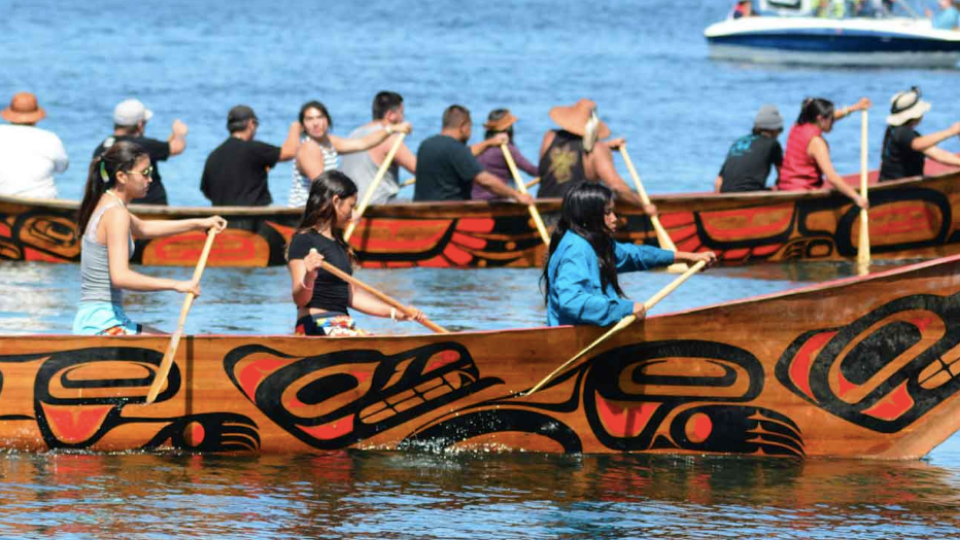
LOWER ELWHA KLALLAM VILLAGE—Braving high winds and stormy seas and even a tsunami alert, more than 100 canoes converged on the Lower Elwha Klallam tribal village in the 2025 ‘Paddle to Elwha’ July 31-Aug. 5.
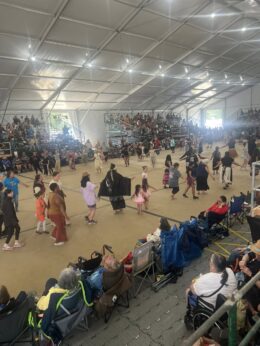
Every vacant square inch of the Elwha River delta surrounding the village was occupied by tents, at least 1000 stretching in every direction to the water’s edge. A huge tent, as large as a full-sized basketball court, was erected. Called the “Protocol” tent, all the speeches, storytelling, singing, drumming, and dancing were performed there. The crowds were so large that cars and other vehicles were banned. Visitors parked in parking lots a mile or so upstream, and passengers were delivered by shuttle-bus to the village.
More than 500 “pullers” from scores of Pacific Northwest tribes paddled the canoes, some from hundreds of miles down the Pacific coast to California and north to British Columbia, from towns and villages along the Salish Sea that includes Puget Sound, the Strait of Juan de Fuca, and the Georgia Strait. Others paddled from villages along the Pacific coast of Vancouver Island.
They were welcomed ashore on July 31 in a landing ceremony on the beach at the mouth of the Elwha River. An estimated 10,000 visitors have poured into Clallam County to join an immense crowd in greeting the pullers, most of them youthful Native American women and men. The “Paddle to Elwha” celebrated the removal of two hydroelectric dams on the Elwha that blocked salmon and steelhead from swimming upstream to spawn in the headwaters of the river, most of its 70-mile stream inside the Olympic National Park. The dams were removed in 2014 at a cost of well over $300 million. The Lower Elwha Klallam Tribe led that effort. It is now leading a grassroots movement to protect the Elwha from timber interests that are bidding with the Department of Natural Resources (DNR) to buy parcels to log timber right in the Elwha River watershed. The city of Port Angeles—and the Lower Elwha Klallam village—all draw their drinking water from the Elwha River. The City Council of Port Angeles has written letters, signed unanimously, urging that this state agency terminate all logging in the Elwha River watershed. So far, DNR has rejected those appeals.
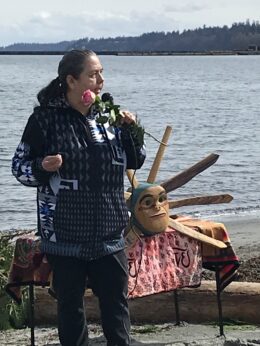
Lower Elwha Klallam Tribal Chair, Frances Charles, and other tribal elders welcomed the pullers ashore. She told the crowd that the struggle to take down the dams and restore the salmon runs will take time, although the fish have already begun to return, spawning far up in the headwaters of the river.
“We need to have patience,” Charles told the Seattle Times. “We were told it would never happen, and unfortunately, it did not happen in some elders’ lifetimes, but it did happen in our lifetime, and that’s something that we have the ability to share with our grandkids.”
On July 18, the driver of a tanker truck and trailer lost control of his vehicle, running off nearby Highway 101, down a steep embankment, rolling over, and landing upside down in the middle of Indian Creek a few yards from the Elwha River. The upended tanker dumped well over 3,000 gallons of gasoline and diesel that flowed down into the Elwha, poisoning the water and killing thousands of fish. Hundreds of emergency and environmental workers rushed to the scene of the accident—so dire that the people of Port Angeles and the surrounding region were told not to drink the water. Highway 101 was closed.
Gov. Bob Ferguson said, “This is a devastating accident for Indian Creek and the Elwha River….nothing short of heartbreaking for local tribes and other Washingtonians who rely on clean, healthy rivers and streams for their food and livelihoods.” Ferguson visited the site, joined by Charles, U.S. Rep. Emily Randall, and Washington State Department of Ecology Director Casey Sixkiller. Ferguson praised the speed and skilled work of the emergency crews that limited the damage to the river. Yet environmental experts found clear proof that many thousands of fish died, and warned that it will take the river years to fully recover.
The tribes and their allies have fought for generations against government and corporate policies that amount to a drive to oppress and exploit the tribes and all other working people. Charles has pointed out that her tribe was living in a village at the base of Ediz Hook about a mile west of Port Angeles. The ruins of the village—Tse-whit-zen—were discovered when bulldozers were clearing ground for a graving yard to construct pontoons for the Hood Canal floating bridge in 2003. The Lower Elwha Klallam had been forced to move from Tse-whit-zen by white settlers to make way for the Crown-Z paper mill—now defunct.
Charles has also been in leadership of the struggle to force Rayonier, a plywood company, to clean up the heavy metal dioxin, polychlorinated biphenyls, and other toxins they left behind in Port Angeles Harbor when they closed their plywood mill in 1997. Despite a partial cleanup, the Environmental Protection Agency declared the former mill location a “Superfund Site” and ordered a full cleanup, which Rayonier has failed to comply with for 28 years. The Washington State Department of Ecology convened a public hearing on the Rayonier cleanup that packed the Field Aerts & Events Hall in Port Angeles on June 12. The Port Angeles City Council has voted unanimously against any compromise “Consent Decree,” urging the State Department of Ecology to order Rayonier to do a total cleanup of the former mill site in Port Angeles harbor.
The Lower Elwha Klallam Tribe is named in all the Department of Ecology documents as the main party demanding a full cleanup.
We hope you appreciated this article. At People’s World, we believe news and information should be free and accessible to all, but we need your help. Our journalism is free of corporate influence and paywalls because we are totally reader-supported. Only you, our readers and supporters, make this possible. If you enjoy reading People’s World and the stories we bring you, please support our work by donating or becoming a monthly sustainer today. Thank you!
CONTRIBUTOR