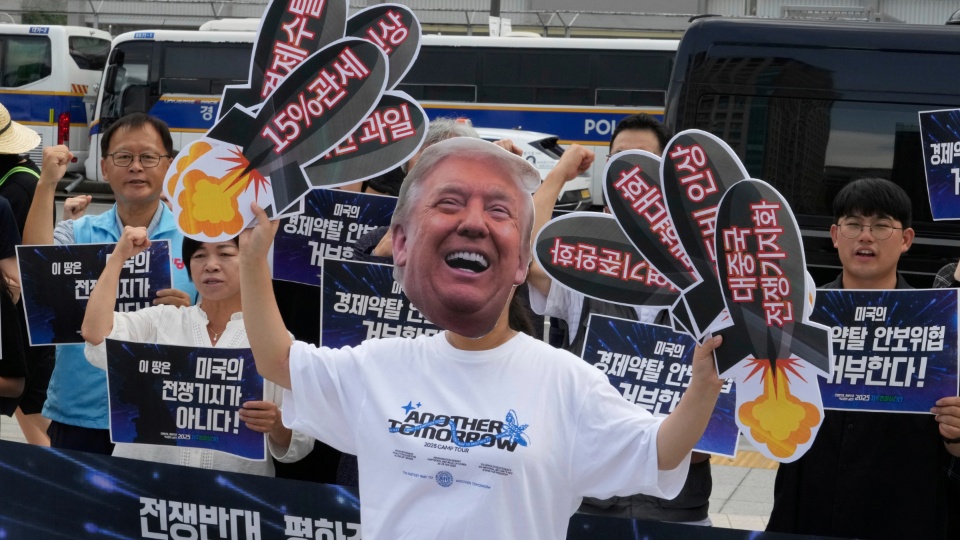
The current U.S. administration is determined to abandon multilateral frameworks, favoring instead the resolution of trade disputes through bilateral negotiations, one by one, in pursuit of maximizing American interests. It has openly declared its intention to replace multilateral agreements with bilateral pressure, believing that the U.S. holds stronger leverage in one-on-one negotiations.
Under this approach, the U.S. unilaterally launched a global tariff war on what it called “Liberation Day,” using threats of high tariffs as a bargaining chip to force its trade partners into submission. This strategy led to a series of bilateral trade agreements, in which individual economies—including the United Kingdom, Japan, and the European Union—were pressured into making compromises and concessions to the U.S.
These agreements share a common pattern: The U.S. first unilaterally raises its demands—through tariff threats or punitive duties—and once the other party is forced to the negotiating table, it offers so-called “limited concessions” by agreeing to tariffs slightly lower than its initial threats. In return, it demands additional concessions such as large-scale purchases or investments, enabling the U.S. to claim it has secured a “victory.”
As some scholars have pointed out, such U.S. practices amount to a new form of “economic colonialism”—a blatant imposition of “unequal treaties.”
Take the United Kingdom as an example. After the U.S. announced the imposition of so-called “reciprocal tariffs” on its major global trading partners, the U.K. became the first economy to yield to America’s tariff pressure. As early as May 2025, the U.S. and the U.K. announced that they had reached a preliminary trade agreement framework, with the U.K. accepting most of the conditions put forward by the U.S.
According to a statement from the British government, the U.K. became the only country to receive “preferential” treatment from the U.S. Under the agreement, the U.S. agreed to slash its threatened 27.5% tariff on U.K. automobile exports to 10%, saving the U.K. auto industry hundreds of millions of dollars annually and preserving hundreds of thousands of jobs.
However, it is important to note that even though the 10% tariff appears lower than the previously threatened 25% or higher, it is still significantly above the low tariff rates the U.K. had enjoyed as a U.S. trade partner prior to this deal (the U.S. generally imposes only a 2.5% tariff on car imports). By first raising then slightly lowering its demands, the U.S. effectively forced the U.K.—under duress—to regard what should have been unrestricted market access as a “favor.” This tariff extortion tactic underscores the arbitrary and heavy-handed nature of the U.S. negotiating strategy.
The U.S. adopted a similar approach with Japan. Citing national security concerns, it threatened to impose a 25% tariff on Japanese cars and auto parts—targeting Japan’s core exports to the U.S. Facing immense pressure, Japan signed a limited Phase One trade agreement with the U.S. in 2019, barely securing a verbal commitment for a temporary exemption from auto tariffs. This left Japan perpetually under the shadow of a Damocles’ sword, with the U.S. free to reinstate the threat of auto tariffs at any time.
In 2025, the U.S. once again deployed its “reciprocal tariff” tactic, issuing a high-pressure ultimatum to Japan: If a deal was not reached by Aug. 1, new tariffs of up to 25% or more would be imposed on Japanese cars and other products. Pressured by the looming deadline, the Japanese government agreed to offer a massive “gift” to the U.S.—including $550 billion in investments and loans over the next three years to support U.S. supply chain development in semiconductors, pharmaceuticals, and other sectors, along with the purchase of 100 Boeing aircraft and an annual increase in defense procurement from the U.S. to $17 billion.
In exchange, the U.S. reduced the originally planned punitive tariff rate on Japanese cars from 27.5% to 15% and also lowered the additional tariffs planned on other Japanese goods from 25% to 15%, effective Aug. 1. U.S. officials then boasted on social media that they had just signed “the largest trade deal in history” with Japan. Some even bluntly stated that Japan received the lower 15% tariff “because they were willing to offer this innovative financing mechanism,” implying that other countries would be unlikely to replicate such concessions.
It is clear that the outcome of the U.S.-Japan agreement was not a win-win arrangement involving mutual market opening and tariff reduction, but rather a textbook example of the U.S. using tariff threats to extract “tribute.” Only after Japan pledged massive investments and purchases did the U.S. partially walk back its threats.
Commentators have described this kind of asymmetrical arrangement as a revival of what amounts to “unilateral free trade”—benefiting only the United States. While Japanese leaders expressed “satisfaction” at having avoided auto tariffs, international observers widely questioned whether such an agreement, reached under one-sided pressure, could be sustainably implemented.
A similar drama unfolded with the European Union. Starting in 2018, the U.S. imposed tariffs on EU steel and aluminum products and repeatedly threatened to raise tariffs on European automobiles, wielding the threat of a trade war to pressure the EU into concessions. It wasn’t until July 2025, on the eve of a U.S.-set deadline, that both sides hastily reached a deal in Scotland after grueling negotiations, in an effort to prevent a mutually destructive transatlantic trade war from further escalating.
Under the announced U.S.-EU agreement, the U.S. would impose a uniform 15% tariff on most EU exports to the American market. While this was only half of the previously threatened 30%, it was still far higher than the average tariff rate of under 5% that prevailed before the Trump administration. In other words, the EU was forced to accept a significant step backward from existing multilateral terms, agreeing to a 15% tariff ceiling on its exports to the U.S. simply in exchange for avoiding the more punitive 30% rate.
As additional conditions, the EU agreed to purchase up to $750 billion worth of U.S. goods over the next three years—including energy (such as LNG, oil, and nuclear fuel), semiconductors, and more—and to invest $600 billion in the United States, including procurement of U.S.-made military equipment. The U.S., for its part, retained the right to adjust tariffs at any time—U.S. officials made it clear that if European countries failed to fulfill their investment pledges, Washington could reimpose higher tariffs in the future.
EU leaders tried to frame the deal as a “stable and predictable” new partnership but were forced to acknowledge that the 15% overall tariff level they accepted was “much worse than before Trump came to power” and amounted to a major concession made under U.S. coercion.
While leaders of major EU exporters like Germany and Italy breathed a sigh of relief, they also expressed concern about the details of the agreement and stressed the need to assess its long-term impact on their economies. As one German commentator noted, the EU’s move effectively validated the U.S.’s coercive tactic of “retreating in order to advance”—first manufacturing a crisis through the threat of massive tariffs, then backing off slightly to make the other side feel “grateful” for a less extreme rate, thereby extracting economic and trade concessions through sheer leverage.
The U.S. president publicly boasted that this was a “strong agreement,” claiming that increased EU purchases would lead to “tremendous cooperation,” and touted it as proof of the success of his tariff threat strategy.
These cases illustrate a consistent U.S. strategy in recent foreign economic and trade negotiations: repeatedly wielding the tariff stick, applying unilateral and extreme pressure, conducting closed-door, one-on-one talks to isolate and wear down trade partners, forcing them to concede one by one.
These efforts have resulted in the rewriting of bilateral trade agreements centered on U.S. interests, often embedded with hidden unequal clauses that raise barriers to market access for foreign products and services, while extracting additional concessions beyond tariffs.
Whether in terms of the interests the U.S. seeks or the nature of the terms themselves, such agreements constitute unequal treaties for the other parties involved. They represent a new form of economic colonialism—one that fractures existing multilateral cooperation frameworks, depletes U.S. international credibility, and plants deep risks for the healthy development of the global economic and trade order.
China Academy
We hope you appreciated this article. At People’s World, we believe news and information should be free and accessible to all, but we need your help. Our journalism is free of corporate influence and paywalls because we are totally reader-supported. Only you, our readers and supporters, make this possible. If you enjoy reading People’s World and the stories we bring you, please support our work by donating or becoming a monthly sustainer today. Thank you!
CONTRIBUTOR