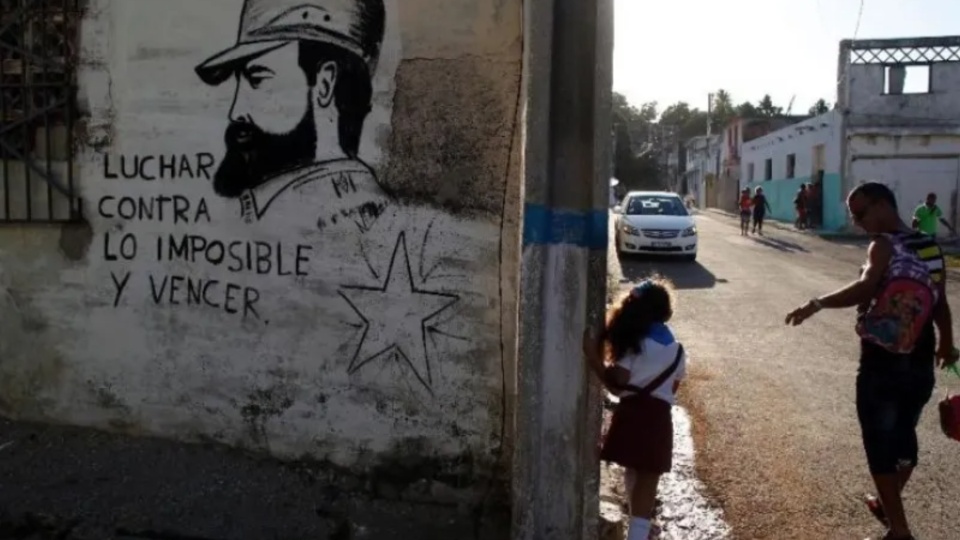
This past Wednesday, Aug. 13, Fidel Castro—born in 1926 and dying in 2016—would have been 99 years old. Castro’s leadership of Cuba’s Revolution and his vision of human possibilities place him in the company of revolutionary giants. What did he do that we remember him?
Castro clearly established that the change needed by oppressed Cubans—restoration of democracy and social and economic rescue—only happens once working and marginalized people have political power.
Castro testified in his own defense in 1953 at a trial following the attacks on July 26 that he led against two of the Batista dictatorship’s military installations. He told the court about injustices weighing on the Cuban people and what the movement he led would be doing to make things right. He was communicating also with the Cuban people, especially after his testimony appeared as the book History Will Absolve Me.
From its beginning, Cuba’s Revolution as led by Fidel Castro represented anti-imperialist struggle. Specifically, the revolutionary government was defending Cuba’s national independence against U.S. power. The Revolution’s anti-imperialist vocation descended from the thought and deeds of Cuba’s national hero, José Martí. Cuba’s 1895-98 War for Independence, organized and promoted by Martí, targeted both Spanish colonialism and U.S. imperialism.
The Revolution as led by Castro manifested first as those attacks on the military barracks. The revolutionaries, around 130 young people, called themselves the “centennial generation” in honor of Martí, born 100 years earlier.
In launching a social revolution under the banner of anti-imperialism and national independence, Castro was joining Chinese and Vietnamese revolutionaries Mao Zedong and Ho Chi Minh in carrying out a new kind of revolution.

The three upheavals departed from assumptions of the 19th century founders of the Marxist movement, which were mostly about confrontation taking place inside national borders between industrial workers and the owning classes. That scenario played out with the Bolshevik Revolution of 1917, but even there the new Soviet Union had to contend with imperialism in the form of intervening U.S. and European military forces.
Lenin himself saw what was ahead. In 1919, he wrote (as quoted by John Bellamy Foster) that, “The socialist revolution will not be solely, or chiefly, a struggle of the revolutionary proletarians in each country against their bourgeoisie—no, it will be a struggle of all imperialist-oppressed colonies and countries, of all dependent countries, against international imperialism.”
Fidel Castro was uniquely well-placed to take the lead in fashioning and then defending this new type of social revolution. That he did so is a big part of his legacy. As an informed Cuban, he was well aware of the perils of European colonialism and U.S. imperialism. As a gifted analyst, he understood the new possibilities of plunder and exploitation opening up from global capitalism’s embrace of expanding commercial, financial, and communication networks.
Fidel Castro was a visionary. For him, international solidarity was a matter of creative action. Speaking at the United Nations Earth Summit held in Rio de Janeiro in 1992, he said:
“An important biological species is at risk of disappearing due to the rapid and progressive liquidation of its natural living conditions: mankind … If you want to save humanity from this self-destruction, you have to better distribute the wealth and technology available … Less luxury and less waste in a few countries … No more transfers to the Third World of lifestyles and consumption habits that ruin the environment … Make human life more rational …”
Castro and his colleagues inspired tens of thousands of Cuban physicians over many years to voluntarily undertake medical missions in countries throughout the world. Cuba succeeded in educating many thousands of the world’s young people to serve their own peoples as doctors, teachers, and more. The students prepared themselves in Cuba, or in other countries under Cuban auspices,
Recognizing the African heritage of many Cubans and opposing the apartheid regime imposed by the racist South African government, Castro motivated Cubans to voluntarily serve militarily in southern African border regions where they fought and defeated occupying South African troops.
Castro led in devising ways to generate income needed for development in a Cuba lacking subsoil resources and industrial capacities. Cuba’s government prioritized the preparation and training of future scientists and created an institutional framework and, that way, created a biomedical research-and-production complex from which drugs, vaccines, and other materials are made available for export.
Fidel Castro had an expanded view of education. It ranged from Cuba’s Literacy Campaign of 1961, to ensuring full and equal access at all educational levels, including graduate work, to a full complement of schools for handicapped people, to the emphasis on education for science and healthcare, to the spread of schools of music and art throughout the country.
Like no one else, Fidel Castro was dedicated to Latin American unity. In that regard, he again was following Martí, author of an essay published in 1891 entitled “Our America.” There, Martí spoke of what was shared among the region’s peoples, how they differed from Europeans, and of the need to acknowledge and honor American peculiarities.
The term “Our America” signifies all the area lying between the Rio Bravo (Rio Grande) in the north and Tierra del Fuego in the south. The influence of Fidel Castro extends from one end to the other.
As with all op-eds published by People’s World, this article reflects the views of its author.
We hope you appreciated this article. At People’s World, we believe news and information should be free and accessible to all, but we need your help. Our journalism is free of corporate influence and paywalls because we are totally reader-supported. Only you, our readers and supporters, make this possible. If you enjoy reading People’s World and the stories we bring you, please support our work by donating or becoming a monthly sustainer today. Thank you!
CONTRIBUTOR