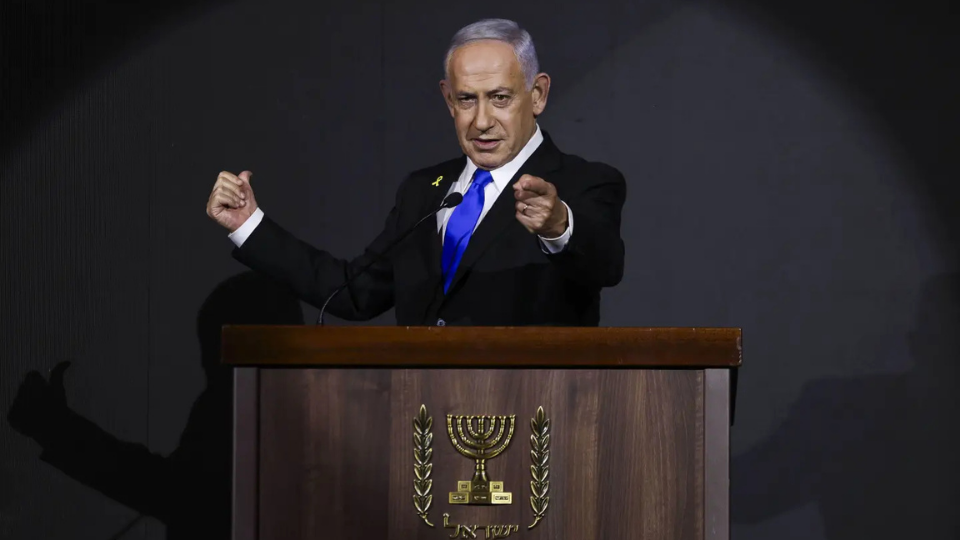
In a recent interview with Israel’s i24 News, Prime Minister Benjamin Netanyahu openly declared his support for the vision of “Greater Israel.” Asked by interviewer Sharon Gal if he subscribes to this controversial idea, Netanyahu responded without hesitation: “Absolutely.”
While the U.S. mainstream media has largely ignored the comment, the Israeli leader’s statement immediately drew condemnation from a coalition of Arab and Muslim states. For those unfamiliar with the term, it may seem like political jargon.
But in reality, Netanyahu’s words represent a dangerous watershed moment. To understand why, it is necessary to trace the history and meaning of “Greater Israel.”
The phrase “Greater Israel” gained political currency after Israel’s territorial conquests in the 1967 Arab-Israeli War. But its ideological roots lie in the Revisionist Zionism of the early 20th century.
Founded by Ze’ev Jabotinsky, Revisionism rejected the cautious, diplomatic approach of Labor Zionism in favor of a more militant vision. Jabotinsky himself wrote that Jewish sovereignty could only be secured through what he called an “iron wall” of force.
This hardline philosophy shaped the Irgun (Etzel), a paramilitary organization founded in 1931, which fought British rule in Palestine and carried out violent attacks against Palestinian communities.
The Irgun’s emblem was a map of the entire British Mandate, including both banks of the Jordan River, with a rifle imposed over it. This was no accident. A decade earlier, Britain had carved the Emirate of Transjordan (today’s Jordan) out of the Mandate.
Revisionists insisted that this land, too, was part of Eretz Yisrael HaShlema—the “Whole Land of Israel.” Rooted in biblical claims, they argued that both sides of the Jordan River were divinely promised to the Jewish people.
After Israel declared independence in 1948, Revisionist veterans of the Irgun formed the Herut Party, the forerunner of today’s Likud. From its inception, Likud inherited Revisionism’s refusal to accept partition and its attachment to a “whole” Land of Israel.
This ideological continuity is crucial: Netanyahu’s party did not invent the vision of Greater Israel, but rather carries a legacy that stretches back nearly a century.
For decades, right-wing Zionists have used this framework to dismiss Palestinian statehood outright. Rehavam Ze’evi, the late far-right minister, infamously declared that Jordan was already the Palestinian state.
More recently, senior government figures such as Gideon Sa’ar have echoed this sentiment. The implication is clear: Palestinians do not need a state in the West Bank or Gaza because, in this logic, they already have one across the river.
Israel’s conquest of the West Bank, Gaza, Sinai, and Golan Heights in 1967 propelled the idea of “Greater Israel” into mainstream political discourse. Citing biblical passages promising Abraham’s descendants land “from the brook of Egypt to the Euphrates,” Revisionists and messianic Zionists alike saw the war as divine confirmation of their project.
Fueled by this ideology
The settler movement, born in the late 1960s, was fueled by this ideology. Its leaders believed that planting Jewish settlements in conquered territory—despite their illegality under international law—would make “Greater Israel” irreversible.
Settlements appeared across the new territories, though those in Sinai and Gaza were later dismantled. When Israel invaded Lebanon in 1982, settlers even tried to establish outposts in the occupied “security zone,” though this effort failed due to lack of government backing. The impulse was clear: wherever Israeli soldiers advanced, settlers sought to follow.
Today, as Israel reoccupies Gaza and seizes more land in Syria, settlers once again see opportunity. Conferences are being held to discuss new settlements in Gaza.
Some extremists have even called for settlement in southern Syria. Israeli soldiers have been photographed wearing patches with maps of “Greater Israel,” stretching from the Nile to the Euphrates.
These are not fringe images. They reflect a wider cultural acceptance within parts of Israeli society that settlement expansion is both natural and divinely ordained.
Finance Minister Bezalel Smotrich has become one of the most outspoken advocates of resettling Gaza. He has promised supporters that new settlements will be established there, drawing international condemnation at a time when much of the world still insists on a two-state solution. His growing influence within Netanyahu’s government shows how far the Greater Israel idea has penetrated official policy circles.
Until recently, Netanyahu publicly distanced himself from such rhetoric, even while enabling settlement expansion throughout the West Bank. But by declaring his “absolute” support for Greater Israel, he has dropped the pretense. His statement signals open endorsement of a project of expansion and permanent occupation.
The vision of “Greater Israel” is not a peaceful one. It is a vision of permanent war, conquest, and settlement—an ideology that denies Palestinian nationhood, threatens Israel’s neighbors and forecloses any hope of peace. That an Israeli Prime Minister, backed with billions in U.S. aid and diplomatic support, now openly embraces it should alarm people everywhere.
This is not a marginal statement. It is a declaration that the leader of Israel subscribes to a worldview of endless expansion. The fact that U.S. media has chosen to ignore it does not make it less dangerous; it only makes it more urgent to shine light on what Netanyahu has just said.
Washington’s silence speaks volumes. The United States remains Israel’s chief patron, supplying it with weapons, military aid, and diplomatic cover at the United Nations.
By continuing to bankroll Israel unconditionally, the U.S. is not a bystander—it is an active enabler of the Greater Israel project. Every settlement built, every family displaced, and every village demolished is carried out with American arms and American money.
Netanyahu’s “absolutely” is therefore not just a statement of Israeli intent, it is a manifestation of U.S. foreign policy. Unless this support is withdrawn, Greater Israel will continue to expand at the expense of Palestinian survival and the prospects of peace for the entire region.
As with all op-eds published by People’s World, the views presented here are those of the authors.
We hope you appreciated this article. At People’s World, we believe news and information should be free and accessible to all, but we need your help. Our journalism is free of corporate influence and paywalls because we are totally reader-supported. Only you, our readers and supporters, make this possible. If you enjoy reading People’s World and the stories we bring you, please support our work by donating or becoming a monthly sustainer today. Thank you!
CONTRIBUTOR