Beginning in 2006, President Evo Morales and his Movement Toward Socialism (MAS) party, victorious in elections the previous year, took Bolivia by storm. The government and people formed a new constitution and a “plurinational state” promising rescue for indigenous peoples, Morales being Bolivia’s first indigenous president. Meaningful social reforms took root.
Great numbers of marginalized Bolivians experienced new access to education; healthcare, particularly for mothers and children; old-age security; and land. The government used income generated from oil and natural gas exports, especially to Brazil and Argentina, to pay for social programs. Nationalization of oil and gas production was crucial to funding capabilities.
In 2018, the Center for Economic and Policy Research noted that Bolivia had become “the fastest-growing economy in South America over the past five years,” and consequently had “reduce[d] poverty by 42% and extreme poverty by 60%.” Bolivia markedly increased its international currency reserves.
Then, troubles came. Export income plummeted due to falling oil and gas prices and the depletion of natural gas deposits. Bolivians were grappling with shortages of gasoline, diesel fuel, and currency, particularly dollars. Inflation skyrocketed, due mainly to the government having taken on debt in order to fund social programs, and due also to withdrawals from foreign currency reserves.
In 2019, Morales was pushed out by a coup, but the people rallied and the MAS party took the 2020 elections, pushing former finance minister Luis Arce into the presidency.
The first-round presidential elections this week, however, have put an end to Bolivia’s journey down the socialist-oriented path, at least for the time being.
Left is shut out
Voters on Aug. 17 determined that centrist Rodrigo Paz and right-winger Jorge Tuto Quiroga will be the only two candidates heading for second-round voting on Oct. 19.
With 78% of the vote counted, they obtained 32.1% and 26.9% of the votes, respectively. Left out were the conservative billionaire politician Samuel Doria Medina, whose tally was 20%, leftist Andrónico Rodríguez with 8.1%, and Eduardo del Castillo, candidate of the MAS, who won 3.1% of the vote.
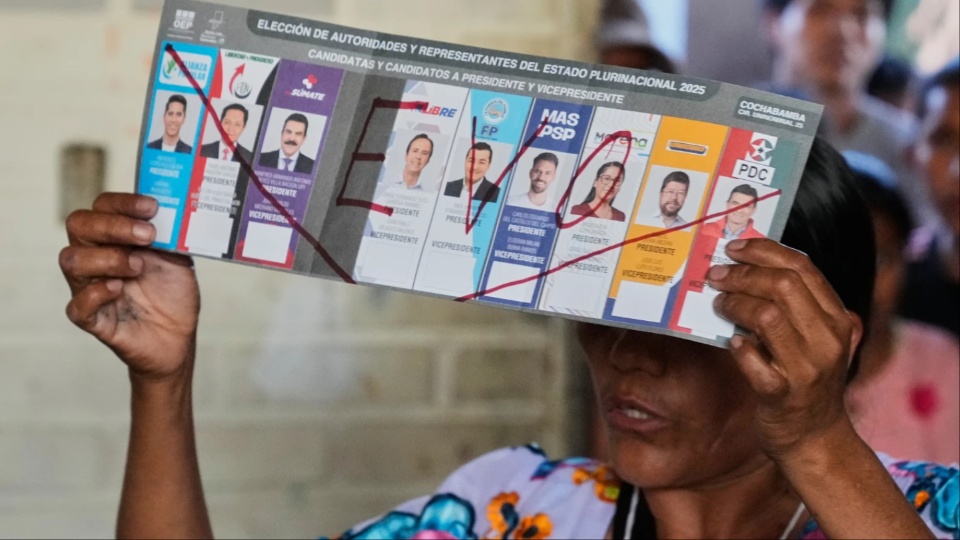
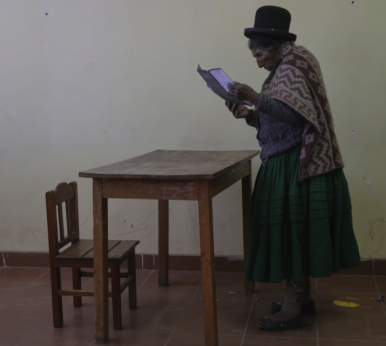
Morales had sought a return to office, but facing overwhelming obstacles, he urged his followers to submit a null vote signifying their rejection of all candidates. Those ballots, which essentially amounted to a boycott vote, represented 19.1% of the total.
As for Arce, he opted not to run for re-election, even though he scored a 55% majority win for the MAS last time.
Rodrigo Paz Pereira, candidate for the Christian Democrat Party, represented a surprise in view of his low ratings in pre-election polling. The U.S.-educated Paz served as mayor of Tarija city and senator for Tarija department. His father, Jaime Paz Zamora, a prominent leader of Bolivia’s Revolutionary Left Movement, democratic socialist in orientation, served as Bolivia’s president from 1989 to 1993.
Jorge Tuto Quiroga took undergraduate and graduate degrees in Texas. Formerly vice president of Bolivia, he served as president for a year ending in 2002. A perennial presidential candidate, this year he represented the Libre Alliance.
The problem of Evo
The trajectory of Evo Morales has a lot to do with the fall of the socialist movement in Bolivia. Morales ran for president and won overwhelmingly not only in 2005, but also in 2009 and 2014. That presidential term, which would end in 2019, was generally taken as his second rather than third term on the theory that a new constitution was in effect, essentially resetting the term limit count.
In 2019, he narrowly won a constitutionally forbidden third presidential term. He was seeking to continue as president even after a constitutional referendum failed that would have allowed a third term. At the end of his presidency, Morales was facing charges of corruption and accusations of having abused an underage female in his care.
Morales went into exile following a U.S.-assisted right-wing coup in November 2019, a month after he had won the disputed election to another term. The move against Morales followed weeks of street protests, culminating in military intervention.
Jeanine Áñez, president of the coup government, and rabid right-winger Luis Fernando Camacho, the principal coup organizer, are presently serving prison terms.
Having returned from exile following Arce’s electoral victory in 2020, Morales then turned against Arce’s MAS government. Reasons are obscure, save for suggestions of lessened MAS support for indigenous peoples. Morales’s presidential ambitions took on new life, despite a Supreme Electoral Council ruling against another presidential term and despite rejection by the members of his own MAS party.
The MAS party instead selected Eduardo del Castillo as its presidential candidate in place of President Arce, who removed himself from consideration.
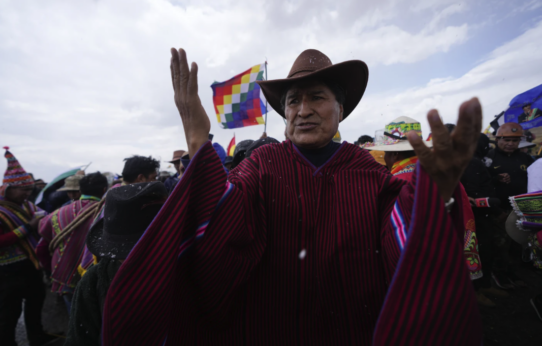
Meanwhile, Morales offered himself as a candidate of the newly created “Evo the People” Party. Adherents, mostly indigenous people from Chapare state, Morales’s home base, carried out marches, rallies, and highway blockades on his behalf in early 2025.
The intense and sometimes violent divisions on the left cost considerable public support and provided an opening for big money on the right and foreign influences.
Making arrangements
Analyst Carlos Peñaranda Pinto, writing for rebelion.org, identifies great wealth as one factor shaping the outcome of this first round of elections. Another is the looming presence of the United States.
He points to Marcelo Claure, Bolivia’s richest man. Claure lives in New York, the command center for his communications, finance, and sports empire. Claure’s instrument was Andrónico Rodríguez, president of Bolivia’s Senate for the MAS party. Many had regarded him as Evo Morales’s political heir.
Peñaranda Pinto shows Claure on Jan. 29, 2025, on social media, extolling Rodríguez’s potential as “hope for renovation” within MAS and “leader of the democratic left.” An opinion poll, paid for by Claure and appearing on Feb. 5, placed Rodríguez’s favorability rating at 16%, topping all candidates for the first round of presidential voting.
New polling on March 31, also under Claure’s auspices, showed Rodríguez to be favored by 25% of potential voters. That 41% of those favoring Rodríguez were shown to be opposed to both the Luis Arce government and Evo Morales convinced Claure, according to the writer, to further widen divisions within the left opposition.
Rodríguez on May 3 announced his independent candidacy. Reacting on social media, Claure expressed pleasure: “I have shared a lot with him over the last three years, and now that he has decided to become a politician who said NO to pedophiles and incompetents, I am sure he will be a constructive, not destructive, opposition figure.”
The pretense ended on July 24, on Facebook, as it became clear that the left had been completely fractured. Claure switched gears, linking Rodríguez with Arce and Morales. “The cursed socialists do everything possible to scare away investments,” he wrote. Polling on July 30 put Rodríguez’s approval rating at 6.1%.
Peñaranda Pinto concludes that, “Claure clearly did not intend to influence the renewal of a new electoral ‘left’; his real goal was to destroy the old one.”
What future for the indigenous?
With Morales now appearing out of the picture and the left in pieces, one of many loose ends in the wake of this election relates to the place of indigenous peoples within struggle for decency and justice in Latin America.
The histories and cultures of the different indigenous peoples do differ from the lived experience of their European-descended compatriots. What matters, however, is that which is shared, specifically awareness among oppressed peoples that the basic needs of one and all go begging.
Resources, of course, do exist, notably the wealth of their own labor, which they are entitled to, and the wealth of what ought to be held in common. A useful kind of political struggle in Bolivia and farther afield, not excluding North America, would attend to the retrieval of wealth not only from individual labor but also wealth derived from the natural resources of whatever region—and retrieval too of the fruit of collective endeavors like schooling, healthcare, and food production.
Perhaps the failure of the MAS political movement leaves the message that the quality of leadership, analysis, understanding, and communication matters, as does the rigor of organizing popular mobilization and of securing unity. The struggle is long, as is known, and in Bolivia, it appears there is nothing left to do but start again.
We hope you appreciated this article. At People’s World, we believe news and information should be free and accessible to all, but we need your help. Our journalism is free of corporate influence and paywalls because we are totally reader-supported. Only you, our readers and supporters, make this possible. If you enjoy reading People’s World and the stories we bring you, please support our work by donating or becoming a monthly sustainer today. Thank you!
CONTRIBUTOR