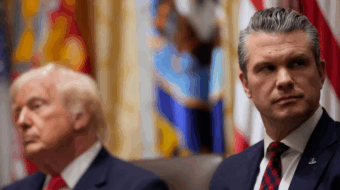
A wise man once said, “History repeats itself as farce.” Yes, President Trump ordering the National Guard, the U.S. Marines, ICE, and other armed forces to invade Los Angeles and Washington, D.C., is a case of history repeating itself. U.S. history is littered with an unbroken train of Presidents ordering U.S. troops to crush strikes, anti-war protests, and demands for equal rights.
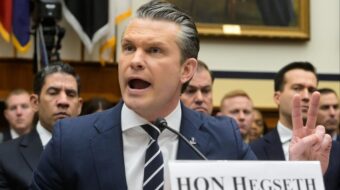
Trump claims he is sending these troops to “restore law and order” so citizens feel safe walking the streets of the nation’s capital. That is farcical in the extreme! Furthermore, it is a lie. Trump’s aim is to terrorize people not only in Los Angeles and D.C. but everywhere. Merchants report that their customers are terrorized by the swaggering ICE thugs wearing masks, without name tags, arresting people of color, ignoring proof of citizenship, including documents proving them veterans of foreign wars. School attendance is down. Many employers report that employees are afraid to come to work, fearing Trump’s dragnet arrests.
It would be a farce if it were not such an extreme abuse of power by the scowling gangland boss in the White House.
And what is the past history of Presidents using U.S. troops against the people of the United States? Start with the one and only case of the National Guard, federalized, being reassigned to protect human rights.
In September 1957, Arkansas Governor Orville Faubus ordered the Arkansas National Guard to block nine Black American children and youth from entering Little Rock Central High School. A nationwide outcry ensued. President Dwight D. Eisenhower then federalized all 10,000 Arkansas National Guardsmen and ordered them to protect the Black students entering Little Rock Central. President Eisenhower also deployed the 101st Airborne Division. Perhaps it reflected Eisenhower’s role as commander of U.S. Forces in alliance with the Soviet Union in the defeat of Adolph Hitler. He was a Republican….but then so was Abraham Lincoln.
Just a few years later, in 1967, the impoverished masses of Newark, New Jersey, reacted to a case of police brutality and rose in rebellion. Governor Hughes deployed the New Jersey National Guard, New Jersey State Troopers, and local police. This reporter covered the story for The Worker. At least 26 innocent people were shot dead by the National Guard and police, the vast majority in the back.
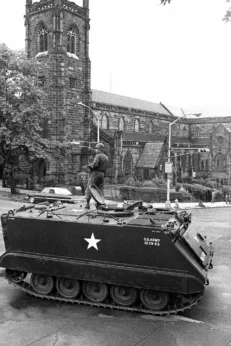
On July 25, 1967, President Lyndon B. Johnson ordered the 82nd Airborne and the 101st Airborne deployed to Detroit to suppress a mass uprising against police racist oppression. Gov. George Romney mobilized the Michigan National Guard. A total of 43 women, men, and children died, a majority innocent, unarmed Black American civilians.
Just over a year later, in 1968, National Guard troops were deployed to help break a strike by sanitation workers in Memphis, Tennessee. This is the “I Am A Man” strike in which Dr. Martin Luther King Jr. was assassinated.
Enraged by Dr. King’s murder, millions of Black Americans in cities across the nation rose in rebellion. The reaction by the white power elite was to deploy the National Guard, Federal troops, and other police and military forces to crush these rebellions. It was a nationwide inferno that cost scores of innocent lives and tens of billions in the destruction of homes and businesses.
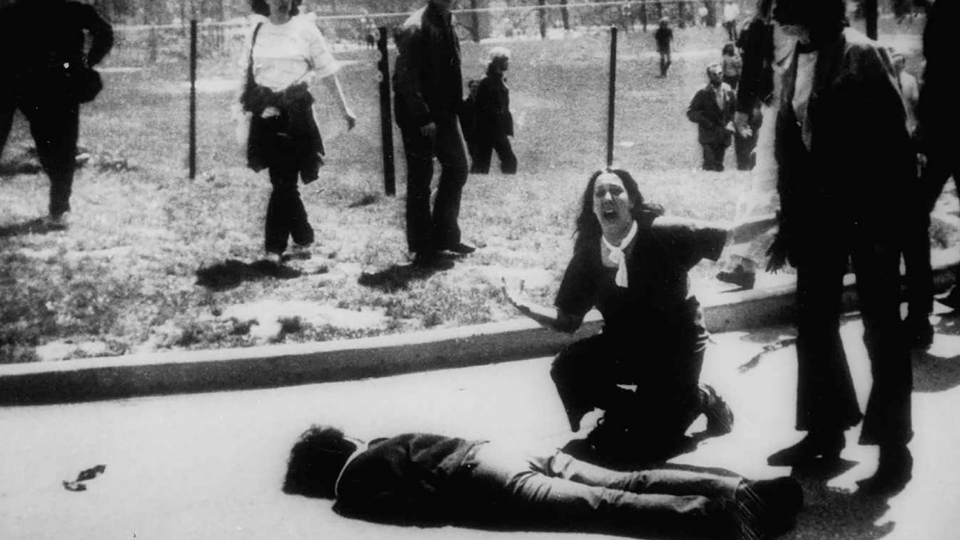
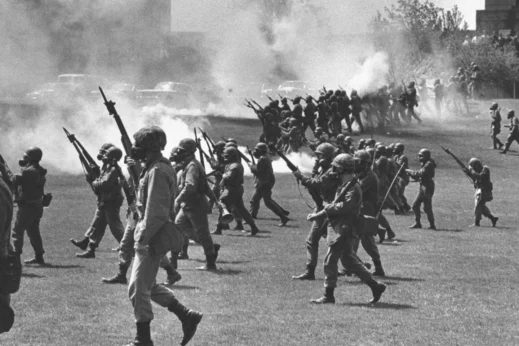
On May 4, 1970, the students at Kent State University in Ohio staged a protest rally against the Vietnam War. President Richard Nixon had just ordered the so-called “Cambodia incursion,” widely seen as the Pentagon’s scheme to escalate the war throughout Southeast Asia. Students were also mobilizing against the military draft, and a nationwide student strike was underway. Gov. Rhodes of Ohio ordered the Ohio National Guard onto the Kent State campus with the assignment to crush the student protest. The National Guardsmen fired 67 rounds in 83 seconds, murdering four students and wounding nine more, one suffering permanent paralysis. The massacre triggered nationwide and worldwide outrage.
Yet, on May 15, 1970, just 11 days later, National Guard troops opened fire on African American students at the historically Black Jackson State University, killing two and wounding 11.
Richard. M. Nixon was responsible for these massacres. He had whipped up hysteria against the peaceful, unarmed anti-war movement, snarling that the students are “bums.” This from a President forced to resign for his Watergate crimes, for his war crimes like the My Lai massacre.
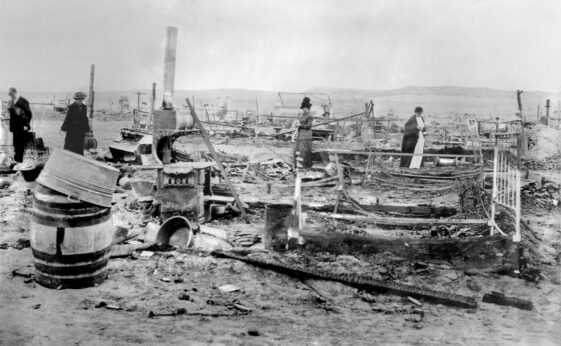
Many working-class people, especially if their moms and dads are union members, know about the Ludlow Massacre of April 20, 1914. At least 21 striking coal miners at the Colorado Fuel & Iron Company mine outside Ludlow, Colorado, were massacred when Colorado National Guard troops opened fire with machine guns on the tent colony. The strikers were living in tents outside Ludlow because John D. Rockefeller Jr. had evicted them from company housing. The National Guard troops set fire to the tents, and some of the strikers were burned to death.
The death toll included 12 children and eight adults, most of them mothers struggling to save their infants. President Woodrow Wilson bowed to mine owner, John D. Rockefeller Jr., in ordering the National Guard to break the strike on April 29, 1914.
Ludlow was not the first use of the National Guard to smash a strike. In 1877, railroad workers, beaten down by the ruthless profiteering of the railroad barons, finally went out on strike. The rage was fueled by the demand of the railroad owners for a second round of wage cuts justified on the specious grounds that the economic depression of 1873 made wage cuts necessary. This was the high point of the “Gilded Age,” when the wealthy elite seemed to ooze wealth from every pore. It is true that capitalism was in the midst of an economic collapse caused by capitalist greed, not by the starving workers whose labor had generated those super-profits in the first place.
The walkout first erupted July 16, 1877, in Camden Junction, near Baltimore, when the workers blocked trains of the Baltimore & Ohio Railroad. The Maryland Militia opened fire on a crowd of strikers and their allies in downtown Baltimore. Eleven workers were murdered.
This massacre spread outrage across the nation, and railroad workers and their partners rose up in rebellion. Many thousands gathered at a protest rally in Pittsburgh on July 20, 1877. The Philadelphia National Guard opened fire on this angry, yet peaceful, unarmed crowd, murdering at least 20.
In 1894, the Pullman strike led by Eugene V. Debs once again idled the nation’s railroads. President Grover Cleveland ordered the National Guard to crush the strike. An estimated 70 unarmed workers were shot to death.
Daily Worker reporter Art Shields, the greatest labor reporter of all time, described himself as a “war correspondent” in a chapter in his book “On the Battle Lines: 1919-1939.” The “war” that Shields was assigned to cover as a reporter for the Federated Press in August 1921 was not a foreign adventure. No, it was the “Battle of Blair Mountain” when an army of union coal miners, members of the United Mine Workers, were struggling against the drive by John D. Rockefeller and other Wall Street financiers to crush the union and force all the miners of Appalachia to accept starvation wages.
Shields tells us that the mood of angry fightback was fueled by the murder of beloved Matewan Sheriff Sid Hatfield. “A spark would start an explosion,” he writes. “The spark flashed when Sid Hatfield, the miners’ hero, was shot dead on the steps of Welch, the county seat of nonunion McDowell County. His wife was by his side as he fell. Ed Chambers, a young union miner, was martyred with Sid.”
Shields explains that Hatfield was assassinated in revenge for his role in slaying Albert and Lee Felts, brothers, of Tom Felts, owner of the infamous union busting Baldwin-Felts Detective Agency during a May gunfight in Matewan, W. Va. Albert and Lee Felts had come to Matewan to serve Hatfield with a fake arrest warrant accusing him falsely of conspiring to blow up a non-union coal mine.
Matewan Mayor Testeman, who was with Hatfield at the time, took one look at the warrant and pronounced it a fake. Albert Felts then shot Testeman dead. Sid Hatfield pulled the 45 revolver from his holster and shot Albert Felts dead. But Lee Felts succeeded in knocking the gun from Hatfield’s hand. Hatfield pulled his 38 revolver from his other holster and shot Lee Felts dead.
This shootout echoed in the mountains of West Virginia. The miners decided to march from Charleston to Mingo County, crossing Blair Mountain, the highest point in Logan County, on the way, to free the Mingo miners toiling under the non-union tyranny of the mine owners. They knew that Logan County Sheriff Don Chafin had recruited a private army of 2,000 union-busting goons armed with rifles and machine guns to block the union miners. Chafin was himself a multi-millionaire owner of coal mines in Logan County.
So, the union miners, many of them veterans of WWI, armed themselves with their hunting rifles and sidearms.
Art Shields writes: “Victory seemed in sight the next day. The outfit I was with was cutting deep gashes in the enemy lines. The whole Don Chafin front was falling back. Ed predicted that the miners would soon sweep through Logan in their liberating mission. But our volunteer forces hadn’t much time. Word came that two regiments of the U.S. Army under General Bandholz were on their way to Blair Mountain. The liberating job must be finished before the troops intervened….I am proud of those West Virginia miners and the other volunteers with them. There wasn’t the slightest panic as they pushed ahead…”
Shields describes crude bombs dropped on them by airborne pirates recruited by the mine owners. One bomb fell between Mrs. Sallie Polly and Mrs. Lizzie Oxley. It was a dud. “The thug pilot expected the bomb to strike on its nose. Had this happened, Mrs. Polly and Mrs Oxley would have been torn to pieces….Several more bombs fell on Blair Mountain without exploding. But Mrs Dula Chambers, the wife of the Jeffrey blacksmith was sickened for two days by poison gas. A bottle of chlorine gas burst under her nose when it dropped from the plane.
“A much bigger danger came from President Harding’s government planes. The miners would have been butchered by murderous bombing raids if the tentative plans of Billy Mitchell, the commander of the U.S. Air Force, had been carried out. Thirteen army planes were waiting at Charleston’s airfield. They were loaded with gas bombs and big fragmentation bombs for use against the miners.” Shields tells us that documentation of this preparation by the U.S. War Department for the bombing of U.S. citizens was provided to him by Nikki Bridges, wife of West Coast Longshore leader Harry Bridges, who obtained it from the National Archives. Nikki Bridges was preparing a Labor History lecture in San Francisco.
Shields concludes: “The battle of Blair Mountain ended without army bombings when 2,000 U.S. infantrymen arrived on Blair Mountain in full battle gear. The miners quit fighting, and 800 were arrested. Don Chafin’s tyranny was temporarily saved by what Mother Jones called, ‘the coal barons’ reserve army of gunmen’ the United States Army.”
Trump is using U.S. troops against the American people. He is not the first.
As with all op-eds published by People’s World, the views presented here are those of the authors.
We hope you appreciated this article. At People’s World, we believe news and information should be free and accessible to all, but we need your help. Our journalism is free of corporate influence and paywalls because we are totally reader-supported. Only you, our readers and supporters, make this possible. If you enjoy reading People’s World and the stories we bring you, please support our work by donating or becoming a monthly sustainer today. Thank you!
CONTRIBUTOR