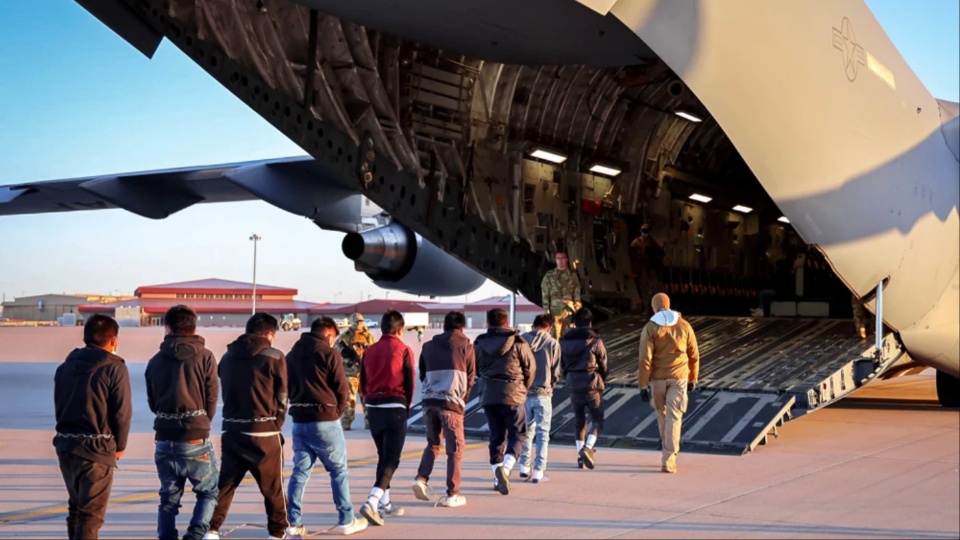
In addition to all his other attacks on the foreign-born in the United States, President Donald Trump is now proposing to deport them to countries with repressive, anti-democratic governments.
Deportees have already been dispatched to countries they are not originally from or have any connection to, including El Salvador, South Sudan, Djibouti, and the Kingdom of Eswatini (Swaziland). At various times, Trump and his enablers have also talked about sending the immigrants they are nabbing to Rwanda, Somalia, and Sudan. But now added to this list is another African country: Uganda.
The latest proposal is to send Kilmar Abrego García, the Salvadoran immigrant who has been the victim of the most notorious victim of the tug of war between the Trump administration and the U.S. judiciary, to that East African country. Abrego García had been sent illegally to the CECOT concentration camp in El Salvador, but the Trump administration was forced to return him, only to arrest him again and now threaten to send him to Uganda.
Abrego García’s imprisonment in El Salvador was based on an arrangement with Nayib Bukele, the Salvadoran strongman president, and involved U.S. payments to the Salvadoran government. For its part, the Ugandan government is hard hit by sharp cuts in U.S. foreign aid, as well as tariffs on its exports. So, until we know otherwise, we have to assume that the U.S. has made a similar arrangement with Uganda—cash for accepting deportees.
So, it’s worth asking, what going on in Uganda? What are prison conditions like? How is due process doing there? Will Abrego García and other deportees have access to Ugandan lawyers and courts? Or will they be held in effective life imprisonment without chance of appeal? Will family members be allowed to travel to Uganda to visit? So many unanswered questions.
Uganda has elections, a parliament, and courts, but the long rule of President Yoweri Museveni—in power since 1986—is frequently criticized for authoritarian tendencies, including harsh persecution of LGBTQ people. Uganda is also regularly rocked by ethnic and sectarian conflicts. Now, the proposal to send U.S. prisoners to Uganda is raising protests from opposition lawmakers, who say “Museveni will be happy” to accept deportees and money from Trump as a means of easing the impact of the economic sanctions he and his government have long faced.
In the case of Eswatini, also known as Swaziland, the country is ruled by King Mswati III with an iron hand. The king and his multiple wives, children, and other relatives live in great luxury and dominate all institutions of government. Opposition groups often face heavy-handed repression. But even so, protests and a court challenge have arisen against the king’s plan to host U.S. prisoners. Some of the objections appear to be based on people taking seriously Trump’s claims that the immigrants he is arresting and deporting are violent criminals who might pose a danger to Swazi citizens, which, of course, is not necessarily true. Others complain about the violation of the prisoners’ rights.
Can we in the United States leave the fates of deportees up to the likes of Bukele, Museveni, and King Mswati? Or to the whims of Trump, Homan, and Noem?
It is up to us to do all in our power to call the Trump administration to account, to stop the arbitrary persecution of the foreign-born, and the grotesque farming out of the U.S. immigration issues to foreign despots.
We hope you appreciated this article. At People’s World, we believe news and information should be free and accessible to all, but we need your help. Our journalism is free of corporate influence and paywalls because we are totally reader-supported. Only you, our readers and supporters, make this possible. If you enjoy reading People’s World and the stories we bring you, please support our work by donating or becoming a monthly sustainer today. Thank you!
CONTRIBUTOR