
China’s modernization has been one of the most remarkable processes of the 21st century and one that has sparked endless academic debate. Meng Jie (孟捷), a distinguished professor from the School of Marxism at Fudan University in Shanghai, has spent the better part of his career unpacking this process to better understand what has taken place.
As a Chinese Marxist economist, Meng Jie has built his theories based on his own primary research in China’s modern factories, tracing how national supply chains have been built, how markets are constructed, and how the Communist Party and the state set goals and frameworks to achieve specific economic outcomes.
In the following interview, conducted by Tricontinental researcher Shiran Illanperuma, Meng Jie shares his perspectives on some basic elements of China’s process of socialist modernization.
Shiran Illanperuma: State-led development models are commonly associated with excessive bureaucratization. How does China avoid this problem?
Meng Jie: I think this is because, firstly, China’s economic activities are premised on the market playing a decisive role in resource allocation. This means that for the government to better play its role, it must first acknowledge the market economy’s priority status.
China’s industrial policy is systemically and structurally quite complex. This is because China has both centralized leadership and an inclusive system of local government decentralization. Therefore, both China’s central ministries and local governments have their own industrial policies. These policies may, in fact, differ from each other.
Local governments are more familiar with local contexts and possess what is referred to as “local knowledge.” These local governments might therefore adapt central government policies to local conditions. In turn, these adaptations might later be recognized by the central government, which is compelled to amend its policies based on ground realities.
Another aspect is that even for industrial policies implemented by the central government, there is a certain kind of competition among different departments—we call this inter-departmental competition. For example, during the development of China’s high-speed railway, both the Ministry of Railways and the Ministry of Science and Technology were involved. The competition between the two had a positive effect on the implementation of industrial policy.
You have argued that China has a “constructive market.” How is this different from neoliberal free markets?
While the market plays a decisive role in resource allocation in China, the government also plays a role as a facilitator. In a constructive market, the government basically plays the following roles:
First, it must coordinate the division of labor. We can see examples of this in many industries. In a purely market economy, the market price mechanism is the sole means of coordinating the division of labor. However, in China’s socialist market economy, the government also undertakes the responsibility of directly coordinating the division of labor.

Second, the government usually needs to establish an incentive mechanism in the market. This is because it needs to align the national development strategy with the micro-level objectives pursued by enterprises. Therefore, providing such appropriate incentives is actually crucial for promoting the development and growth of the market.
What’s so “socialist” about China’s modernization?
China’s modernization is led by the Communist Party of China and premised on the basic socialist economic system. Chinese-style modernization has several key features:
First, it is the modernization of a huge population. Second, it is the modernization of common prosperity for all. Third, it is the modernization of both material and cultural-ethical advancement. Fourth, it is the modernization of harmony between humanity and nature. Fifth, it is the modernization of peaceful development.
The combination of these features means that Chinese-style modernization has to be inherently socialist in nature.
First, consider the challenge of modernizing China’s huge population. Former U.S. President Barack Obama once said that the planet would not be able to sustain China’s modernization because its population is so large. In his view, China achieving modernization would trigger and intensify various conflicts.
The implication is that there aren’t enough resources to sustain China’s modernization. It implies that China’s modernization would crowd out other countries’ resources and undermine the prospects of peaceful development.
Second, consider the challenge of modernizing while maintaining harmonious coexistence between humanity and nature. This means that China must achieve green development, develop new quality productive forces, and develop green productive forces to realize its modernization. Only such a development model can solve the challenges of peacefully and sustainably modernizing a huge population.
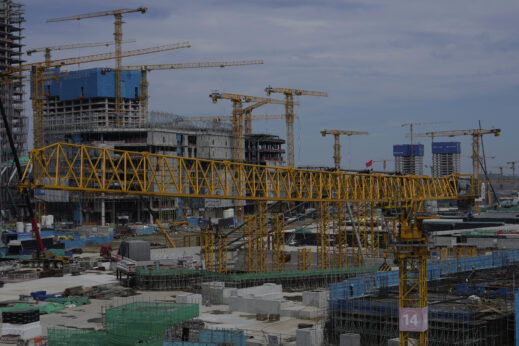
I believe that only within a socialist framework and under the leadership of the Communist Party of China can China’s modernization be achieved. In the last decade, the Chinese government has made great achievements in promoting green development. In comparison, the U.S. government is constrained by the vested interests of capital in the energy sector. As a result, when it comes to tackling issues like climate change and global warming, the U.S. government has shown significant regression.
This is not accidental. In fact, it is caused by the capitalist system.
China’s systemic advantages enable it to pursue a path of green development. This drives Chinese-style modernization forward through the development of new quality productive forces and the achievement of high-quality growth.
***
Meng Jie’s essay Industrial Policy with Chinese Characteristics: The Political Economy of China’s Intermediary Institutions (co-written with Zhang Zibin) was published in the latest issue of Wenhua Zongheng: A Journal of Contemporary Chinese Thought.
Produced by Globetrotter
We hope you appreciated this article. At People’s World, we believe news and information should be free and accessible to all, but we need your help. Our journalism is free of corporate influence and paywalls because we are totally reader-supported. Only you, our readers and supporters, make this possible. If you enjoy reading People’s World and the stories we bring you, please support our work by donating or becoming a monthly sustainer today. Thank you!
CONTRIBUTOR