For much of the 20th century, the Arab world carried a reputation for solidarity and collective defiance of imperialism. Arab governments and movements projected an image of unity against Western domination and in defense of Palestine.
The Arab people, in their millions, marched and organized for liberation not only of their own nations but for the broader cause of anti-imperialism. Today, that spirit feels like a relic of another era.
Arab governments openly collaborate with Israel, normalize relations with Zionism, and quietly accept genocidal wars against Palestinians, Syrians, Lebanese, Yemenis—and now, even against Arab states like Qatar, once out of range of direct Israeli aggression. How did we get from collective resistance to this moment of capitulation?
At first, Pan-Arabism and liberation
In 1948, at the founding of Israel, armies from Egypt, Jordan, Syria, Lebanon, and Iraq entered Palestine. Despite their divisions, these governments acted under the banner of defending Arab land from colonial settler encroachment.
The war ended in their defeat, but it symbolized a sense of common destiny. Palestine was not seen as only a “Palestinian problem,” but an Arab one.
That spirit carried into the 1950s and 1960s. The rise of Gamal Abdel Nasser in Egypt gave voice to pan-Arabism: a vision of one Arab nation standing against imperial domination.
Egypt’s nationalization of the Suez Canal in 1956 rallied Arab peoples against Britain, France, and Israel. The Ba’ath Party in Syria and Iraq, though fractured and authoritarian in practice, also raised the slogan of Arab unity. The Palestinian cause was woven into this ideology, not as charity but as the frontline of Arab independence.
They gathered in Khartoum
After the devastating defeat of the Arab states in the 1967 Six-Day War, Arab leaders gathered in Khartoum, Sudan. Out of that summit came the famous “Three Nos”: no peace with Israel, no recognition of Israel, no negotiations with Israel.
Whatever else divided them, Arab governments agreed that Palestine’s liberation was a red line. This posture, though unevenly enforced, defined Arab diplomacy for decades.
The 1973 October War brought another moment of solidarity. While Egyptian and Syrian forces struck at Israeli positions, OPEC oil producers led by Arab states used the “oil weapon.”
By cutting production and embargoing exports to countries backing Israel, they sent shockwaves through the world economy. For a moment, it looked as though Arab resources could discipline imperial powers. Oil revenues funded ambitious social programs at home, and the Palestinian resistance seemed to enjoy unprecedented legitimacy.
Cracks in the wall
But solidarity began to fracture in the late 1970s. Anwar Sadat of Egypt signed the Camp David Accords with Israel in 1978, breaking the united Arab front.
Egypt, once the beating heart of Arab nationalism, became a U.S. ally and aid client. Other Arab governments denounced the deal but followed similar paths over time. By the 1990s, the Oslo Accords between Israel and the PLO, brokered by Washington, gave cover for Arab regimes to downgrade their commitment to Palestine.
The 1991 Gulf War deepened the collapse. The reckless invasion of Kuwait by Iraq offered the U.S. the opportunity to take advantage of divisions within the Arab world.
The U.S. assembled an “Arab coalition” to bomb Iraq, one of the most vocal anti-imperialist states. The spectacle of Arab regimes providing bases and troops for U.S. warplanes against another Arab people destroyed illusions of unity. The Arab League, once a forum of cautious solidarity, became increasingly an instrument for U.S. policy in the region.
From resistance to capitulation
The 2000s and 2010s showed how far the shift had gone. As Israel waged repeated wars against Lebanon and Gaza, Arab governments offered little more than muted statements.
When the U.S. invaded Iraq in 2003, most Arab states either endorsed or quietly facilitated the occupation. During the Syrian war, Gulf monarchies openly financed sectarian militias, some aligned with al-Qaeda, with the goal of overthrowing a government allied to the Palestinian resistance.
Even the language of “Arab solidarity” evaporated. Instead, new slogans emerged: “counterterrorism,” “regional stability,” and “modernization.” These were not slogans of liberation but of accommodation with imperialism. Israel, once the common enemy, became a “partner” in intelligence, technology, and trade.
The Abraham Accords and beyond
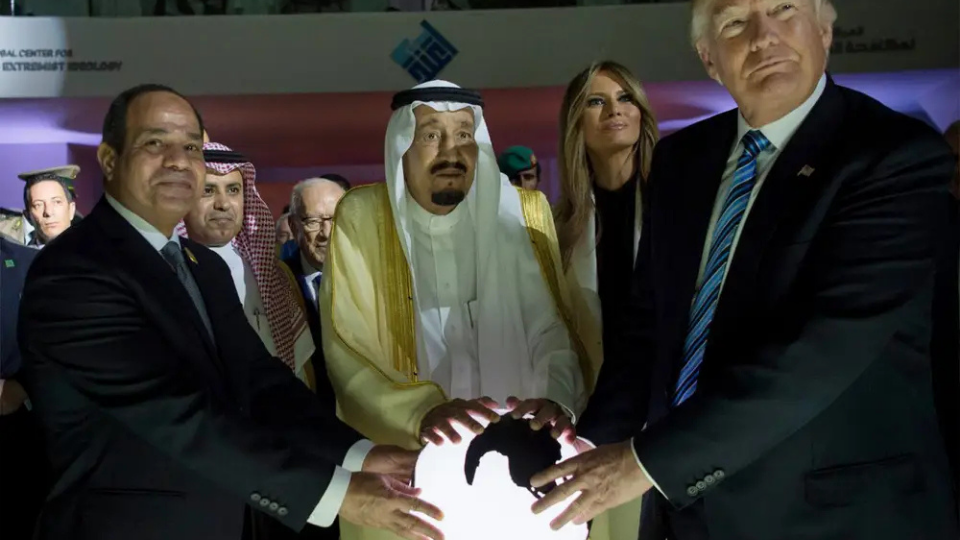
The Trump-era Abraham Accords stripped away the last pretenses. The UAE, Bahrain, Morocco, and Sudan openly normalized relations with Israel. Saudi Arabia is preparing to follow.
These deals were not made in exchange for Palestinian freedom but in pursuit of weapons, surveillance technology, and U.S. guarantees for ruling elites. Today, Arab states cooperate with Israel in monitoring dissent, suppressing uprisings, and tightening authoritarian control.
Meanwhile, the Palestinian people face extermination in Gaza and suffocation in the West Bank. Israel’s strikes on Syria, Lebanon, and Yemen barely provoke official protest. The Arab League, once a venue for anti-colonial coordination, now avoids even symbolic gestures of solidarity.
What happened?
Three dynamics help explain this transformation:
- Class Interests of Arab Ruling Elites: The Arab ruling-classes, whether monarchic or republican, long ago abandoned anti-imperialism. Their wealth depends on oil revenue, U.S. military protection, and global finance—not on liberation struggles. Palestine became a bargaining chip, not a cause.
- U.S. Hegemony: Since the 1970s, U.S. dominance of the Middle East has been cemented through bases, arms sales, debt, and political leverage. Arab states learned that challenging Washington brought punishment, while collaboration brought survival. The collapse of the Soviet Union removed the one global counterweight that had offered political, economic, and sometimes military backing to Arab national and leftist movements. With no rival power to balance U.S. influence, Washington’s hegemony became virtually unchecked, and Arab regimes increasingly aligned themselves with the U.S.–Israel axis as the only path to regime security.
- Fragmentation and Counter-Revolution: The defeats of Arab and pan-Arab nationalist projects, coupled with the rise of sectarianism and neoliberal restructuring, eroded the social basis for solidarity. While popular, grassroots movements continue to call for dignity and unity, for the most part the ruling class crushes them with the help of imperial powers—and, increasingly, with Israel’s support.
Hope for the future
If Arab governments have capitulated, Arab peoples have not. From Cairo to Rabat, from Beirut to Baghdad, millions still march in solidarity with Palestine whenever bombs fall on Gaza.
Arab workers and students continue to see the Palestinian cause as their own. The disconnect lies between rulers who cling to imperial protection and peoples who remember the promises of liberation.
The question, then, is not only “what happened” to Arab solidarity—it is whether it can be rebuilt, and on what foundation. History shows that real unity has never come from royal palaces or presidential compounds, but from the ground up: from workers, students, left parties, and popular movements whose struggles once gave the region its reputation for defiance. The memory of those struggles remains, a reminder that the power to change the world has always rested with ordinary people.
From the pan-Arab invasion of 1948 to the oil embargo of 1973, from Khartoum’s “Three Nos” to the chants of 2011, the Arab world has a history of collective defiance of imperialism. Today, its governments have abandoned that legacy, preferring alliance with imperialism and complicity in genocide.
But history is not finished. Arab solidarity is not dead—it has been betrayed. It waits, as it always has, in the streets and in the struggle, to be reborn.
As with all op-eds published by People’s World, the views reflected here are those of the author.
We hope you appreciated this article. At People’s World, we believe news and information should be free and accessible to all, but we need your help. Our journalism is free of corporate influence and paywalls because we are totally reader-supported. Only you, our readers and supporters, make this possible. If you enjoy reading People’s World and the stories we bring you, please support our work by donating or becoming a monthly sustainer today. Thank you!
CONTRIBUTOR