Puerto Rico has a long history of protests against using the island for U.S. military purposes. Now, in reaction to the Trump administration’s aggressive actions toward Venezuela, new protests are gearing up.
Trump has called for the arrest and replacement of Venezuelan President Nicolas Maduro, alleging that he is a major sponsor of narcotics exports to the United States through the Cartel de Soles (Cartel of Suns) and the Tren de Aragua (Aragua Train) gang. The Venezuelan government denies all this. But worry about an actual armed intervention of the U.S. military in Venezuela has been ramped up by a number of actions by the U.S. military in recent weeks.
One was the bombing, evidently by U.S. military drones, of a small speedboat that the Trump administration claimed was bringing drugs into the United States. The Trump administration bragged that eleven people on board were killed in the bombing. A blurry video feed of the bombing was released by the United States.
But the U.S. claims about the boat appear to be falling apart. Latin America expert Greg Grandin pointed out that if it were a drug boat, there would be no reason for there to be eleven people on board, taking up space that would normally be used for the drugs. Others have pointed out that such a small boat would have great trouble getting from Venezuela to the United States, due to the distance, the conditions of the Caribbean, and the weight of so many passengers. Some, including members of Congress, are asking whether, in fact, the U.S. has simply murdered eleven people in cold blood.
But the Trump administration just plows ahead. Secretary of “War” Hegseth has sent several warships to Puerto Rico, including an amphibious craft specially designed to land troops on beaches. And the U.S. has announced the sending of ten F-35 Lockheed-Martin jets to Puerto Rico. These are described as “multirole” warplanes, which can bomb land targets as well as do other things. Hegseth has also told the troops in Puerto Rico that their assignment is not a mere training exercise.
But the people of Puerto Rico don’t accept being passive spectators to the Trump administration’s use of their own nation. And they have a long history of resistance to abuses by the U.S. military on Puerto Rican territory. In the 1970s, there were mass protests against the U.S. military’s use of Culebra Island, a “municipio” (an entity similar to a stateside “county”) of Puerto Rico as a military bombing range. The U.S. government finally gave in to the protests in 1975. Subsequently, the focus of protests turned to the island of Vieques, which the U.S. had been using as a testing ground for bombing, resulting in the death of a local person from an explosion, and a serious problem caused by the population’s exposure to depleted uranium and other hazards caused by the bombing. Although the protests, which included large-scale mobilizations in Puerto Rican and Latino neighborhoods in U.S. cities, eventually put an end to the bombing, promised cleanup efforts by the U.S. government are as yet far from satisfactory.
There have also been objections to the large Roosevelt Roads military base in Puerto Rico, leading to its shutdown in 2004. And now, with the new Trump threats against Venezuela (and also Cuba, Brazil, and perhaps more to come), there is fear in Puerto Rico that the United States might fully re-militarize the island and involve it in one or more regional wars.
Puerto Rico faces other political dilemmas. One is the PROMESA structure, an unelected, neo-liberal board the U.S. imposed on the island during the Obama administration, which has mandated serious cuts to the social safety net in the island to satisfy corporate creditors. And during the first Trump administration, Hurricane Maria caused immense destruction and suffering in Puerto Rico. Trump went to Puerto Rico supposedly to assess the damage, but put on a clown show instead, which included throwing paper towels to people instead of committing to help.
So there is general dissatisfaction in Puerto Rico with the island’s relationship with the United States, more than ever revealed as a case of latter-day colonialism. This had an impact on the 2024 territorial elections. For years, parties calling for Puerto Rico to become the 51st U.S. state have alternated in power, with supporters of Puerto Rico retaining its present “Free Associated State” (Estado Libre Asociado) relationship with Washington. This duopoly has given Puerto Rico a non-voting Representative in the House of Representatives, just like Washington, DC, but not much more.
But in Puerto Rico’s vote for governor last year, a coalition of left-wing parties that lean toward independence for the island nation greatly increased their vote. Although the right wing, pro-statehood candidate, Jennifer Gonzalez Colon (New Progressive Party), was elected with a plurality of 41.22 percent of the vote, the pro-independence candidate, Juan Dalmau, himself of the Puerto Rican Independence Party but on the ticket of a couple of other left wing parties as well, got 30.73 percent, and the candidate of the Popular Democratic Party, which supports the current “free associated’ commonwealth arrangement, Jesus Manuel Ortiz, got only 21.44 percent. In past elections, the pro-independence left candidates have garnered minuscule votes.
And there are other signs of disaffection. The popular Puerto Rican music sensation, “Bad Bunny,” has moved his official headquarters from New York to San Juan, Puerto Rico’s capital, in part, he says, because he is afraid that if he attracts big Latino crowds to some of his concerts, this would also attract ICE raids. Yet there are reports of ICE activity in Puerto Rico, too.
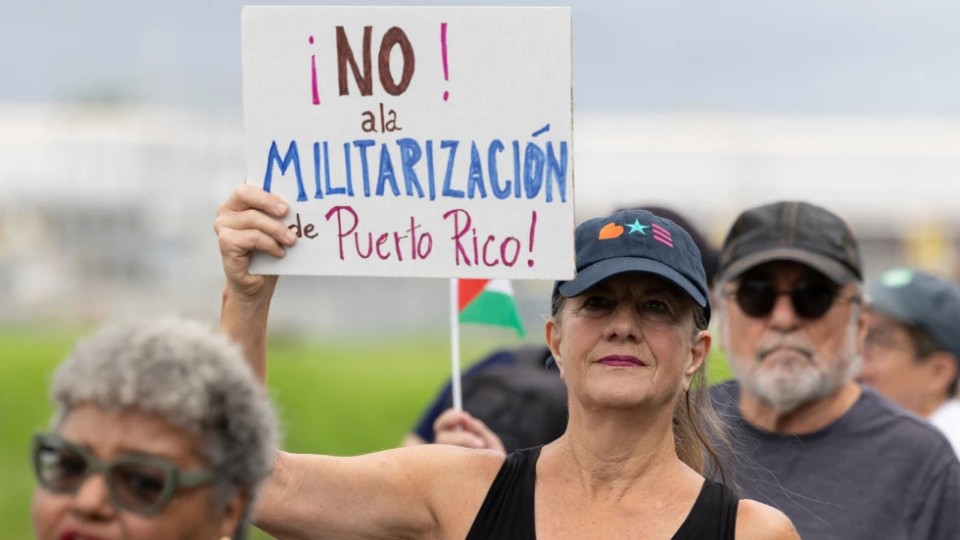
And protests against the use of Puerto Rico as a staging area for interference, including possible armed incursions, in fraternal Latin American countries are building. There is a lot of criticism of Governor Gonzalez-Colon for her links to the U.S. Republican Party and failure, so far, to oppose Trump’s Latin America policy. An organization called “Madres Contra la Guerra” (“Mothers Against War” has issued a call for mobilization against the U.S. military plans with the slogans “El pueblo grita fuerte, no más bases pa’ mi gente” (“The people strongly cry out, no more bases for my people”), “Más escuelas, menos armaas, más futuro, menos armas” (“More schools, fewer armaments; more future, fewer armaments”).
On September 7, there was a picketing of the Muñiz U.S. Air Force base. The Puerto Rican national flag, and also the flags of Palestine, Cuba, and Venezuela, were flown. The Movimiento Independentista Nacional Hostiano, a successor to the former Puerto Rican Socialist Party, took part, among others. Among the messages was a firm repudiation of any use of Puerto Rican territory or resources to interfere in the sovereignty of Cuba, Venezuela, or other countries by U.S. imperialism.
And all this before the awaited attacks are even launched!
We hope you appreciated this article. At People’s World, we believe news and information should be free and accessible to all, but we need your help. Our journalism is free of corporate influence and paywalls because we are totally reader-supported. Only you, our readers and supporters, make this possible. If you enjoy reading People’s World and the stories we bring you, please support our work by donating or becoming a monthly sustainer today. Thank you!
CONTRIBUTOR