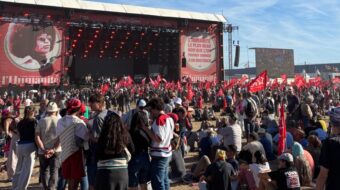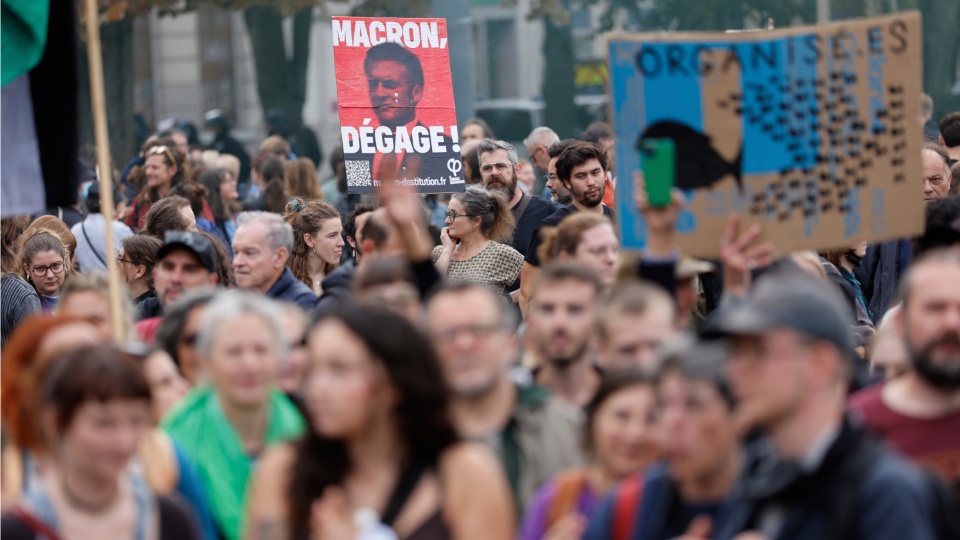
PARIS—Building on the Bloquons Tout movement, a national protest against French President Emmanuel Macron’s austerity budget, which drew supporters from both left and right, the combined might of the French unions late last week led an even more impressive mobilization.
“Let’s Block Everything” was an attempt to bring the country to a standstill, which did not quite happen and was met with a good deal of police repression, with somewhere between 200,000 and 300,000 protesters in the streets.
The union movement, building on demo or manifestation or manif of earlier this month, most likely doubled or tripled those figures. In 2023, in a 14-day mobilization against the increase of the pension age from 62 to 64, Macron’s government ignored this expression of the people’s will and then passed the unpopular measure by an undemocratic mechanism where a law can be enacted without a vote, simply on the will of the president and prime minister.
The stakes are higher this year with the 2026 budget attempting to put the full weight of cuts on the workers while leaving the richest, who have benefited greatly in Macron’s two terms, practically untouched. So, numbers in the street are important in making sure that the will of the vast majority cannot again be ignored and overturned.
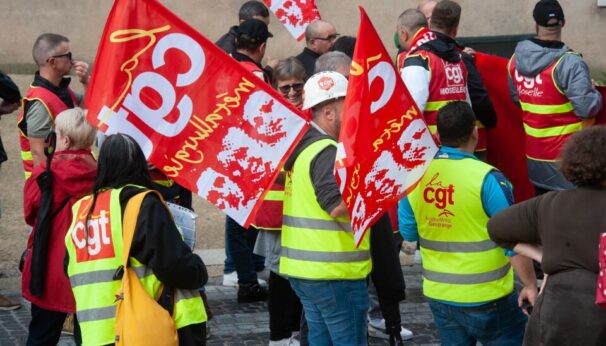
The official figure for Thursday’s rally was 500,000, but the CGT, the most radical union, estimated the figure at the magic number of 1 million, a touchstone needed to convince the powers that be how out of touch they are. The Thursday protest was followed up on Friday, but an interunion meeting to decide what action to take next.
There were more than 250 manifs throughout the country, and in fact, because of the participation of the French transportation workers in Paris, with subway and bus service effectively halted and schools shut down, Thursday came much closer to the goal of Bloquons Tout. Though there were between double and triple the amount of people in the streets, the demonstrations were for the most part peaceful, with only 181 arrests throughout the country and only 31 in Paris.
What violence there was was often instigated by the Black Bloc, a group of mostly youths clad in black from head to toe and often wearing masks. They took a place at the front of the union cortege with a combative stance toward the police, though it has been frequently rumored that some of their number are paid police agitators.
At the actual head of the cortege, marching from Bastille, site of the instigation of the French Revolution to Republique to Nation was the police in numerous vans and on foot, also clad from head to toe in black, stressing the similarities between the two groups.
The placards the demonstrators carried expressed their anger at the unequal taxation and the privileges of the wealthiest and the richest corporations. One banner read, “Pay Your Taxes or We Burn Your Castles,” recalling the feudal nature of this unequal treatment, of turning citizens back into serfs. One of the marchers noted how much Macron had reduced taxes on the rich (who have seldom had it so good) “and then once the cash registers were empty, they tell us it is necessary to cut expenses.”
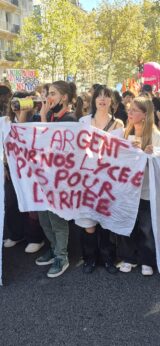
All age groups were represented. At Besançon in the north, a steel plant, owned by ArcelorMittel, has threatened to cut 350 jobs, and workers in that town and in Paris took up the cause of the company retaining the jobs. In Paris, the high schools were out in force, with one group marching behind a banner that read, “Money for Schools, Not for Cops and the Army.”
Again, there was widespread support for the demonstrations, with traditionally regarded as more right-wing Gilets Jaunes and the left parties of Le France Insoumise (France Unbowed), the Communists, the Greens, and the Socialists cheering and marching with the union cortege. A proponent of this newfound unity, one Gilets Jaunes protester said, “There are not enough of us here to have the luxury of division,” a recognition that, like the protest last week, all sides of the political spectrum will need to come together to defeat this full-on austerity attack.”
Macron and his new Prime Minister LeCornu were silent, but they are listening to the roar from the streets because, after the first eruption, now called the September 10th Movement, LeCornu announced the cancellation of the plan to strip the French workers of two of their holidays.
On the front of one truck in the cortege, reading “They Want Austerity [but] Another Budget Is Vital” was a people’s response to Macron’s tax cuts for the rich. This included: the Zucman 2% tax on billionaires, which would bring in 15 to 25 billion euros; reinstating the luxury tax on wealth, which Macron abolished, accounting for 10 billion; suppression of a flat tax—a disproportionate tax on the poorest, for 9 billion; and reduction of public aids to the largest corporations, which would bring in 211 billion.
Other demands were more modest and indicated the scarcity conditions of French workers who are already experiencing austerity.
One worker mentioned being able to go to a restaurant once a month, being able to go on vacation, go to an amusement park once a year, and pay for his kid’s education. These union members were also wise about how they are portrayed in the media, with one woman adding that, “All they will show on the television tonight will be burning garbage.”
The hope, desperation, and growing movement of resistance was probably best expressed by CGT President Sophie Binet, who concluded, “It’s the street which will write the budget. If not, LeCornu will finish in the street.”
We hope you appreciated this article. At People’s World, we believe news and information should be free and accessible to all, but we need your help. Our journalism is free of corporate influence and paywalls because we are totally reader-supported. Only you, our readers and supporters, make this possible. If you enjoy reading People’s World and the stories we bring you, please support our work by donating or becoming a monthly sustainer today. Thank you!
CONTRIBUTOR