On a recent architecture tour of Chicago, I learned that Adrian Smith, the architect of the Burj Khalifa in Dubai, is also responsible for designing the Trump Hotel here in the city. The tour guide mentioned it almost offhandedly, but I immediately began connecting the two: Both towers are designed to overwhelm, to equate size with significance, and to make the individual (whose exploitation made these monuments possible) feel small and powerless.
The Burj Khalifa, the tallest building in the world, rises so high that it erases from view the graves of the slaves who built the city surrounding it. The Trump Hotel’s sheer size and the giant “Trump” logo stamped across its glass façade present an image of power, wealth, and permanence.
Examining the aesthetics of the far right moves beyond simply categorizing visual tropes or condemning “bad taste.” Reactionary imagery acts as a pedagogy of perception, not through communication, but by command. It attempts to train the audience in the “correct” way to perceive the world and measure importance.
Spectacle (the staging of grand displays to command attention), monumentality (the use of size to project authority), and repetition (the overwhelming recirculation of ideas and phrases) are its most crucial tools for staging the new reality as natural and inevitable. Together, they redefine “shine” as substance and “size” as power while distracting from worsening material conditions and convincing audiences that real progress is being made.

This logic is not new. Benito Mussolini, the father of fascism, used oversized busts of himself as propaganda to project an image of omnipresence and authority. Adolf Hitler hired architects to design massive structures that affirmed Nazi ideology through scale and uniformity. In both cases, design choices were intentionally made to anesthetize interpretation and teach viewers how to feel their own insignificance in the presence of authority.
Today, the Trump regime relies on the same aesthetic strategies, though adapted to a decaying neoliberal empire (and, let’s be honest, in a cheapened, dumbed-down form). With Trump, everything is always “the biggest” and “the best.”
Take, for example, his “Big Beautiful Bill.” The name itself serves as a distraction. The bill is devastating for Americans; it cuts funding from SNAP and Medicaid while financing tax breaks for the rich. But by framing it as monumental, Trump’s base is duped into supporting it and mistaking devastation for victory. At the very moment when social services are being stripped away from millions of Americans, the regime announced its plans to construct a $200 million ballroom for the White House, a monumental vanity project designed to impress.
Spectacle and monumentality are utilized not to deliver material improvements but to distract from crises of poverty, debt, and social collapse with glitter and scale.

Unlike the regimes of the past, today’s reactionaries have access to a particularly dangerous medium: generative AI. U.S. government agencies, as well as the president himself, have been flooding the internet with AI-generated propaganda. It focuses on vilifying those whom the right has deemed as the enemy (immigrants, Palestinians, trans people, etc.), while worshipping Trump and his regime.
Trump recently posted an image on his Truth Social that reads, “I love the smell of deportations in the morning. Chicago about to find out why it’s called the Department of WAR.” The post is accompanied by an AI-generated image of Trump kneeling in front of the burning skyline, with military helicopters flying overhead, and text that reads “Chipocalypse Now.”
In another post, Trump shared an AI-generated video that shows Gaza being transformed into “Trump Gaza,” a luxurious Gulf resort. The video includes scenes of a child holding a golden Trump balloon, a gift shop selling Trump statues, and Elon Musk dancing on the beach with dollar bills raining down from above. It is accompanied by an AI-generated song with lyrics that include “Trump Gaza shining bright. Golden future, a brand-new light.”
The goal of this digital propaganda isn’t to persuade people emotionally or intellectually. It’s to overwhelm discourse through complexity and repetition, while also disarming critique by turning politics into a circus. These images often combine photorealism with surreal elements (Trump as a god riding an eagle or the White House as a golden castle), blurring the line between reality and fiction. This inherent quality of generative AI reflects a political tendency toward denying facts and history. Mocking the gaudiness merely grants the posts virality and does nothing to address the underlying message: Reality is whatever the rich and powerful decide.
Rhetoric itself has also become a medium for the far-right’s pedagogy of perception.

Through repetition and exaggeration in media coverage, marginalized groups, such as immigrants, people of color, and transgender people, are portrayed as threatening and morally corrupt. And thus, scapegoats are established for the real, worsening material conditions that many Americans are facing (rising costs of living, stagnant wages, crushing debt, and lack of healthcare).
This is a strategy long used by the ruling class to divide the working class and distract from the economic system that actually causes these problems. Without class consciousness, anger is misdirected. Frustration at systemic inequality is turned toward those with even less power, while the elites truly responsible remain untouched.
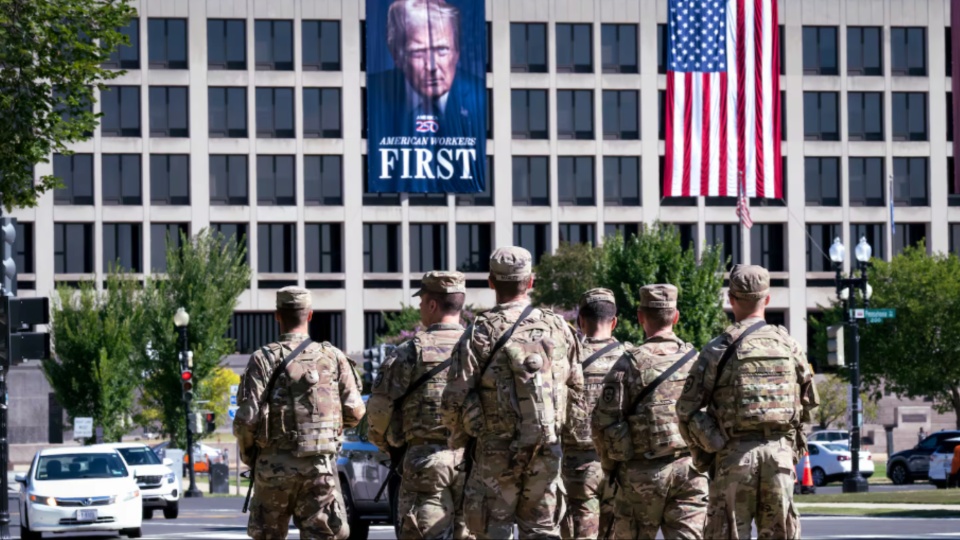
Demonization of these marginalized groups also allows the Trump regime to stage faux “wins.” Projects like building the wall at the southern border or deploying the National Guard in U.S. cities are presented as evidence of progress under his leadership.
Of course, these actions don’t actually solve any problems. Instead, they act as monumental displays for Trump to point at while praising himself for improving the lives of Americans. Repetition in the media coverage reinforces the preferred narrative. Meanwhile, the underlying material conditions responsible for so much suffering are only deteriorating further.

In buildings, AI images, and political theater, far-right aesthetics distract from deepening crises. Monumentality, repetition, and spectacle do not improve lives. Instead, they hide decline and direct public anger away from elites and toward the marginalized. These are not neutral or decorative choices, but tools designed to shape perception and block class-consciousness.
Examining how these tools are used reveals the interconnectedness among the struggle for liberation among all marginalized groups, which is ultimately the struggle for a reorganization of society that utilizes resources, wealth, and power to serve the needs of all people, not just those at the top.
Reclaiming perception by recognizing our interconnected struggle is essential for redirecting power toward the majority.
We hope you appreciated this article. At People’s World, we believe news and information should be free and accessible to all, but we need your help. Our journalism is free of corporate influence and paywalls because we are totally reader-supported. Only you, our readers and supporters, make this possible. If you enjoy reading People’s World and the stories we bring you, please support our work by donating or becoming a monthly sustainer today. Thank you!
CONTRIBUTOR