Twenty-two players, two nets, and one ball. These are the required pieces to play the beautiful game. Some call it soccer, most call it football, but no matter the name, a shared love for the game unites people of all backgrounds. While there are intense rivalries, the game brings together people in more ways than not. Kids play together after school, workers find time on days off to play in Sunday leagues, and of course fans crowd into stadiums to catch a glimpse of their favorite teams.
With all the examples of soccer breaking down barriers, sadly in some cases, fans have built walls instead of bridges. One such example can be found tucked in the crossroads between Asia, Africa, and Europe on the island nation of Cyprus.
I recently visited that beautiful Mediterranean country as part of the Hello Comrade delegation, knowing very little of its uneasy and very politicized soccer history. I knew they called it football, like most countries around the world, but besides that, I couldn’t tell you who played where. However, even with my limited knowledge, I did know one thing: Omonoia FC was a team in Nicosia and they had a left-wing history.
Omonoia FC is short for “football club,” as the Cypriots call the sport. Omonoia FC is part of AC Omonoia, short for “athletic club.” In Cyprus, athletic clubs have teams in several sports under their umbrella, and the football clubs are generally the most popular of the teams.
My naive knowledge on Omonoia FC took an unexpected turn towards complication when I learned that there was not just one team called Omonoia in Nicosia, but rather two! There was the Omonoia FC I knew about, but behind a cloud of mystery to me was Omonoia 29M.
In 2018, AC Omonoia of Nicosia decided to privatize their football department, Omonoia FC, which was a major a change after a long history of fan ownership. The club voted to sell the soccer team to U.S.-based Cypriot Stavros Papastavrou. While the activities of the football team are now under private control, the teams of other sports, such as handball, are still publicly owned under AC Omonoia. The selling of the soccer team resulted in a split fan base and culture, one that is still divided to this day.

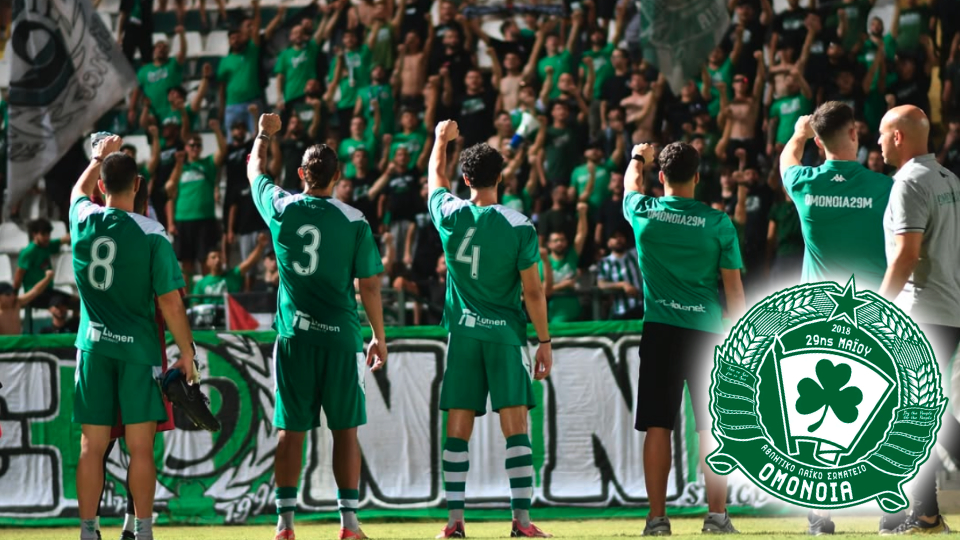
The aftermath of the privatization was the formation of a second Omonoia team, Omonoia 29M. Leading the charge to form a new Omonoia soccer team was Gate 9, a supporters’ group originally created by Omonoia FC fans. Following the vote within AC Omonoia to sell the football team, Gate 9 held their own vote. The result was a decision to form Omonoia 29M. The date of the vote, the 29th of May, served as inspiration for the team’s name. Even in 2025, fans are still torn between the two teams, wondering which deserves their time and energy.
AC Omonoia formed in 1948, a time of civil war in Greece and political turbulence in Cyprus. Prior to that time, APOEL FC was the sole team of Nicosia, the capital city. During this era, Greek nationalists were organizing with the ultimate goal of unifying Cyprus with Greece. One of the main arenas in which they fought for the cause was sports, particularly soccer.
With the help of Greek sporting organizations such as the Hellenic Athletic Association, soccer clubs such as APOEL began forcing club members and players to officially declare their support for the monarchist side of the Greek Civil War and step aside from the Communists. During a purge of left-wing athletes, clubs like APOEL made their intentions clear with press reports claiming that “only those who think as Greeks and not those who praise the traitors” would be able to play for and support their team.
However, just like today in Cyprus, not every player was a Greek nationalist, and in fact many were Communists. After the Greek nationalists forced left-wing players out, many went on to form their own clubs, one of which was Omonoia FC. While the new club was formed quickly, they were not allowed into the Cypriot league right away. Together with other clubs such as Nea Salamina, Alki Larnaca, and Orfeas Nicosia, the left-wing teams formed the Cyprus Amateur Football Association, or KEPO.
Omonoia FC played in KEPO for five years, however the league didn’t last long. Despite billing itself as “amateur,” KEPO’s games still attracted thousands of fans and drew in talented players. In 1953, after years of divided soccer, the biggest clubs from KEPO applied to join the Cyprus Football Association, or CFA. Now playing alongside the club that had originally kicked them out, left-wing players and clubs won the right to exist in the national soccer league without discrimination or intimidation.

While Omonoia FC is one of the most successful football clubs in Cyprus, its good times dwindled in the 2000s. Debt overwhelmed the publicly-owned club, and in 2018 AC Omonoia voted to sell the football department. AC Omonoia has teams in several other sports, including basketball, volleyball, and cycling, but given that soccer is the most popular sport, the sell-off caused a storm within the club.
Omonoia 29M had a rather historic and rapid rise within the Cypriot soccer pyramid. In 2018, the club entered the fifth tier of soccer, and within six years, the team battled its way to the first division, playing right alongside Omonoia FC. In the 2024 season, the two teams played to a 1-1 draw. Omonoia 29M’s quick rise to the first division was groundbreaking but short-lived. It finished at the bottom of the table and has been relegated to the second division for 2025.
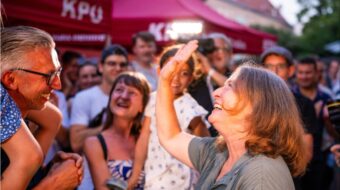
While in Cyprus, I visited a fan day held by Omonoia FC where fans from around Nicosia gathered at the stadium for an evening of comradery and celebration of their favorite team. Kids chased each other between vendor stalls, and the smell of grilled kebab drafted through the outdoor event space. Several vendors and sponsors had tables set up, hoping to entice visitors into spending money.
However, nestled between these booths was a group of young adults representing the club’s fan group: Semper Fidelis 48. The phrase translates to “always faithful” in English and is an accurate description. The group is the main fan base of Omonoia FC. When drums need beating and chants need leading on match day, they are the group to do it.
Despite the fans’ loyalty to their team, the split of 2018 was not something that was easy to stomach for them. Sophia, a Semper Fidelis 48 member, explained to me: “We faced our biggest nightmare, not only as Omonoia fans, but as Communists. If you look from the outside, there’s a corporate Omonoia and a people’s Omonoia.”
She wasn’t lying. From surface level research, it can appear that Omonoia FC is nothing more than a corporate sellout and that anyone with a heart would pack up and go with Omonoia 29M. Still, the split to form Omonoia 29M was in her opinion the wrong decision. To her, breaking up the Omonoia fan base only made them weaker in their united goal of bringing club ownership back to the football team. Now two separate strategies were being used against the owners. Whatever solution Omonoia FC or Omonoia 29M felt was best, their ability to see it through was now suddenly diluted.
While there is disagreement over what is the best path forward for Omonoia, the two sides both share a feeling of heartbreak and loss. Fans of Omonoia 29M hanging out at their club’s store in downtown Nicosia communicated their feelings on the subject to me. “The soul of Omonoia is in Omonoia 29M,” according to the supporters of the breakaway team. They differed from Omonoia FC fans on which team to support, but across the board a feeling of tragedy lingered in the hearts of all those who had grown up supporting the green and white of Nicosia.

Choosing which team to support is especially hard within the club model that exists in Cyprus, as well as many other European countries. In Cyprus, football clubs are sewn into local culture in a way that is foreign and different from American franchise sports. Teams have club houses that serve as bars, gathering spots, and even after school care sites for children.
As soccer blog Breaking the Lines writes, “Soccer is more than just 90 minutes of players chasing a ball on a grassy field. It’s a powerful unifying force that transcends differences, creating a sense of community and belonging.”
Unlike in the U.S., where fans will go to games once a week and return to a life outside of sports, in Cyprus clubs are a part of life that holds value to the supporters. Clubs have presidents who are democratically elected and play a significant role in shaping a team’s future. Compare that to the United States, where if you don’t like your team’s ownership there is not much you can do about it.
For all these reasons, the split of Omonoia left no one satisfied following the sale. Fans either lost their childhood team to stay true to their moral values, or they stayed faithful to their original team but lost the grassroots organization that drew them in the first place.
The path forward is not certain for either team. While Omonoia 29M fans have stated they would hold a vote to rejoin AC Omonoia if the club was bought back, there is no sign of that happening any time soon. Omonoia FC continues to play in the first division and draws in thousands of supporters for every match. Omonoia 29M, meanwhile, now playing in the second division, holds on to its die-hard supporters and aims to compete among the top levels of Cypriot football.
The Cypriot soccer league survived a split in 1948. Now with two Omonoia teams, the two fan bases face the challenge of surviving a second storm. In the end, no matter how many trophies come or successful seasons there are for either team, the only real winner at the moment is capitalism.
CONTRIBUTOR