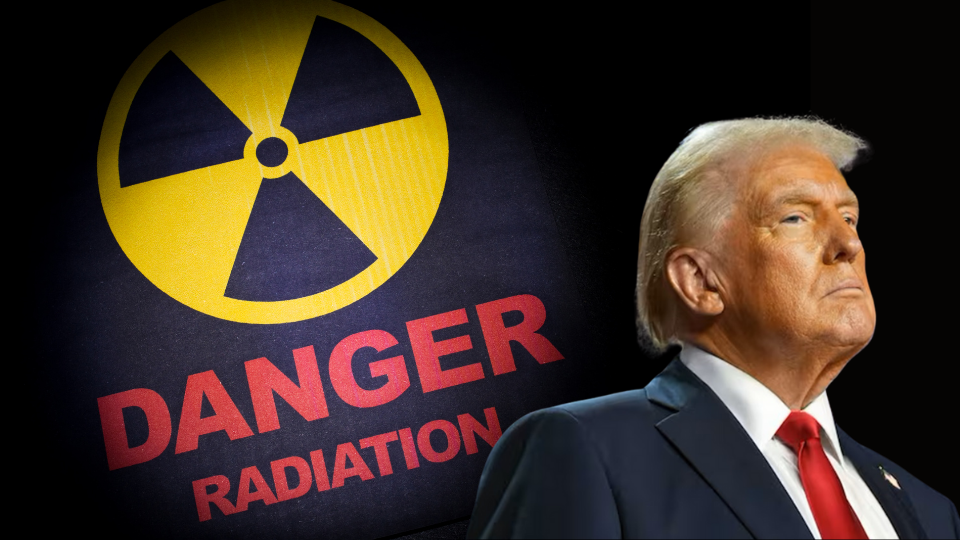
In May, President Donald Trump issued a series of executive orders that, in part, require the US Nuclear Regulatory Commission (NRC) to consider dramatically weakening its radiation protection standard. If federal radiation limits are gutted in the manner urged by the president, the new standard could allow four out of five people exposed over a 70-year lifetime to develop a cancer they would not otherwise get.
Contesting the scientific consensus
Section 5(b) of the executive order—formally titled “Ordering the Reform of the Nuclear Regulatory Commission”—directs the NRC to issue a proposed “wholesale revision of its regulations and guidance documents,” including reconsideration of the agency’s “reliance on the linear no-threshold (LNT) model for radiation exposure.” The LNT model maintains that risk from radiation exposure is proportional to the dose: Even a tiny amount of radiation causes some small but real increased risk of cancer, and that risk goes up linearly as the dose increases.
While most Americans have doubtless never heard of the LNT model, it has been the bedrock of radiation exposure risk analysis for decades and forms the basis of public health protection from radiation. The LNT model is scientifically robust, supported by the longstanding and repeatedly affirmed determinations on low-dose radiation by the National Academies of Sciences, Engineering, and Medicine, virtually all international scientific bodies, the Environmental Protection Agency (EPA), and the NRC itself.
Despite the LNT model’s long track record and the well-established body of scientific evidence upon which it is built, President Trump has unilaterally issued a presidential finding that this scientific consensus is wrong. His order could lead to LNT’s complete abandonment in a matter of months, posing a serious increase in the amount of radiation that industries and government agencies would be allowed to inflict upon the public.
If the NRC goes along with Trump’s assertion, the weakening of radiation protection standards would likely be extreme. Advocates of abandoning LNT have often asserted that low-dose radiation is harmless or even beneficial, and therefore, that the public health radiation limits should be hugely increased. In 2015, three petitions for rulemaking to the NRC proposed doing away with the LNT model and increasing allowable radiation exposures for everyone—including children and pregnant women—to 10 rem. (The Roentgen equivalent man (rem) is a unit of effective absorbed radiation in human tissue, equivalent to one roentgen of X-rays. One rem is equal to 0.01 Sievert in the international system of units.)
One petition to the NRC went so far as to ask, “Why deprive the public of the benefits of low-dose radiation?” The NRC strongly rejected the petitions in 2021, citing the conclusions of numerous scientific bodies that “[c]onvincing evidence has not yet demonstrated the existence of a threshold.”
Low-level, or “low-dose,” radiation is generally defined as a dose range of 10 rem and below. However, “low dose” is something of a misnomer, as 10 rem is still relatively high. Even when doses are low, they nonetheless cause substantial harm when spread across a large population over time, especially for sensitive groups like children.
Raising radiation exposure limits
If President Trump’s executive order results in a new public radiation exposure limit of around 10 rem—the level LNT opponents often advocate—the increased health risks would be extraordinary. Longstanding radiation protection limits for members of the public are in the range of 10 to 100 millirem (0.01 to 0.1 rem) per year. A 10-rem limit would increase allowed exposures to radiation by factors of 100 to 1000—and so would increase the risk of cancer.
A single chest X-ray is about 2 millirem (0.002 rem) of radiation exposure. An annual limit of 10 rem would correspond to a person receiving a dose equivalent to 5,000 chest X-rays each year, from conception to death. Current official radiation risk estimates—adopted by EPA from the National Academies’ BEIR VII study on the health risks from exposure to low levels of ionizing radiation—indicate that receiving 10 rem per year over a 70-year lifetime would result in about four out of every five people exposed getting a cancer they would not get otherwise.
Despite what opponents of the LNT model claim, there is no threshold at 10 rem below which there is no measurable health harm. A substantial body of scientific work has demonstrated significant negative health impacts well below 10 rem. Beginning in the 1950s, pioneering Oxford researcher Alice Stewart demonstrated that a single fetal X-ray with a dose of 200 millirem (0.2 rem) was associated with a measurable increase in the risk of that child dying of cancer. The radiation establishment fought Stewart’s findings vigorously, but her research has long since been vindicated.
More recently, a major study covering an international cohort of over 300,000 nuclear facility workers has found that annual doses well below 1 rem create measurable increases in the risk of developing a variety of cancers, and that, as NRC put it, “even tiny doses slightly boost the risk of leukemia.” A second massive study of nearly one million European children found that those who received a CT scan, at an average dose of 800 millirem (0.8 rem), suffered a measurable increase in their risk of getting cancer.
Standards already weak
Radiation protection standards should be tightened, not weakened. The US government has a long history of underestimating radiation risks. The more scientists have learned about low-dose radiation, the more their estimates of the risk per unit dose have tended to increase. Yet the NRC has not updated in step with the science.
The NRC protection limit for workers of 5 rem per year was set in the early 1960s and has not changed since, despite decades of increasing official estimates of radiation risk. The current best estimate, from the National Academies’ BEIR VII, indicates that one out of every five workers receiving the NRC’s allowable dose each year from ages 18 to 65 would develop a cancer.
NRC’s radiation exposure limits for the public have not been updated in 35 years. Despite a requirement to employ EPA’s more conservative radiation risk standards, the NRC has long ignored it and instead continues to use 100 millirem per year—100 times lower than what Trump’s executive order could lead to. Current risk figures from the National Academies and the EPA indicate that 70 years of exposure at that level would result in nearly one in 100 people getting cancer from that exposure. That is 100 to 10,000 times higher than the EPA’s acceptable risk range. As the former director of EPA’s Office of Radiation and Indoor Air said years ago, “To put it bluntly, radiation should not be treated as a privileged pollutant. You and I should not be exposed to higher risks from radiation sites than we should be from sites which had contained any other environmental pollutant.”
The NRC held a webinar in July to gather public feedback on implementing President Trump’s executive order on abolishing the LNT model. Many presenters—including representatives from the National Council on Radiation Protection and the Union of Concerned Scientists—gave a vigorous defense of the LNT model, as did many of the comments from the public. Yet the NRC, despite itself having strongly reaffirmed this standard only 4 years ago, seemed to minimize low-dose radiation risks and suggested that all radiation cancer risk models be treated equally (including the long-discredited view that low-dose radiation has health benefits). More concerning, the NRC has put its thumb on the scale, giving special treatment to LNT opposition by posting among the general meeting materials a link to one presenter’s paper, which suggests that an annual dose of 10 rem is acceptably safe.
At a time when radiation protection should be strengthened, President Trump has directed action to weaken it markedly. If the NRC implements the executive order, the potential outcome would be a new, deeply flawed radiation standard as much as a thousand times weaker than the current standard, resulting in a massive increase in radiation-related health hazards across the American population.
The article was originally published on The Bulletin.
We hope you appreciated this article. At People’s World, we believe news and information should be free and accessible to all, but we need your help. Our journalism is free of corporate influence and paywalls because we are totally reader-supported. Only you, our readers and supporters, make this possible. If you enjoy reading People’s World and the stories we bring you, please support our work by donating or becoming a monthly sustainer today. Thank you!
CONTRIBUTOR