
The 2022 adaptation of Kindred as a TV series (streamed on Hulu) introduced a new generation to the most famous novel by Afrofuturist icon Octavia Butler. With an estimated one million copies in print, Kindred remains Butler’s most successful and critically acclaimed novel. While it holds a special place among the various genres of fiction it touches—such as speculative fiction, neo-slave narratives, and Black literature—it deserves to be ranked alongside the greatest U.S. novels of the late 20th century, including Morrison’s Beloved, Walker’s The Color Purple, McCarthy’s Blood Meridian, DeLillo’s White Noise, and Banks’ Affliction. It is an allegorical novel that teaches as much about our modern world as it does about the history of slavery and white supremacy.
A new, stirring biography by scholar Susana M. Morris, titled Positive Obsession, explores the personal journals of the renowned novelist and offers an intimate look at her struggles for recognition, her working style, and her views on American political and social realities. Positive Obsession is organized primarily around the significant writing chunks that coincide with different stages of Butler’s life and career. Each chapter combines research into Butler’s journals, non-fiction writings, and interviews to develop a picture of her life surrounding the writing and publication of her major works, usually treated by series.
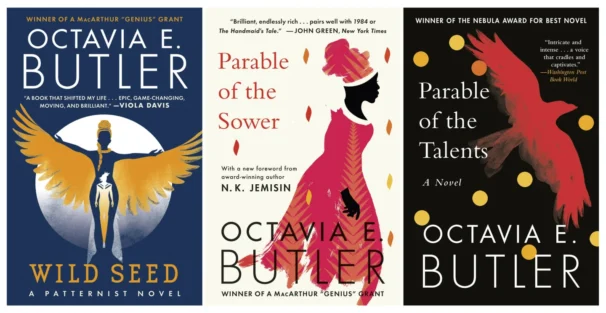
For example, chapter one leads up to and contextualizes Butler’s publication of her first science fiction series, the Patternist, which includes her first three novels, Patternmaster (1976), Mind of My Mind (1977), and Survivor (1978). Two additional books—Wild Seed and Clay’s Ark—were added to it in the early 1980s. Contextualizing this body of work, Morris shares details about Butler’s upbringing in Pasadena, California; her desire and dedication to becoming a professional writer; her struggles with formal education; her neurodivergent mind and social awkwardness; and other personal background details that were vital to her development as a major literary figure.
In this opening section, we learn that Butler became obsessed with science fiction and writing as a child after watching a B-movie titled Devil Girl from Mars and deciding she could write a better story. Despite her family’s advice to stick to realistic ideas about jobs and roles available to Black women, Butler discovered as a child that the stories she devoured were written by people—and that Black people, too, wrote such stories. And, as Morris writes, Butler resolved that despite the odds against a Black woman from a working-class background, she would be one of those people who wrote stories for a living.
Butler completed a two-year degree at Pasadena City College in 1968, but her non-normative learning and work styles didn’t fit the usual path to educational success, and she gave up on completing a bachelor’s degree in the early 1980s. Morris follows these biographical details with a reading of the Patternist series’s significant themes and plotlines. She concludes that this early group of science fiction stories “invites readers to meditate on the politics of the American empire and internalized white supremacy,” themes that persisted in Butler’s fiction over the subsequent thirty years of her life.
The second chapter concentrates entirely on Butler’s life around her writing and the publication of Kindred in 1979. Kindred was one of her two stand-alone novels, and she had started developing its characters and storylines in the late 1960s. Butler was chosen to attend the Clarion writers’ workshop in Pittsburgh, which she traveled to 2400 miles by Greyhound, despite limited funds. The workshop was led by the renowned science fiction author Harlan Ellison and included Samuel Delany as one of the instructors. Delany would eventually become a lifelong friend, but Ellison confirmed for Butler that her careful work ethic—constant research, daily writing, and keen human observation—was essential to her success. In the 1960s and 1970s, Butler held various factory, custodial, and service jobs to support her writing.
A small advance for the manuscript of Survivor in 1977 funded Butler’s trip to Baltimore to conduct research for Kindred, which was to be set on the Eastern shore of the Chesapeake Bay in Maryland. Again, she climbed aboard a Greyhound for the journey. She stayed in cheap hotels in Baltimore and budgeted for one meal per day. She toured Mt. Vernon, George Washington’s home and plantation, and based Kindred’s Weylin plantation on it. She visited local libraries and historical societies, and studied antebellum architecture, furniture, the landscape, clothing styles, and everyday utensils and tools. She also studied people—their habits, interactions, and social cues. Back in L.A., she read several major historical accounts of slavery and the cultures of enslaved Black people. As she wrote the manuscript, Butler experimented with different characters, plot lines, and chronologies before settling on the final version. She often used caffeine pills to stay awake while pulling a shift at a factory or a hospital, then set up in her tiny apartment office to write, revise, or do more research before snatching a few hours of sleep.
The success of Kindred opened new doors for Butler. She was invited to speak at science fiction conventions, and by the early 1980s, she had more financial stability. Chapters 3 and 4 document Butler’s work in the 1980s, including finishing the Patternist series and taking on the Xenogenesis trilogy, comprising Dawn (1987), Adulthood Rites (1988), and Imago (1989). Morris’s biography locates Butler within the political turmoil of the Reagan era. Butler correctly believed that Reagan sought to roll back the Civil Rights victories, gut public education funding, entrench the U.S. in permanent military conflict with most of the world, and pursue economic policies that would worsen the environmental and climate crises. Butler believed that science fiction could illuminate these social problems and move readers to conscious action.
Butler’s stories, Morris reveals, were never escapist, even when the plots suggested a need for escape. In her view, flight was a literary device to emphasize the need for political struggle to change current realities, preserve threatened lives, or reset the conditions of our existence—all of which Butler believed were on the verge of tipping toward apocalypse. Butler’s premonitions seem to be proving true as new scientific data suggest we have entered a “new reality” and face “potentially irreversible climate tipping points” caused by modern human activities and regrettable decisions by the most powerful classes to deny those realities. The Xenogenesis trilogy grappled with the existential questions of what it means to be human, what human nature is, and how humans can evolve out of their patterns of exploitation and oppression toward something more egalitarian and communitarian. The 1980s saw Butler receive major science fiction awards, undertake extensive world travel (including a 1982 visit to the Soviet Union), and solidify her reputation as a major American writer.
The fifth chapter takes the reader into the 1990s and Butler’s work on the critically acclaimed Parable series. The Parable of the Sower (1993) and The Parable of the Talents (1998)—set in 2024 and in the 2030s—are stories that most directly express Butler’s anti-fascist and anti-racist politics. Morris documents Butler’s affiliation and adherence to Black feminist thought as developed in the 1970s and 1980s, as well as her occasional positive affirmation of socialism as humanity’s most advanced political system, but it is anti-fascism and anti-racism combined with deep concerns about growing economic inequality and climate change that are dominant themes of the Parable novels. Morris also reveals that teaching those novels in her own classes, beginning with the first Trump administration, led many of her students to view Butler as a prophet. In 1995, Butler became the first science fiction writer ever to win the MacArthur “genius” grant, finally stabilizing her financial situation. Releasing the Parables series with a smaller publisher also meant the publisher was devoted to the book’s success, and Butler was able to travel to nearly every major city in the country to promote the books.
While three more novels in the Parable series were in the works, Butler struggled with writer’s block and worsening health conditions in the early 2000s, leading to much less productivity in her final years. Butler kept writing, researching, and journaling during those last years, believing that relentless work and a “positive obsession” with her stories were the foundation of creativity. She completed her twelfth and final novel, Fledgling, in 2005.
Instead of seeking “inspiration,” Butler advised aspiring writers that a steadfast commitment to daily work—researching, observing, writing, and revising—is essential for success. Butler’s early passing in 2006 shocked the literary world and left many of her projects unfinished. Morris notes that Butler “was a barrier-breaking writer whose fiction and essays revealed a sharp mind honed by rigorous introspection and research, one whose striking prose challenged readers to question what they knew about the past, present, and future.” She mastered clear, straightforward sentences through which a realistic world unfolded. While apocalyptic themes—the end times and world-destroying events—featured in her stories, the second meaning of that word—from the ancient Greek, to uncover or reveal truth—was also central to her writing.
Positive Obsession tells a powerful story of Butler as what Morris calls “an individual genius,” but a genius who refused to see herself as different from the mass of Black people with whom she said she shared this quality. Butler told one interviewer, “I will not permit anyone to say that I am the exception—different from other blacks…I am the daughter of a maid and a bootblack, the descendant of slaves. I climb upon the bones of those who survived hell.” In our present time of emergency, and despite hypocritical attempts by fascists to ban Butler’s novels, our world is better with her stories in it.
Positive Obsession: The Life and Times of Octavia Butler
Susana M. Morris
New York: HarperCollins, 2025
We hope you appreciated this article. At People’s World, we believe news and information should be free and accessible to all, but we need your help. Our journalism is free of corporate influence and paywalls because we are totally reader-supported. Only you, our readers and supporters, make this possible. If you enjoy reading People’s World and the stories we bring you, please support our work by donating or becoming a monthly sustainer today. Thank you!
CONTRIBUTOR