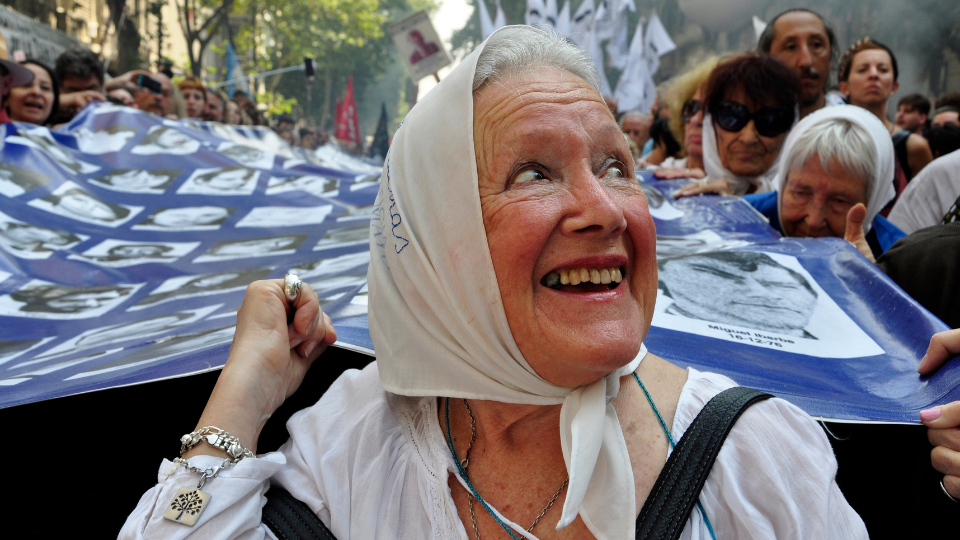
The documentary Norita is both an emotional gut-punch and a soothing hug of inspiration and hope. And that makes sense, given that the film’s central focus is a small spitfire of a woman who gave a murderous dictatorship hell by never backing down in the fight to find her son and stood in solidarity and love with her fellow mothers in their journey for justice.
Nora Morales de Cortiñas’s story is a strong and bright thread in the layered, colorful tapestry of a crucial historical era in Argentina. It is also a story all too relevant to the world’s current battle to resist fascism and the destruction of democracy. The film is a deep reflection, a warning, and ultimately a call to action.
Directed by Jayson McNamara and Andrea Carbonatto Tortonese, Norita tells the story of Cortiñas, a renowned figure in the human rights and women’s movements in Argentina. For over 45 years, she, along with other women, has been on the front lines battling for democracy.
The film takes a deeper dive into her life as she transitions from being a sheltered housewife in the early 1970s to an influential member of the Mothers of Plaza de Mayo who demonstrated daily to find the whereabouts of their loved ones who were disappeared under the military dictatorship led by President Jorge Rafael Videla from the mid-1970s to 1983.
The film aims to connect Cortiñas’s life to the larger movement she was part of while also telling her extraordinary personal story.
Between 1974 and 1976, a military dictatorship solidified power in Argentina, taking over the state and mounting a repressive campaign to silence any opposition or forces they saw as a threat—a process that was repeated by military governments across South America during this time as part of a U.S.-funded campaign known as “Operation Condor.”
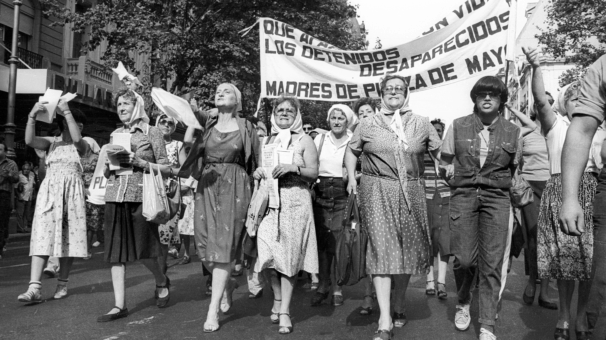
Calling their local edition the “National Reorganization Process,” Argentina’s military under Videla carried out a systematic plan of state terrorism, which included murders, kidnappings, torture, and the forced disappearances of over 30,000 people. Those targeted often included union workers, journalists, young political activists, students, and eventually the mothers of those initially disappeared who dared to demand answers and accountability.
This is where Nora’s story begins, as her world as a sheltered housewife was forever changed when her son, political activist Gustavo Cortiñas, was disappeared on his way to work. Nora, who had once cautioned her eldest son against participating in demonstrations against the Videla regime, soon found herself in the streets with other mothers who had been politicized by tragedy.
The documentary does a fine job of connecting the past to the present. Two battles are showcased during the film. The first is Cortiñas’s early political life, when she was part of the formation of the Mothers of Plaza de Mayo back in the 1970s. The second is her participation in the campaign to legalize abortion in Argentina from 2018 onward. It is through this lens that we are able to witness how lives were changed by the dictatorship and how they continue to evolve amidst the fight for justice in the present day.
Nora’s long effort to put murdering military leaders in jail inspired the growing new women’s movement in 2018, which are also fighting against the church and the patriarchal state—in this case to decriminalize abortion. Nora and her fellow Mothers of the Plaza are seen as “godmothers” of the new generation of activists.
Norita blends archival footage, present-day interviews, and expressive animation to tell Cortiñas story. This visual storytelling, coupled with the already gripping tale, keeps viewers engaged throughout the film. There are many emotional moments, and no doubt, audience members will feel a similar rage as the Mothers when learning of the atrocities of the former military dictatorship. The documentary allows for a more intimate exploration of this time in history from the perspective of someone who lived it, making it new for both those familiar with it and those who are not.
Argentina was the first country to put a former dictatorial government on trial in a large-scale post-WWII proceeding before a civilian court. The Trial of the Juntas, which began in 1985, prosecuted the military leaders, including former President Videla, for crimes against humanity—and got results. Although it took over a decade to sentence those who committed mass murder against the citizens of Argentina, a large part of the credit for making the trials possible goes to Nora and the Mothers of the Plaza.
Norita shows how their grouping was formed in the face of the atrocities of the military regime but proved strong enough, even in the face of threats and murder, to outlast it. The documentary details how Cortiñas and her peers did not stop when the regime gave up power in 1983 but rather continued the fight to hold those formerly in power accountable. The film emphasizes that true change and civil action are shaped in both the courtrooms and the streets, where people demonstrate their collectivity. 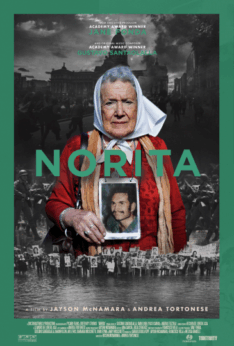
This understanding is why Norita is not only a film to watch to understand the past but also one that puts in perspective the reality we as a society face today. As the current White House administration continues to make unilateral decisions uprooting longstanding practices of democracy, many in the United States are facing similar emotions found in Norita—feelings of rage and fear. Just like in 1970s Argentina, people—often undocumented working people—are being disappeared off the streets of the United States.
At a recent screening of the film held at the Museum of Tolerance in Los Angeles, Jane Fonda—a Hollywood icon with a long history of activism who also executive-produced the film—introduced Norita, explaining the importance of Nora’s story. In her emotional speech, Fonda noted that audiences are watching the film during a time of instability, “ICE tears families apart, most of the democratic guardrails in this country are being taken away…. We never thought this would happen here [in the U.S.], but it’s happening. And we have to be brave—like Nora.”
The Hollywood activist went on to note, in referring to President Donald Trump, that an “authoritarian clique” has assumed power in the country. “They’ve broken through very fast. Faster than has ever happened in any industrialized democracy in the world…. We have to resist now.”
There are even connections to draw between what’s happening in the U.S. and Argentina’s current political battles, with the rise of far-right President Javier Milei and his Libertad Avanza party, which pushes social conservatism and the slashing and privatizing of many public assistance programs in the country. Trump recently played a crucial role in Milei and his party solidifying power in Argentina’s midterm elections by dangling a $20 billion bailout in front of voters there.
Audiences will view Nora Morales de Cortiñas’s historic moments as we live through our own, and hopefully, the story will resonate and inspire them as well. It’s a powerful film with strong themes of resistance and resilience. It showcases how the personal is political, as Nora’s role as a mother did not exist in a vacuum amid the socio-political upheaval she endured during the 1970s. It’s a documentary that should be on anyone’s list of essential viewing.
Those interested in where they can watch Norita can visit NoritaFilm.com for more information.
We hope you appreciated this article. At People’s World, we believe news and information should be free and accessible to all, but we need your help. Our journalism is free of corporate influence and paywalls because we are totally reader-supported. Only you, our readers and supporters, make this possible. If you enjoy reading People’s World and the stories we bring you, please support our work by donating or becoming a monthly sustainer today. Thank you!
CONTRIBUTOR