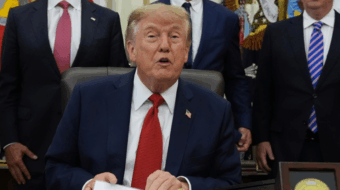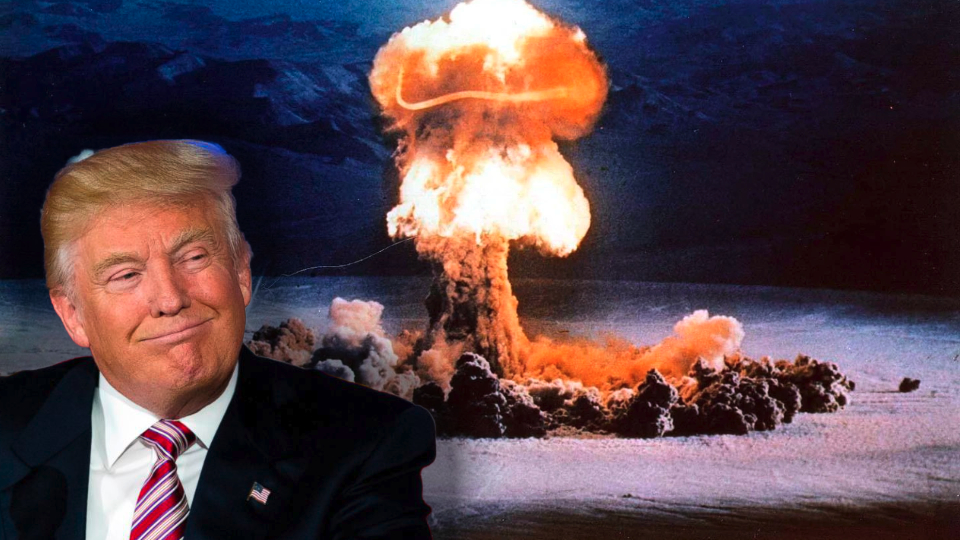
Shortly before he met with Chinese President Xi Jinping on Oct. 29, Donald Trump took to social media to post an announcement both profoundly concerning for worldwide efforts to end the existential menace of nuclear weapons and marked by inaccuracies about the current status of nuclear weapons testing.
Posting on his social media account, Truth Social, Trump declared that “Because of other countries’ testing programs, I have instructed the Department of War (sic) to start testing our Nuclear Weapons on an equal basis. That process will begin immediately.”
The post came at a tense time in international negotiations on nuclear weapons control and disarmament.
New START, the last remaining nuclear arms agreement between the U.S. and Russia, is set to expire in less than 100 days, but no talks have yet begun for a new agreement between the nations holding by far the world’s largest nuclear arsenals. And the next Review Conference for the 1970 nuclear Nonproliferation Treaty is set to open at United Nations headquarters in New York City in late April 2026.
Meanwhile, support for the UN Treaty on the Prohibition of Nuclear Weapons, launched in 2017, continues to grow, with 95 nations signing on and 75 of them ratifying the agreement.
Among the inaccuracies in Trump’s post:
- Explosive nuclear weapons tests are conducted by the Department of Energy and the National Nuclear Security Administration, not the Defense Department.
- The only country to conduct explosive nuclear weapons tests since the early 1990s has been North Korea. The other countries possessing nuclear weapons have all adhered to the 1996 Comprehensive Test Ban Treaty, although that treaty has not formally entered into force.
- In the meantime, the United States and the other nuclear powers have tested delivery systems, not warheads.
Responses from nuclear disarmament advocates were immediate and outspoken.
In a statement released Oct. 30, Arms Control Association Executive Director Daryl Kimball declared, “Trump appears to be misinformed and out of touch. The U.S. has no technical, military, or political reason to resume nuclear explosive testing for the first time since 1992, when a bipartisan majority of the U.S. Congress mandated a nuclear test moratorium.”
He said nearly all nations in the world, including the five largest nuclear weapons powers, have signed the Comprehensive Test Ban Treaty, and having signed the treaty, the U.S. is legally obligated to respect it.
Kimball added, “Trump’s nuclear policy is incoherent and unclear: calling for denuclearization talks one day; threatening nuclear tests the next. But what is clear: U.S. resumption of nuclear testing, or reckless words and actions that trigger a nuclear testing chain reaction, harm U.S. security.”
Physicians for Social Responsibility and International Physicians for the Prevention of Nuclear War said in a joint statement: “As physicians and health professionals, we condemn any and all nuclear weapons testing and destabilizing posturing. Regardless of intent, President Trump’s statement is a dangerous escalation that threatens global security and undermines decades of disarmament efforts, including the 1970 Nuclear Nonproliferation Treaty.”
The two organizations urged the president “to maintain the U.S. moratorium on nuclear testing and to open negotiations with Russia, China, and the other nuclear-armed states on steps to reduce the threat of nuclear war, leading to their elimination and joining the Treaty on the Prohibition of Nuclear Weapons.”
Scott Yundt, executive director of Tri-Valley Communities Against a Radioactive Environment (Tri-Valley CAREs), which watchdogs Lawrence Livermore National Laboratory—one of two sites developing all bombs and warheads in the U.S. nuclear arsenal—said in an Oct. 31 blog post that making “a vague but possibly monumental nuclear weapons policy announcement on social media, thereby dodging any questions or further clarification, leaves the American public, our allies, and our adversaries in a dangerously frustrating haze that lends itself to worst-case-scenario speculation.”
Yundt said the U.S. Air Force and Navy currently conduct tests of U.S. delivery systems, as do both Russia and China. He also noted that the Heritage Foundation and other right-wing think tanks oppose the Comprehensive Test Ban Treaty and are calling for immediate readiness to resume explosive nuclear weapons tests at the Nevada National Security Site.
Yundt highlighted the Renewing Efforts to Suspend Testing and Reinforce Arms Control Initiative Now (RESTRAIN) Act, introduced in Congress by U.S. Rep. Dina Titus, D-Nev., on Oct. 30, which would prohibit the U.S. from conducting explosive tests of nuclear weapons.
Unfold Zero, a platform for United Nations-focused initiatives and actions to achieve a nuclear weapons-free world, called attention to another piece of legislation, the No Nuclear Testing Act, introduced on Oct. 30 by Sen. Ed Markey, D-Mass., who is co-president of Parliamentarians for Nuclear Nonproliferation and Disarmament, a non-partisan forum for parliamentarians nationally and internationally to work together on nuclear nonproliferation and disarmament issues.
The No Nuclear Testing Act would bar use of any funds appropriated or authorized by Congress to fund restarting nuclear weapons testing.
If Trump were to resume U.S. nuclear weapons tests, Markey said in a statement, “it will be a mistake of radioactive proportions … This is a reckless directive from Trump that will only make the country and the world less safe and lead to a terrible new arms race.”
Back from the Brink, a grassroots coalition of individuals, organizations, and elected officials working for a world free of nuclear weapons, called restarting explosive nuclear weapons tests “a very dangerous, unnecessary, and horrible idea,” and predicted that if the U.S. conducts such tests, other countries would probably follow suit, making all the world’s people less safe and increasing the likelihood of a global nuclear arms race.
The coalition urged supporters to call on their representatives and senators to co-sponsor H. Res. 317 and S. Res. 323, two closely related resolutions whose introduction Back from the Brink supported, outlining comprehensive policies to pursue nuclear disarmament and prevent nuclear war.
H. Res. 317 was introduced in the U.S. House of Representatives in April by Reps. Jim McGovern, D-Mass., and Jill Tokuda, D-Hawaii, and currently has 37 co-sponsors. S. Res. 323 was introduced in the U.S. Senate in July by Sen. Ed Markey, D-Mass., with four co-sponsors.
We hope you appreciated this article. At People’s World, we believe news and information should be free and accessible to all, but we need your help. Our journalism is free of corporate influence and paywalls because we are totally reader-supported. Only you, our readers and supporters, make this possible. If you enjoy reading People’s World and the stories we bring you, please support our work by donating or becoming a monthly sustainer today
CONTRIBUTOR