On July 4, 2025, Republican Rep. Mark Green of Tennessee announced his resignation from Congress. He said that he was honored to have served the state of Tennessee for the past six years and that his supporters should not be worried since he will be moving on to do “something specifically designed to help America compete against the CCP [Chinese Communist Party], but this time in business.”
Although many of his colleagues had known that he was pitching ideas of a new mystery business venture to colleagues while still a member of Congress, others felt his resignation had more to due with his extramarital activities, after a conflict which saw him leave his wife of 35 years for “a younger woman.”
While in Congress, Green’s record was defined by a number of malicious bills, such as the District of Columbia Federal Immigration Compliance Act, a bill passed by the House in June to “prevent D.C. from limiting its cooperation with federal immigration enforcement.” Another one under Green’s name is the National Defense Authorization Act for Fiscal Year 2026, which would increase military funding for the purpose of “various items, including aircraft, ships, and missiles” and repeal “various statutory provisions related to diversity, equity, and inclusion” within the Pentagon.
And back in March, only four months before his resignation, Green introduced a new measure, titled H. Res. 205, which is denounces what it calls “human trafficking and forced labor of and profiteering from Cuban medical personnel serving in third-world countries.” It’s a propagandistic provocation that has since been used to spread hyperbolic lies about the Cuban government and conflates a national policy of medical internationalism with forced trafficking.
What is H. Res. 205?
Green’s five-page resolution accuses the Cuban government of “trafficking” the country’s doctors as a way to exploit their involuntary labor and steal their earnings.
The resolution alleges that the Cuban government “failed to address trafficking crimes despite an increasing number of allegations from survivors, credible nongovernmental organizations, international organizations, and foreign governments.” It accuses Cuban officials of “facilitating serious human rights abuses and forced labor” in supposed violation of “international human trafficking and forced labor treaties and protocols.”
The idea that Cuban doctors would voluntarily travel the world to help developing countries has always been viewed as an impossibility by many within the U.S. government. This is due to willful ignorance, both in relation to Cuba’s history of medical internationalism and its socialist system.
For Cuba, ever since its 1959 revolution, medical care has carried a dual role. First, access to it is viewed as a universal right, a free right for all human beings. Secondly, focusing beyond its shores, Cubans have seen provision of health services as an expression of solidarity to other peoples of the world. Medical care is not viewed as simply a commodity to be bought and sold as it is in the United States but rather as a reflection of care for the people.
This concept extends to the care of Cuba’s own population. For example, in terms of infant mortality rates, Cuba scores higher than the U.S., even when accounting for ongoing limitations of crucial medical supplies due to the U.S.’ economic blockade. In the U.S., the average infant mortality rate in 2017 was 5.8 deaths per 1,000, compared to 4.0 in Cuba. The gap increases even further when one accounts for specific populations in the U.S. that face higher mortality due to a racist U.S. medical system, most notable of course among Black infants.

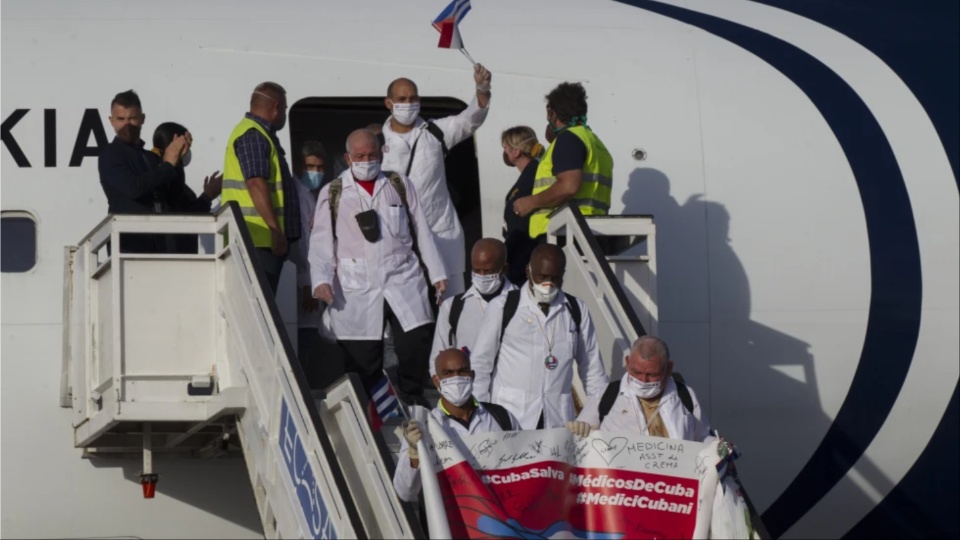
Secondly, Cuba has a long history of medical internationalism—from medical brigades sent abroad to the training of doctors from other nations at schools in Cuba. One of the country’s most well-known institutions for the purpose is the Latin American School of Medicine (ELAM), founded in 1999. Many of its students come from low-income backgrounds and don’t have the funds needed to study in their home country.
To date, over 31,200 students from 122 countries have graduated from the institution. Graduates go back to their home countries after completing their studies and serve the most vulnerable populations. The late Cuban leader Fidel Castro, who conceived of ELAM and with Rev. Lucius Walker of the U.S., said the graduates of the school are “more than doctors;” he called them “apostles and creators of a more humane world.”
The U.S. government claims these doctors perform their service out of coercion and not from any personal drive to help or a desire to be part of a historic project of medical solidarity. ELAM students return to their homelands and benefit the most vulnerable by using the information they learn in Cuba, but the U.S. claims this is a case of Cuba “trafficking doctors.”
Accusations against the Mais Médicos Brasil program
Green’s H. Res. 205 takes these accusations further, declaring anyone involved in medical internationalism to be guilty and deserving of punishment by the U.S government.
His measure would grant President Trump the power to revoke the U.S. visas of “officials who have participated in Cuba’s human trafficking schemes,” including not just Cubans but Brazilian, Honduran, Mexican, and Pan American Health Organization officials as well.
 H. Res. 205 specifically references the Mais Médicos para o Brasil program, which was re-introduced on March 20, 2023, and brought around 28,000 Cuban medical professionals to Brazil to provide care mainly in areas of extreme poverty. It saw 96 million Brazilian people gain access to primary care.
When volunteering for the program, Cuban physicians are explicitly informed of the services Mais Médicos provides and the benefits they would receive if they choose to serve. The latter include “maternity leave, paternity leave, retention incentives, program participation time, and an offer of education, Specialization, Master’s degree or Betterment.” The commitment is for a four-year cycle, with possible extension and bonus grants.
In the retelling of the U.S. government, instead of providing medical care and vaccines to millions, Mais Medicos was directly involved in human trafficking in collaboration with the Cuban government. Under Green’s resolution, the U.S. president would revoke visas from individuals who provide healthcare to the most vulnerable individuals in Brazil.
False accusations
The U.S. State Department’s 2024 trafficking report and H. Res. 205 are filled with countless other unfounded accusations against the Cuban government.
The State Department alleged Cuban doctors serving abroad are abused and tormented while working. “Many Cuban medical personnel,” the report stated, “claim they work long hours without rest and face substandard and dangerous working and living conditions in some countries, including a lack of hygienic conditions and privacy, and are forced to falsify medical records.” It even alleges that many Cuban medical professionals reported being “sexually abused by their supervisors.”
There are plenty of allegations, but little evidence.
The U.S. government adds further charges of trafficking against Cuba beyond the overseas medical missions, saying the government in Havana “profited from other similarly coercive labor export programs.” It lists professional baseball players and coaches, teachers, artists, musicians, architects, engineers, forestry technicians, construction workers, nearly 7,000 sea mariners, and all other government-affiliated workers as being “vulnerable to forced labor and coercive, fraudulent practices by the Cuban government.”
In the view of the U.S. State Department, it seems almost any Cuban with a job is a victim of trafficking and must be saved.
Internationalism, not coercion
History has shown the world that the exact opposite is true, that Cuba’s doctors have committed their time and energy to showing the world what international medical solidarity looks like.
Cases of successful medical brigades include Guatemala where “Cuban health professionals have been present…for the last 17 years.” Or in Angola, where 160 Cuban doctors and nurses worked 2010 and 2011 involved in various sectors such as primary health, hospitals, and pharmacies. Then, when a hurricane disaster hit Haiti in 2011, Cuban volunteers quickly volunteered as a brigade to help. In fact, when Hurricane Katrina struck New Orleans in 2005, Cuba offered to send its doctors to assist and provide lifesaving medical care to the thousands injured. President George W. Bush refused Castro’s offer of help.
Even inside its State Department reports, the U.S. government admits the scale of Cuba’s contribution to medical care around the world. In “2024 Trafficking in Persons Report: Cuba,” the State Department lists all the nations its doctors have worked:
“There were roughly 22,000 workers in more than 53 countries by the end of 2023. Over the last five years, the labor export program operated or currently operates in Algeria, Andorra, Angola, Antigua and Barbuda, Argentina, The Bahamas, Bahrain, Barbados, Belize, Botswana, Burkina Faso, Cabo Verde, Chad, People’s Republic of China, Djibouti, Dominica, Dominican Republic, Equatorial Guinea, Eritrea, Eswatini, Ethiopia, France, Gabon, The Gambia, Ghana, Grenada, Guatemala, Guinea, Guinea Bissau, Guyana, Haiti, Honduras, Italy, Jamaica, Kenya, Kuwait, Lesotho, Liberia, Maldives, Mauritania, Mexico, Mozambique, Namibia, Niger, Nicaragua, Palau, Panama, Peru, Portugal, Qatar, Saint Kitts and Nevis, Saint Lucia, , Saint Vincent and the Grenadines, Sao Tome and Principe, Saudi Arabia, Seychelles, Sierra Leone, South Africa, Spain, Suriname, Tanzania, Timor-Leste, Togo, Trinidad and Tobago, Türkiye, Uganda, United Arab Emirates, United Kingdom, Uruguay, Venezuela, Vietnam, and Zimbabwe.”
To the government in Washington, any act of international cooperation is deemed a threat to the hegemony of U.S. imperialism. It therefore claims that Cuban medical workers are being forced to give away their labor—further proof, supposedly, that all Cubans live under an authoritarian regime and would benefit from intervention by the U.S. to overthrow it.
For the U.S. citizen, it is difficult to imagine a system where doctors volunteer their time for the wellbeing of others. Our capitalist health system positions quality medical care as a luxury which only some citizens are afforded. Nearly 100 million Americans carry some form of medical debt, a collective balance of $220 billion dollars. This is in stark contrast to the socialist model of medical care, which presents health as a universal right that cannot be privatized.
The final paragraph of Green’s H. Res. 205 lists a series of requirements the Cuban government would have to follow to show it is complying with anti-trafficking measures, including allowing “an independent international commission to monitor the government-sponsored labor export program.”
Instead of worrying about an independent review of Cuban government-sponsored labor programs, the U.S. should be paying attention to various studies showing the amount of money Cuba loses due to the U.S. blockade, which is estimated to be $4.8 billion per year. Or perhaps it could turn its to the number of lives lost due to shortages of medical supplies forbidden from entering the country by the blockade.
When one starts to look at some of these effects, it becomes clear that the enemy of humanity is neither the Cuban government nor the Cuban doctors who bring care to people around the world but rather U.S. imperialist policy.
As with all op-eds published by People’s World, the views reflected here are those of the author.
We hope you appreciated this article. At People’s World, we believe news and information should be free and accessible to all, but we need your help. Our journalism is free of corporate influence and paywalls because we are totally reader-supported. Only you, our readers and supporters, make this possible. If you enjoy reading People’s World and the stories we bring you, please support our work by donating or becoming a monthly sustainer today. Thank you!
CONTRIBUTOR