As the dust of the recently concluded mayoral election settles in New York’s political consciousness, a new dawn begins.
It is now confirmed that 34-year-old Zohran Kwame Mamdani is the mayor-elect of New York City. Mamdani, a self-identified socialist, is a member of both the Democratic Party and the Democratic Socialists of America.
His victory demonstrates that market-led bourgeois politics can be challenged and defeated by working people united around a clear, progressive political agenda.
New York is one of the richest cities in the world, yet one in four of its residents lives in poverty. The costs of housing, rent, childcare, transport, food, and other essentials have become unaffordable for a dignified, basic life.
In this wealthy city, more than 500,000 children go to bed hungry each night. In response to such acute crisis, Mamdani offers a politics of hope in the hopeless world of racialized capitalism in U.S.
Mamdani’s campaign promised to freeze rents, reduce the cost of childcare, double the minimum wage, provide free public transport, and increase corporate tax rates. He also pledged to establish city-owned grocery stores, expand mental health services, and promote community safety across New York.
These progressive policies are not radical enough for a total transformation, to be sure, but the policies are a necessary response to the times and essential for the survival and dignity of working people in New York.
Communist trailblazers
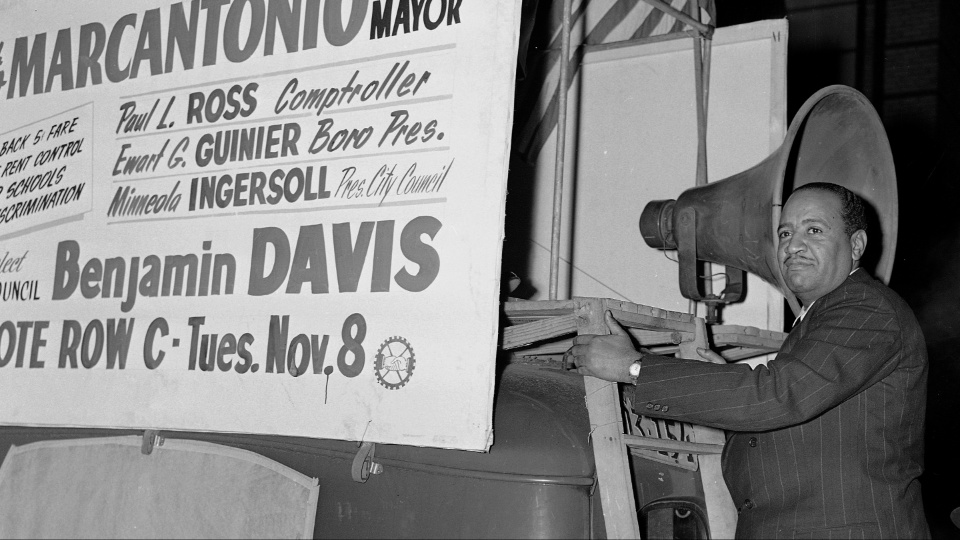
In many ways, Mamdani’s victory is the inheritor of historic struggles and mass mobilizations led by Black people in the city under the leadership of the Communist Party (CPUSA).
During the post-WWI Depression years, trade unions, Works Progress Administration workers, the Workers Alliance, tenants’ unions, legal defense organizations, and cultural groups—under the leadership of the Communist Party USA—from 1921 to 1939 mobilized the working masses and communities around demands similar to those Mamdani is raising today.
Major Black organizations such as the National Association for the Advancement of Colored People (NAACP), the Urban League, Garveyites, and other Black and civil rights groups led by Communists played a significant role in shaping progressive politics and proposing alternative policy platforms to confront racialized capitalism in the city.
Black Communists in Harlem, in particular, were instrumental in developing the progressive political traditions and policy ideas reflected in Mamdani’s platform today.
Rampant racism and economic depression created fertile ground for the growth of radical and progressive politics led by the Communist Party in Harlem.
Mark Naison, in his book Communists in Harlem During the Depression (University of Illinois Press, 1983), documents in detail the contributions of these activists and movements.
The Communists were among the founders and principal organizers of the Harlem Renaissance, which gave rise to powerful cultural, political, and intellectual movements led by African-American communities.
These movements flourished across art, cinema, dance, fashion, film, music, literature, theater, culture, and radical scholarship—laying the progressive foundations of New York City at a time when both Democratic and Republican leaders were more concerned with protecting their shared interests in systems of exploitation and racial inequality.
This pattern of political collaboration continues to resonate today—for instance, when Republican President Donald Trump expressed support for former Democratic Governor Andrew Cuomo during the recent mayoral election in New York.
The Harlem legacy
Mamdani’s victory, achieved despite fierce opposition from the billionaire class, stands as a testament to the enduring legacy of the Harlem Renaissance. He inherits its emancipatory politics, progressive agenda, and ideals of justice and equality that continue to inspire the city’s working people.

Mamdani’s victory mirrors the heroic and historic 1968 struggle against Columbia University, when the Black United Front in Harlem, the Students’ Afro-American Society, and the Students for a Democratic Society confronted both Columbia University and the city’s political and economic establishment.
They rose up against racist gentrification driven by the ruling-class slumlords—and the people of Harlem and Morningside Heights ultimately won that struggle. Harlem’s Communists not only led successful local movements but also played a vital role in internationalist peace campaigns, standing in solidarity with Vietnam and opposing imperialist wars.
The Black men, women, and tenants of Harlem and Morningside Heights have long served as the moral compass of New York City’s politics, shaping the struggles of working people and paving the way for victories like Mamdani’s.
Even a brief look into the city’s recent past reveals the deep and continuing influence of Communists and socialist organizers in shaping mass struggles against landlords, real estate mafias, and the capitalist class—both within New York and beyond.
Underground revolutionaries, Communists, Civil Rights leaders, and socialist activists have kept the city’s progressive foundations alive through decades of resistance.
Defending the Mamdani win against reactionaries
However, reactionary forces in all their forms have already begun attacking Mamdani. The path forward will be difficult, but only the persistence of working-class struggles and ideological battles can secure the lasting gains of this political victory.
For progressives, though, his victory represents a celebration of working-class politics and a triumph born of decades of struggle. Yet history offers a clear warning about the limits of compromise and the dangers of the collaborative politics long practiced by both Democrats and Republicans—at the national level and within New York City itself.
Both corporate Democrats and Republicans have continued to uphold the dreams of billionaires by crushing the dreams, desires, needs of lives, liberties, and livelihoods of working people in the city and beyond.
The future of Mamdani’s politics, leadership, organization, campaign, and movement will depend on his ability to carry forward the progressive and radical legacies of the Communists, socialists, and Civil Rights heroes that shaped the city’s political consciousness. His challenge is to make their emancipatory agendas relevant to the people of New York today.
This is an edited version of an article which originally appeared in Morning Star.
We hope you appreciated this article. At People’s World, we believe news and information should be free and accessible to all, but we need your help. Our journalism is free of corporate influence and paywalls because we are totally reader-supported. Only you, our readers and supporters, make this possible. If you enjoy reading People’s World and the stories we bring you, please support our work by donating or becoming a monthly sustainer today.
CONTRIBUTOR