

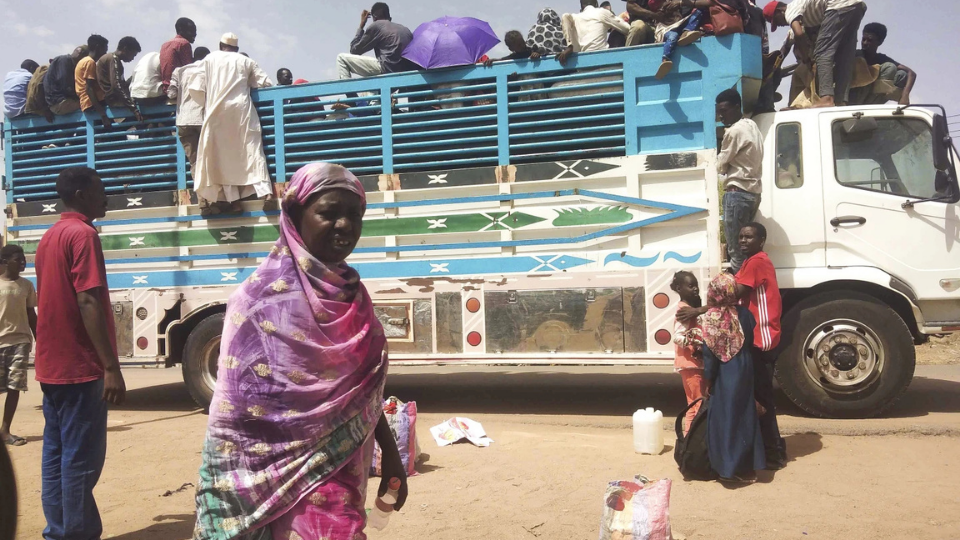
The current Sudanese war began on April 15, 2023. The forces of the RSF (Rapid Support Forces), led by Mohamed Hamdan Dagalo (also known as Hamedti), split from the Sudanese Armed Forces, led by Abdul Fattah al-Burhan. The RSF also leads the broader Janjaweed coalition. The war between the two factions has caused widespread misery and death.
AFRICOM Watch #50 reported the following:
“In December of 2022, it seemed that negotiations for a two-year transition to civilian leadership in Sudan were in the process. By April of 2023, fighting between the Sudanese Armed Forces (SAF) and Rapid Support Forces (RSF) began. According to the UN, over 12,000 women, men, and children have reportedly been killed in Sudan, and about 7.4 million have been displaced.”
The war rages on, and as of this date, according to Al-Jazeera, the number of displaced persons has risen to 11 million. According to the People’s Daily, the figures of displacement are even higher. The Chinese newspaper reports that in “Sudan, relentless fighting has uprooted 12 million people—nearly a quarter of the population—leaving two-thirds dependent on a cripplingly underfunded aid system.”
The U.S. intervention, according to the U.S. diplomatic corps, was designed to bring about stabilization and harmony between the two forces. If anything, it has done exactly the opposite. The war is one of the most horrific that has been seen in a decade. It has involved rape, murder, and wanton killing designed to annihilate the other forces because of tribal affiliation.
Recently, during the fighting for the strategic town of Al Fasher, the RSF killed an estimated 70 individuals who were attending worship at the local mosque. The RSF has continued its struggle to assault the town in an effort to prevent the SAF from taking full control of one of the last towns it dominates in Western Darfur, a region controlled by RSF forces.
Many have died during this conflict, and the numbers have yet to be accurately tabulated. Atrocities and killings have been committed by both sides. The greatest tragedy of the war is the loss of lives among the civilian population.
The UN has reported at least 3,384 civilian deaths in the first half of 2025. Seventy percent of the casualties occurred during active hostilities. Many of these deaths occurred because of UXOs (unexploded ordnance), or unexploded bombs and artillery, that are a threat to civilians who, because of a lack of military training, often mistake them for harmless objects. Especially at risk are the children of Sudan, who are often at great risk of injury or death because of their mistaken use of UXOs as toys.
The question that arises is: Why is this war so ignored by the media in the United States? Why does it continue in the face of the human depravities on both sides? Why did the U.S. fail to step in and demand a workable solution for both sides? The answer is simply the desire for expensive minerals and gold.
According to several news sources, between 50% and 80% of the nation’s gold is smuggled out of the country. Even with that, Sudan is still one of Africa’s largest producers of the precious metal. But gold is not the only mineral in Sudan. It possesses enormous amounts of petroleum and natural gas. The U.S. Energy Information Administration (EIA) reported that as of early 2024, Sudan and South Sudan collectively held an estimated five billion barrels of proven crude oil reserves.
However, there is even more wealth under the soil of the war-torn country. Large deposits of iron ore have been found in the Red Sea Hills, River Nile State, and in South Kordofan. Over two billion tons of low-grade iron ore have been discovered in the Wadi Halfa and Baljrawih areas. However, that is not all; the Ingessana Hills contain chromium, phosphate, nickel, zinc, lead, aluminum, and cobalt. Finally, uranium has also been found there, making it one of the wealthiest countries in the world in terms of mineral wealth.
The war is about wealth. The war is about neocolonialism. The war is about the future of the inhabitants of the Sudan. This material wealth belongs to them. The real problem is the knowledge of the causes of the war. People do not understand the history of Sudan. They see Black people—African people—struggling to survive in a civil war they believe is motivated by leaders of low morals.
What they do not see is the enormous influence of corporate and capitalist wealth being used in Sudan. The U.S. and Britain, and other corporate states have connived to steal this nation’s wealth. This wealth has been in Sudan for a long time.
Dialectics is a philosophical methodology that searches for truth by examining contradictions and relationships between things, objects, and ideas. One of the main problems with the issue of Sudan is the stark reality of its situation. Most of the problems stem from the nation’s history, including its colonial and neocolonial past.
The history and the exploitation of the people and resources must be brought to light. This can only be done with the exposure of over 100 years of British and U.S. imperialism.
The only way to break through the negligence of the U.S. news media is a study of the history of Africa, in general, and the historical racial, political, and economic exploitation of the Sudanese people, in particular.
One African Scholar, Salome Ayuak, Information Secretary of the South Sudanese Acholi of the North American Association, stated:
“Understanding the current war requires a deeper grasp of Sudanese history beyond humanitarian statistics, which many people do not have the inclination to explore in this era of quick information. To truly comprehend the present moment, studying the history of Sudan is necessary, rather than relying solely on social media graphics that conveniently appear on our feeds. This is especially crucial considering the lack of access to the internet and telecommunication tools in Sudan, making it challenging, if not impossible, for everyday people to document the war for the Western audience.”
This is why the responsibility to bring the truth about Sudan and the goings-on in Africa as a whole falls to historians and journalists.
RELATED STORY:
Foreign imperialism and domestic divisions collide to create catastrophe in Sudan
As with all op-eds published by People’s World, the views reflected here are those of the author.
We hope you appreciated this article. At People’s World, we believe news and information should be free and accessible to all, but we need your help. Our journalism is free of corporate influence and paywalls because we are totally reader-supported. Only you, our readers and supporters, make this possible. If you enjoy reading People’s World and the stories we bring you, please support our work by donating or becoming a monthly sustainer today.
CONTRIBUTOR
MOST POPULAR TODAY
As Iran war rages, Netanyahu builds ‘Greater Israel’ from Palestinian and Lebanese land

The other ‘lizard people’: Why the Epstein files are shattering global theory

Trump’s Postmaster General says USPS may shut down in a year

Rooted Resistance: Sustaining Detroit’s movements through education and revolutionary optimism