CHICAGO—The 2025 election has been over for less than two weeks, but the 2026 political campaign for the midterm elections is already underway in earnest.
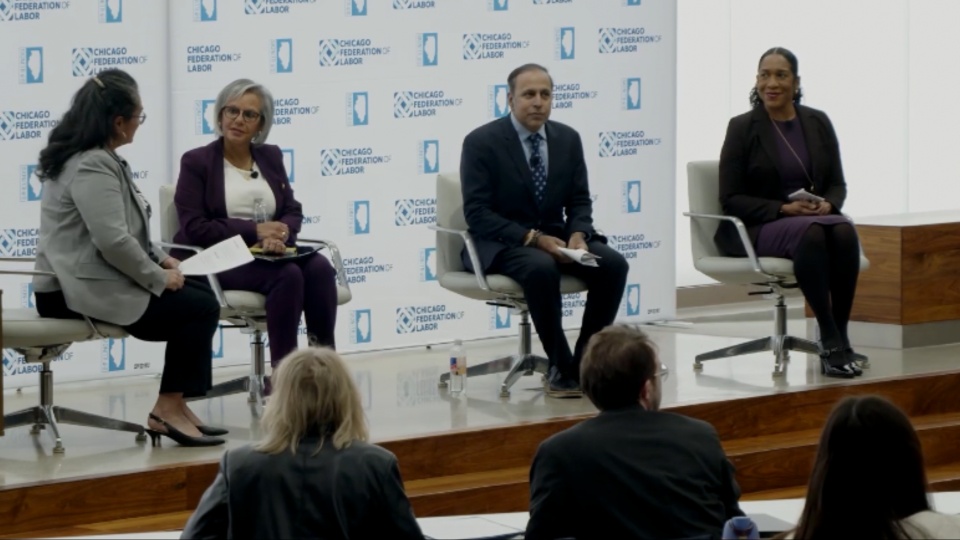
Don’t believe us? Well, welcome to Chicago, where three top Democratic hopefuls for an open U.S. Senate seat spoke Nov. 13 in a candidates’ debate—the first of what will be many such events over the next 12 months nationwide. This one was before a crowd of city unionists in the Electrical Workers hall on South State Street.
The event was hosted by the Illinois AFL-CIO and the Chicago Federation of Labor.
Unlike other such debates, especially late in campaigns, which turn mean, this one between Democratic Reps. Raja Krishnamoorthi and Robin Kelly and Lt. Gov. Juliana Stratton was relatively low-key. Workers’ issues were much of the discussion, but not all. The primary is March 17, 2026.
Krishnamoorthi, Kelly, and Stratton are vying for the party’s nomination next year to succeed longtime Democratic Sen. Dick Durbin. The senatorial seat is the marquee race in Illinois in what will be a busy and tumultuous year. Gov. J.B. Pritzker (D) is favored to coast to another term, but he’s the exception.
Four of the 17 U.S. representatives are leaving, including Kelly and Krishnamoorthi, setting off mad scrambles for open seats. The state legislature may try to redistrict extreme downstate MAGA Republican Mary Miller out of her chair. Seeking the U.S. Senate seat, Stratton’s leaving her job, too.
Each hopeful tried to play to his or her strengths.
Stratton, who is 60, portrayed herself as a fighter ready to take on the regime of President Donald Trump. She’s for Medicare For All, and she doesn’t take corporate campaign contributions, while the other two do, she said. That truth seemed to irk Kelly.
“Health care is being taken away, food is being used as a weapon” by Trump, said Stratton. “Collective bargaining rights are taken away,” again by Trump. “We need a fighter in the U.S. Senate, and I will be that—and I will take Illinois’s successes to Washington.”
Stratton also reminded the crowd she worked hard statewide in 2022 for a successful labor cause: Enshrining the right to organize in the state constitution while outlawing right-to-work laws.
Krishnamoorthi, 52, stressed his immigrant roots and played up to what he believes unionists, especially male factory workers, want to hear: Criticism of supposedly unfair trade by China, which he alleged amounts to “dumping products on the American market.” He said ten union locals, including five from the Letter Carriers, endorsed him already.
He also took a swing, again, at former Postmaster General Louis DeJoy, a corporate executive whom Trump installed, with an ostensible mission—unsuccessful—to privatize the U.S. Postal Service.
Kelly, 69, emphasized that in 12 years in Congress, she’s made deals across the aisle, as she’s been in the minority for eight of them. And she shot back against Stratton that she can’t be bought by campaign contributions. “I’m no cheap date,” Kelly declared. Both Krishnamoorthi and Kelly have 100% AFL-CIO voting records. “I’ll be no different in the Senate,” Kelly promised. She added, “You can’t just fight. You have to have things to show for it.”
Facts gathered by OpenSecrets.org say otherwise about campaign finance. Some 65% of the $1.89 million Kelly raised for her 2023-24 congressional race cycle came from campaign finance committees, called PACs. Building trades unions were a distant third, with $72,500, in Kelly’s PAC list, behind health care PACs and drug firm PACs. The labor donations are all voluntary.
Krishnamoorthi raised $10.78 million in the last election cycle, with 10.75% from PACs. No unions were in his top five. But 71% of his cash came from individual big donors, led by $333,943 from partners and other lawyers at the top-tier Chicago law firm of Kirkland and Ellis.
Some issues were ducked—such as the federal shutdown and the role of eight Senate Democrats who gave the GOP key votes for its bill to reopen the full government through Jan. 30. Durbin was one of the eight.
Those votes ended a Democratic drive to restore billions of dollars in GOP health care cuts from Medicaid and the Affordable Care Act. The GOP law also will drive private insurance premiums way up.
All three touted their pro-worker credentials, supporting the Protect the Right to Organize (PRO) Act, labor’s top legislative priority. It’s going nowhere in the current GOP-run Congress.
“I don’t want a system where the president, through an executive order, can strip people of their protections” they get from collective bargaining, Krishnamoorthi said. That’s what Trump did to 1.5 million federal workers before his now-ended 43-day partial federal shutdown.
All three pushed campaign finance reform, saying special interest money drowns out workers’ voices. “I’ve seen good people who don’t run, good people who don’t win, and good people who win but don’t stay in, because they don’t like dialing for dollars,” said Kelly.
“I’m running on a platform of people over profits,” claimed Kelly, whose district is dominated by Chicago’s South Side but stretches all the way downstate to Danville. “Too many of our people are suffering unequal access to health care.”
Stratton said she entered politics, and is for Medicare for All—a top cause of National Nurses United, which is strong in Chicago—because a former right-wing governor, Republican Bruce Rauner, tried to cut Medicare statewide. It would have harmed her mother, then in a nursing home suffering from Alzheimer’s disease. Stratton’s own state lawmaker was a Rauner supporter. She beat that incumbent.
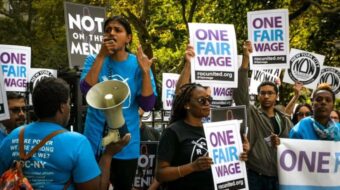
One other issue drew agreement—raising the minimum wage. “I don’t want to just raise the minimum wage” to $15 an hour, said Krishnamoorthi. “I want to index it to inflation.” The other two agreed to the $15 figure. The Illinois minimum wage is $15 an hour and $16.60 hourly in Chicago for firms with at least four workers.
The current federal minimum wage is $7.25, stuck there since 2009. Unsaid: The old slogan of “$15 and a union” is outdated, in dollars. That’s not enough anywhere in the U.S.
We hope you appreciated this article. At People’s World, we believe news and information should be free and accessible to all, but we need your help. Our journalism is free of corporate influence and paywalls because we are totally reader-supported. Only you, our readers and supporters, make this possible. If you enjoy reading People’s World and the stories we bring you, please support our work by donating or becoming a monthly sustainer today. Thank you!
CONTRIBUTOR