The Robin Hood myth, legend, and factual account continues to exert a powerful pull over, especially in these days, our own land, where robbing from the rich and giving to the poor, or even taxing the rich and taking a meager portion of their income, is a major battle.
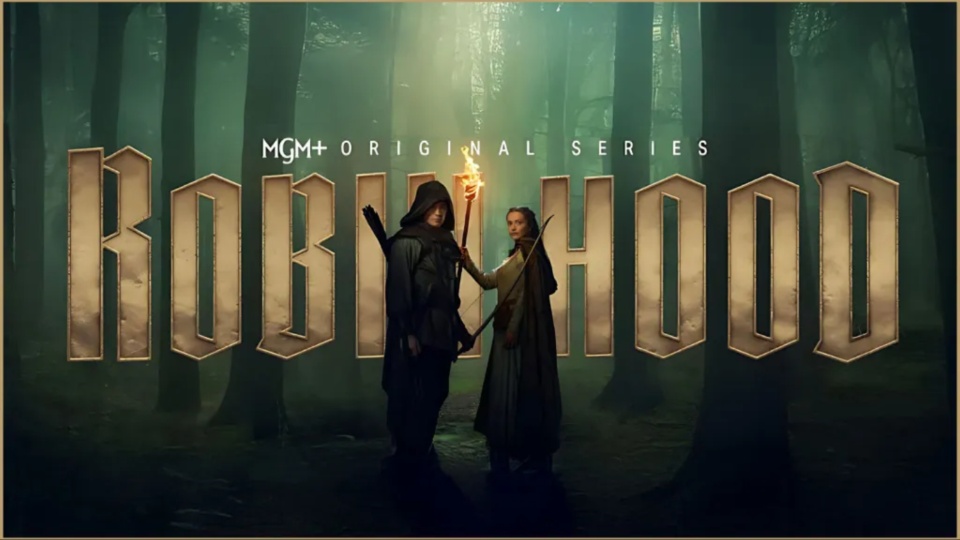
Into this fray comes a contemporary television series, titled simply Robin Hood, produced and streaming on MGM+, the studio recently bought by Amazon.
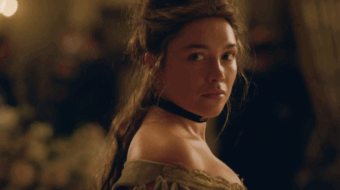
This Robin, full of raucous, savage violence and gratuitous sex, a kind of 300 Robin Hood, dispenses with wealth distribution and instead focuses on a quarrel among elites, Norman Lords versus Saxon Lords, with the young Robin’s father the latter.
The peasantry are almost nowhere to be found and when they do show up in a wedding ceremony they bop around not like weary toilers of the soil but like Hobbits. Sean Bean is along as the well-meaning Sheriff, forced to issue a harsh decree.
This conservative revisionist characterization goes along nicely with the postmodern claim that there is no evil or exploitation, only murky unknowable motives.
The situation figured here unfortunately has an element of accuracy because what we get in most British and American mainstream media is indeed a debate between one group of the wealthy and another, that is, in Britain Labour and Conservatives and in the U.S. Republicans and Democrats, with the actual will of the people almost nowhere in evidence.
We had Errol Flyn’s swashbuckling Robin Hood in the ‘30s, the television series The Adventures of Robin Hood in the 50s, the majority of the episodes written by Hollywood blacklistees, and now we have Jeff Bezos’s Robin Hood, where two CEO’s hammer it out while the rest of us serfs are left to till our digital fields on the AI manor.
But all is not lost in the legend. The television series The Adventures of Robin Hood, all 143 episodes from 1955 to 1959 available for free on YouTube and Dailymotion, was the first hit of the fledgling and more populist ITV network, challenging the BBC’s stodgy elitism and featuring scripts written by groups of casualties of the McCarthy era in New York, Los Angles and on the continent including Hollywood Ten members Ring Lardner Jr. and Adrian Scott.
Robin and his band of guerilla warriors
This Robin Hood comes of age in the wake of both the 1955 Bandung Conference of non-aligned nations seeking their own sovereignty and independence which took place in the year the series originated and the guerilla wars that both proceeded and followed the conference as country after country revolted and won their freedom from the colonial European powers.
The raping of the land and theft of its resources during the colonial period, which after World War II was particularly dominant in India which won its independence in 1947. Just as in the series where the Norman lords were exploiting the Saxon peasants with Robin defining himself as “a Saxon outlaw,” so too the British decimated India in the 19th and 20th centuries.

Real wages declined, prompting famines with this exploitation resulting in 50 million excess deaths in one 30-year period. Britain destroyed a once-vibrant Indian economy and through a system of exorbitant taxes forced the Indians to export food and cotton to the empire even in times of famine in a system of legal plunder and a drain on the country’s wealth.
Likewise, the complaint of many of those in and around Sherwood Forest in multiple episodes is the high taxes the serfs are forced to pay to support the lifestyle of the Norman lords while they are barely able to feed their families.
Similar practices were at work in Indonesia by the Dutch colonizers where the Dutch East India Company moved to colonize vast expanses of Java to produce the new most desired commodities: coffee, tea, tobacco and sugar for the European aristocracy. Every peasant now had to pay one-quarter of their harvest in tax and were charged an ever-increasing price to lease what were once their own lands.
When the Dutch tried to recolonize the country from the Japanese after World War II, the Indonesians waged a fierce four-year guerilla war where the objective was to harass the enemy. In this war, the Dutch held the main roads and the Indonesian Republicans swarmed into the mountains and held the hinterlands.
One of the main antitheses in the series is the contrast in the locations between the sheriff and the lords in their castles and the commoners and outlaws in either their primitive shacks or in the forest. The Indonesians were adept at picking off convoys which ventured into the countryside as Robin’s men often robbed those representatives of the landed gentry who dared to enter the forest.
“The principle of guerrilla warfare” as stated by one of the Indonesian leaders is based on the people: “If the people support you, you will always win.” As Robin states in the episode “A Guest for The Gallows, ‘We’re never alone as long as we have friends among the people.’”
In 1955, with independence secured, and the year the series debuted, the Indonesian president Sukarno convened the Bandung Conference in Java, attended by prominent African, Asian and African-American advocates for overthrowing the system of colonialism. Bandung was described by the African-American writer Richard Wright as “a meeting of the rejected, the despised, the insulted, the hurt, the dispossessed” and by a French observer as une evénement universel, planétaire comparable to the French Revolution, the Russian Revolution, and the Independence of the United States and by another as the first intercontinental conference of colored peoples in the history of mankind!”

Hated and opposed by the American and European rulers such as U.S. Secretary of State John Foster Dulles—who characterized its principles of sovereignty and neutrality as “immoral” and the French officials annoyed that representatives of its colonies in Morocco, Tunisia and Algeria had been invited.
Nevertheless, the spirit of Bandung spread precisely in the years that on British and U.S. television Robin and his merry men battled the Norman colonizers in Sherwood and that the series was a hit in London, in the working-class Midlands, and in the U.S. In this period, many of the British, French, and Belgian colonies won their independence often by waging guerilla wars.
Season 1, Episode 12, “A Guest for The Gallows” begins as does the other episodes in Season 1 and 2 with a minstrel song that in Brechtian fashion, summarizes the episode, a kind of leftist logline. The episode proper then commences with the Sheriff’s tax collectors arriving in his quarters with two boxes loaded with tribute while naming one yeoman behind on his taxes.
The sheriff orders him thrown in the castle tower to be hanged for his negligence. A sympathizer steals off in the night to warn the outlaws.
This is one of many noir touches—Robin’s first appearance in the series is him cloaked in darkness as he scales the walls to enter his own castle. The darkness in these sequences not only alerts the viewer to the fact that these are dark times but also allows the producers to save money by concealing sets. This technique was used to perfection in American b-noirs such as the ’47 Anthony Mann French Revolution period noir The Black Book.
To save the yeoman, Robin disguises himself as a meat merchant who, when asked by a suspicious sheriff where his stock comes from, replies in a materialist manner: “the beef from cattle, the mutton from sheep.” Robin plays on the greed of the sheriff in offering him one hundred cattle if he will come with him into the forest.
Robin then arranges a trade, the sheriff for the man about to be hanged but the sheriff’s men betray the arrangement and attempt to ambush Robin. Friar Tuck and his monks get in the way of the ambush, fulfilling Robin’s dictum about having the backing of the people.
Out of the forest appears Little John and a guerilla band that forces the sheriff and his men to back off. As to his underlings’ treachery the sheriff says, “A word given to an outlaw means nothing,” emphasizing that the colonial Normans can never be trusted to hold up their end of a bargain, as for example the 1945 Indonesian statement of independence was betrayed by the Dutch.
The battle at the end with Robin’s men stresses the technological superiority of the lord’s henchmen who use a deadly manufactured crossbow which just has to be aimed whereas Robin’s men use long bows fashioned from the forest trees which require dexterity rather than just crude power, as the colonizers frequently waged war with the most advanced weapons.
The Adventures of Robin Hood expresses not only the domestic concerns of blacklistees but also a larger more multinational concern with the anticolonial struggles for independence concomitant with this iteration of the legend. Meanwhile, the parallels to current colonial struggles against a rapacious and increasingly more dangerous U.S. empire in Gaza, Venezuela, and the three African countries of the Sahel (Burkina Faso, Niger, Mali) attempting to reclaim economic sovereignty could not be more direct.
We hope you appreciated this article. At People’s World, we believe news and information should be free and accessible to all, but we need your help. Our journalism is free of corporate influence and paywalls because we are totally reader-supported. Only you, our readers and supporters, make this possible. If you enjoy reading People’s World and the stories we bring you, please support our work by donating or becoming a monthly sustainer today. Thank you!
CONTRIBUTOR