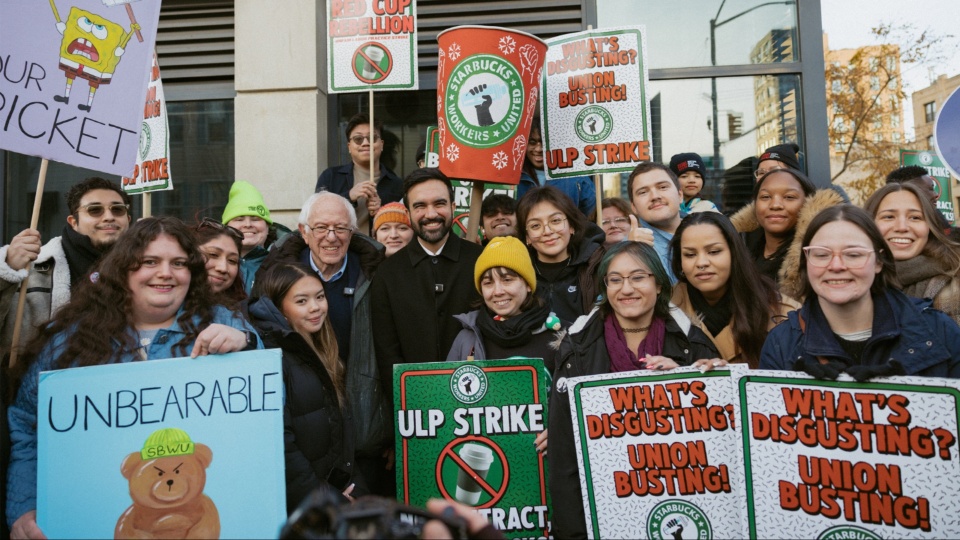
BROOKLYN, N.Y.—Some 12,000 unionized Starbucks workers nationwide, whose “Red Cup Rebellion” walkout has set a new strike record against the giant coffee company, scored key political support while gaining a settlement for $35 million in illegally withheld back pay on the same day, December 1.
But even a penalty that high, plus a concurrent $3.4 million fine, still doesn’t convince Starbucks CEO Brian Nicol, sitting in the anti-union hot seat made infamous by company founder, chief stockholder and labor law-breaker Howard Schultz, to bargain in good faith for a contract with his workers.
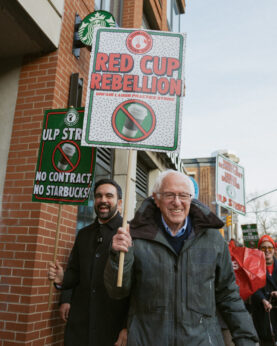
Nor, apparently, did the visible public support by arguably the two most pro-worker straight-shooting politicians in the U.S.: Sen. Bernie Sanders, Ind-Vt., and New York City Mayor-elect Zohran Mamdani. Both marched with striking workers outside a Starbucks store in Brooklyn.
“Starbucks workers across the country are on an Unfair Labor Practices strike, fighting for a fair contract. While workers are on strike, I won’t be buying any Starbucks, and I’m asking you to join us,” Mamdani, a Democratic Socialist, tweeted on X when the strike began two weeks ago on November 13, the company’s “Red Cup Day” to kick off its holiday sales season.
Mamdani also spoke at the Brooklyn rally after picketing. And out in Seattle, Starbucks headquarters, a third Democratic Socialist, Mayor-Elect Katie Wilson, joined Sen. Patty Murray, D-Wash., in backing the Starbucks workers, too.
The workers’ four-year-old grassroots campaign is aided by organizers and legal help from Starbucks Workers United, a Service Employees International Union sector. Workers at approximately 600 Starbucks stores, employing an estimated 12,000 workers, are unionized with SBWU. The first store unionized in Buffalo, N.Y., four years ago.
Like other large hordes of low-wage workers nationwide—retail workers, bar and restaurant workers, adjunct professors, and port truckers among them—the Starbucks workers have had it up to here with their exploitation and repression in the name of corporate greed and profits. With little to lose, since Starbucks is cheap, they’ve walked.
Starbucks workers’ key demands are stable scheduling, higher hourly pay, and enough work hours—at least 20 per worker per week—so they qualify for company benefits, including health care coverage, pensions, and tuition aid.
Through months of talks, which broke off during the summer, the coffee giant has rejected those demands and its counteroffer, for a skimpy pay raise only, got a thumbs-down from the workers in May, a timeline shows. The median pay last year for a Starbucks barista, the AFL-CIO’s Paywatch reported, was $14,371.69.
The median is the point where half the workforce is above and half below. The “half above” includes Niccol, who took over in mid-year and earned $95.801 million on an annual basis, 6,666 times the median barista’s pay.
“These are not demands of greed. These are demands of decency,” Mamdani, who ran on pledges to aid working-class people, said during the rally in Brooklyn. Added Sanders: “Starbucks has refused to sit down and negotiate a fair contract” four years after the first Starbucks stores in Buffalo unionized.
Striking baristas describe a harried workplace with chronic short-staffing, online orders so complex that the ticket is sometimes longer than the coffee cup, and last-minute calls to come in and work, playing havoc with classes, day care, and other responsibilities.
“It is the company’s issue to give us the labor amount to schedule partners fairly, and they are not scheduling us fairly, no matter how much money we are making them,” Bellmore, L.I., shift supervisor Gabriel Pierre—who, despite his title, is an employee and not a boss–told local media.
While Starbucks insists on not paying its workers nationwide, the Big Apple is another matter. The same day as the picketing and rally in Brooklyn, the city’s Department of Consumer and Worker Protection announced Starbucks will pay $3.4 million in civil fines and $35 million for shorting 15,000 workers of back pay and thus violating the city’s Fair Workweek Law.
Starbucks also agreed to obey the law in the future, though a company spokeswoman complained the statute is difficult and complex.
Most of the Big Apple Starbucks workers who get back pay will receive $50 for each week worked from July 2021 to July 2024, the department said. Workers who experienced a workweek law violation since then may file a complaint with the city department for back pay, too.
“I sure hope that it gives Starbucks an awakening,” Kaari Harsila, a Brooklyn store shift supervisor who was walking the picket line, said of the big fine.
Starbucks CEO Niccol, however, may be walking around with his head in a pile of coffee grounds. He refuses to even comment on the strike, much less acknowledge its impact. Instead, he touts his $1 billion “restructuring” plan in the face of declining sales and sour consumer attitudes.
Of the hundreds of stores he’s shut since the revamp began, 14% are unionized—far more than the union’s share of all Starbucks stores.
“It’s time for Brian Niccol and Starbucks executives to stop stalling and cut the excuses,” said veteran barista Michelle Eisen, now a Workers United spokesperson. “We need real solutions that address our basic demands and the hundreds of labor law violations that remain outstanding. The ball is in their court.”
Before the National Labor Relations Board and other federal agencies had to close due to pro-corporate GOP President Donald Trump’s 43-day partial government shutdown, the NLRB cited Starbucks for more than 1,000 instances of unfair labor law practices—the formal name for labor law-breaking—in fighting its workers.
That includes a ULP citation against Starbucks founder Schultz for threatening a pro-union barista in California with firing for speaking up during Schultz’s so-called “listening tour.”
We hope you appreciated this article. At People’s World, we believe news and information should be free and accessible to all, but we need your help. Our journalism is free of corporate influence and paywalls because we are totally reader-supported. Only you, our readers and supporters, make this possible. If you enjoy reading People’s World and the stories we bring you, please support our work by donating or becoming a monthly sustainer today.
CONTRIBUTOR