WASHINGTON—Can right-wing extremist GOP President Donald Trump fire any official at any time for any reason—or none at all—regardless of what the law says? The U.S. Supreme Court’s nine justices, six of them Republican-named, will tackle that issue on December 8.
And if the jurists’ past is precedent, that majority’s answer will be “yes.”
If all this sounds familiar to workers, unions, and their lawyers, it should. It’s how the National Labor Relations Board wound up paralyzed ever since January, unable to rule on worker-boss disputes because it doesn’t have a quorum.
That’s after anti-worker President Trump fired NLRB member Gwynne Wilcox, whose term doesn’t expire until August 2028. She sued to get her job back and won in the lower courts. But Chief Justice John Roberts overruled them with a “temporary” hold on their pro-Wilcox rulings, effectively firing her.
Now, Trump has unilaterally fired Federal Trade Commissioner Rebecca Slaughter, whose term runs to 2029. She’s taken her case to all nine Supreme Court justices. Which is why the AFL-CIO filed a friend-of-the-court brief arguing for restoring Slaughter to her job—and why Wilcox’s attorney wrote a letter to the justices saying, in essence, “Hey, don’t forget about us.”
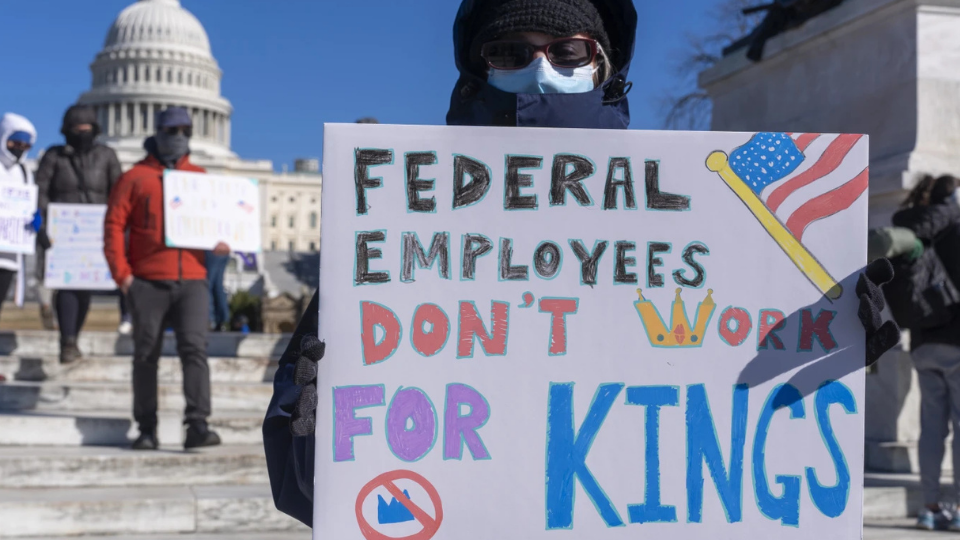
Trump v. Slaughter is important for workers and consumers far beyond the fate of one official. If the justices side with Trump, as they have in most other cases since he returned to the Oval Office, it would represent a triumph of a 25-year-old right-wing legal scheme called “the unitary executive.”
That theory says in essence that any president—Trump in this case—has complete and total and unchallengeable life-and-death power over the future of anyone and everyone in the executive branch of government and total control of their agencies, too.
This would strip the few independent agencies and the causes they rule on, that affect all of us, of any freedom from presidential whims, pressure, and politics.
That’s even though the laws establishing those independent agencies, including the NLRB, two smaller labor agencies, the Federal Trade Commission, and the Consumer Product Safety Commission, specifically stagger top officials’ terms so one president can’t sweep everybody out all at once—and that if the Chief Executive wants to can a commissioner, he can only do it for cause.
Trump fired Slaughter, whose term expires in 2029, for no reason at all. And just weeks after taking office this year, he fired Wilcox, the first female African-American to chair the labor board. In plain English, Trump said Wilcox, a former Service Employees counsel, wasn’t pro-business.
Wilcox’s term expires in August 2028. Her seat is vacant, as is a GOP-held NLRB seat. The five-member board now has just one member. It needs two more to do anything. Trump nominated one.
If a president gets additional sweeping powers, from the same 6-3 Supreme Court majority that ruled last year that Trump, or any president, is immune from criminal prosecution for virtually all official or even semi-official acts, puts a virtual dictator in the White House.
The AFL-CIO, of course, didn’t say so in those terms in its friend-of-the-court brief. But their language points in that direction, citing a 1935 Supreme Court ruling, Humphrey’s Executor, establishing agency independence.
Congress passed, and FDR signed, the National Labor Relations Act the same year—and the AFL-CIO noted lawmakers followed that case when creating the labor board.
“Unions and their members depend on the independence these statutory protections provide to ensure these multi-member labor boards”—the NLRB, the National Mediation Board, and the Federal Labor Relations Authority—”act as impartial fact-finders, adjudicators, and mediators, as Congress—exercising its constitutional power to create and regulate offices—envisioned,” the AFL-CIO said.
The Mediation Board handles union elections and labor-boss disputes in the airline and railroad industries. The Labor Relations Authority does the same thing for running union elections and judging disputes between the federal government and its own workers.
“The AFL-CIO’s interest is not merely theoretical. In the last year, the president has removed tenure-protected members from each agency,” the federation said.
“Congress decided to make the NLRB an independent agency…and to protect its members during their staggered, fixed terms from removal without specified cause,” the federation wrote. “Doing so…was important to assure employers and the public of the impartiality of the new labor tribunal whose members would perform quasi-judicial duties.”
In the 1947 GOP-passed Taft-Hartley Act—the statute which turned labor law into its current obstacle course for workers and unions—Congress separated the NLRB’s “prosecutorial functions, now held exclusively by a [presidentially] removable General Counsel, from its adjudicatory ones now held exclusively by tenure-protected Labor Board members. That law redoubled Congress’s reliance on Humphrey’s Executor,” which made board members, and the board, independent.
The AFL-CIO doesn’t explicitly say the whole structure of labor law would come crashing down if a president—Trump—could exercise total and complete control over it by cashiering NLRB members if they don’t obey his agenda. It does say that public, worker, and employer confidence in the board’s judgments and impartiality would decrease.
And it reminded the justices that before the NLRB was created, the nation went through massive worker suffering, a wave of strikes for union recognition and worker rights—and management’s violence in response.
The AFL-CIO also points out that workers harmed by cowed presidential board appointees would be left out of luck. The NLRB cannot enforce its own decisions, but must rely on the courts to do so if bosses and workers do not comply until an injunction with heavy fines and possible prison terms looms.
And unlike some state laws, including California’s, which let the state labor board step in and enforce labor law where the NLRB is powerless, private citizens can’t sue to enforce the National Labor Relations Act, either.
“By channeling industrial disputes through independent adjudicators, the NLRA helped replace an era of violent labor disputes with one marked overwhelmingly by industrial peace. Employees, unions, and employers all rely on Board members’ independence,” the federation said.
“Only the General Counsel can investigate and prosecute NLRA violations. And only the NLRB has authority, in the first instance,” to rule on them. A tilted NLRB with members a president can trash without warning or cause trashes that authority and credibility, the agency’s brief says.
We hope you appreciated this article. At People’s World, we believe news and information should be free and accessible to all, but we need your help. Our journalism is free of corporate influence and paywalls because we are totally reader-supported. Only you, our readers and supporters, make this possible. If you enjoy reading People’s World and the stories we bring you, please support our work by donating or becoming a monthly sustainer today.
CONTRIBUTOR