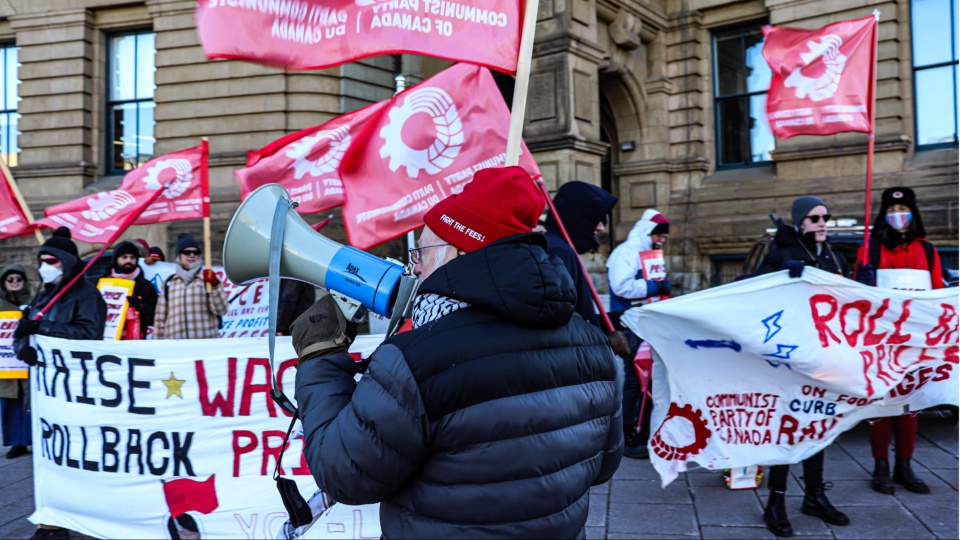
MONTREAL—“This is a city whose history has, to no small degree, been written by Communists,” declared Communist Party of Canada leader Liz Rowley as the 41st Central Convention of the party opened in Montreal, Quebec, on Dec. 5.
It’s the hometown of the famed Dr. Norman Bethune, who first proposed a public healthcare system for Canada and died in China offering his medical expertise to the revolution there. “It’s where the Communist Party of Quebec was founded,” as host committee chair Adrien Welsh said in his welcome greetings.
Montreal was also the scene of one of Canada’s grandest battles against anti-communism in 1937, when journalists at the French-language Clarté newspaper resisted Quebec Premier Maurice Duplessis’ “padlock law,” which sought to outlaw the Communist Party.
And in 1943, at the height of the World War II fight against fascism, the working class here sent Fred Rose, a Communist, to represent them in Parliament. This past weekend, over 80 years later, the Mile End neighborhood in Rose’s old electoral district again welcomed the reds to town.
So, Montreal has clearly earned its Bolshevik bonafides, but the CPC convention there this past weekend wasn’t a session devoted to the study of past history. It was a strategy session focused on the dire and immediate challenges facing the working class in Canada and Quebec.
Canadian capitalism in crisis
Canadian capitalism, dominated by a combination of U.S. and homegrown monopolies, is in crisis, and the post-Trudeau political terrain, as elsewhere, is shifting rapidly to the right.
From auto to steel, aluminum to aerospace, workers in almost every major industry are being deluged with mass layoffs as Donald Trump’s tariff offensive washes over the economy. Farmers, already under pressure from agribusiness giants, now have the U.S. government also trying to destroy their livelihoods by killing off the country’s supply management system.

And the response from the Liberal Party government to all this? Stepped-up military spending and an explosion of natural resource exploitation, over the objections of Indigenous and environmental activists. And all of it is being done in the name of protecting Canadian “sovereignty” and “independence” from the U.S.
“Prime Minister Mark Carney’s ‘elbows up’ against Trump”—a defensive hockey reference, for those outside the icy north not in the know—“have evaporated, along with his spine,” Rowley told delegates in her keynote address.
She said Carney and many provincial politicians have, with the help of the mainstream media, sold the public a nationalistic narrative when it comes to the trade war—a U.S. vs. Canada story. But this “hides the class divide that’s really at work,” Rowley said.
The prime minister is “tearing down interprovincial trade regulations and eliminating supply management” for farm goods—both of which are longstanding demands from U.S. and Canadian corporate monopolies alike.
“Trump wants more access to Canadian markets and resources for U.S. corporations with or without” the U.S.-Canada-Mexico trade agreement, which is up for renegotiation in 2026. Desperate to preserve the position of corporate Canada in its uneven marriage with the U.S. ruling class, Carney is giving the White House occupant much of what he demands.
As the convention’s main political resolution put it: “Big sections of Canadian capital are happy to use the tariff war as a pretext for their agenda, essentially making the working class shoulder the burden of capitalist crisis.”
Workers pay the price
The government’s response to annexationist pressures from the U.S. is “not to advocate any form of sovereignty which would actually advance the interests of working people and oppressed nations” in Canada, according to the resolution, but rather to “fast track the extraction and export of hydrocarbons, minerals, and other resources crucial for the U.S. war machine, in return for guaranteed market access.”
Canadian workers are left paying the price, while their class brethren on the U.S. side of the border also see no benefits from the trade battle. In both countries, job loss and galloping inflation are the only things workers are getting from the tariff war.
Elected on a promise to fight back against Trump, Carney is, of course, taking some initiatives on the jobs front, but according to Rowley, they’re not the kind of employment Canada needs.
“He offers jobs in military production…the drive to militarism and war is at the heart of the most recent federal budget,” she said. “His commitment to meet NATO’s demand that 5% of the budget be spent on the military is indicative of the government’s priorities.”

In the country’s resource-rich west, meanwhile, Carney’s program is premised on pipelines pumping more oil to Pacific Coast ports. Powerful Canadian energy companies are behind the move, Rowley warned: “This initiative flies in the face of Indigenous rights and is tied to preparations for a war economy.”
Canada’s other mainstream parties, she said, offer no alternative and only play the partisan parliamentary game.
“The Conservatives may have opposed the Carney budget in hopes of taking over the government, but they could recognize all their priorities in it,” she said of the main right-wing party. “The separatist Bloc Quebecois lined up with the Conservatives because they compete with Liberals for seats in Quebec.” And the Green Party’s lone member supported Carney’s budget, “showing their comfort with corporate policies.”
As for the severely weakened New Democratic Party, which is tied to the trade unions and was nearly decimated in the last election, Rowley said the NDP is “divided and scrambling to avoid another election, exposing the failures of right-wing social democracy.” She lamented that “no one was fighting for working people in the budget debate.”
The Communist Party puts forward what it calls the “People’s Alternative” as the basis for building a broad working-class-led coalition fightback, centered on public ownership of industry, a rapid transition to renewable energy, withdrawal from the USMCA and NATO, and a turn away from war production.
Several delegates speaking from the floor praised actions by a number of unions as examples of the kind of militancy needed from labor right now.
The union representing Air Canada flight attendants recently went on strike under the slogan “No One Should Work for Free,” a campaign that resonated with the public and demonstrated how the cost-of-living crisis is affecting all workers. Before they went walked off the job, flight attendants were receiving no pay at all for the work they do on the ground before and after takeoff. Their agreement scored gains on that front while also making the company’s CEO look greedy and out-of-touch.
The Air Canada strike, which the government attempted to break with a back-to-work order, put Section 107 of the Canadian Labour Code in the spotlight, a law which gives the state the power to intervene in employer-worker disputes. Those interventions are, unsurprisingly, often “to the benefit of the bosses,” as one convention delegate put it.

The Canadian Union of Postal Workers’ multiple strikes this past year made privatization of public services a central topic of discussion in the country and also helped make the case against Section 107. A delegate from Ontario urged continued solidarity with Canada Post staff, saying their union “has long been one of the most progressive labor bodies in the country.”
Unifor, the main union representing Canadian auto workers, received applause when Rowley mentioned its “pledge to occupy workplaces where plant and production are to be moved out of the country.” She said that all of these cases show what real resistance to the Trump trade war and the attacks by Canadian capital should look like. “The fightback can’t just be reduced to trying to get better severance pay” for laid-off workers.
Renewal and continuity
Alongside tackling the economic battle being fought for Canada’s future and international issues like the blockade on Cuba, the war in Gaza, and the threat of war against Venezuela, delegates also devoted significant time to questions of building and consolidating their party.
The meeting marked a milestone in a multi-year process of generational transition that’s been ongoing for the past few conventions. The most notable development in this regard was the election of Drew Garvie as the new leader of the Communist Party of Canada and a new Central Committee that is a mix of renewal and continuity.
After more than 50 years as a “professional revolutionary” and a decade at the helm, Rowley announced her intention to step back, but as she was quick to tell delegates, she’s not stepping away. She was re-elected to the party’s executive committee and will continue to offer her counsel.
Several of Rowley’s comrades offered remembrances of her time as a Communist militant. Kimball Cariou, retired editor of People’s Voice, told of his first meeting with Rowley in 1972, when she was the youngest parliamentary candidate in all of Canada.
Challenging Marcel Lambert, an “anti-woman asshole” from the Conservative Party, Cariou recalled Rowley using her opponent’s own words against him to convince voters to support the Communist campaign. The battle for abortion access and birth control was raging at the time, and Rowley told a packed hall: “Mr. Lambert says we women should just hold ‘the pill’ between our knees, and then we won’t get pregnant.” The crowd of 500 erupted—with cheers for Rowley and cries of “Shame!” for Lambert. Cariou said, “That’s when I knew this was a leader to follow.”
Rowley went on to serve as a party worker for more than five decades, surviving KKK bombings of her apartment and car at various times, leading the party in Ontario’s industrial heartland for 28 years, and helping save the CPC from liquidation during the crisis of socialism in the early 1990s.
In 2015, party members elected her to serve as the CPC’s first woman leader. Giving her last major speech as leader on Saturday night, Rowley said, “It’s been a long road, but there is no better life.”
Drew Garvie, her successor, is a young man, barely 40, but he already has years of experience as a Communist leader. He’s even got a hometown connection to party history; Guelph, the city where he grew up, is where the CPC was founded back in 1921.

He told People’s World two big developments brought him into the Communist Party. “In the 1990s, when I was in high school, the Mike Harris government in Ontario launched major attacks on public education and so much more.” Garvie said seeing teachers strike and fight for students like him was a major contributor to his politicization.
The other significant event was the chance he got to cut his organizing teeth in the peace movement. “The build-up to the Iraq War dominated that period for me,” he said. “Within a year of those first big demonstrations against the war, I found the Communist Party.” He joined the Young Communist League a short time later and continued in his mass work, being elected to the student union at his university.
In 2014, he was chosen to be General Secretary of the YCL. That work earned him election a short time later as the party’s Central Organizer and eventually as leader of the Communist Party of Ontario, a position he’s held since 2019.
Rowley and the outgoing CPC Central Executive Committee expressed their “absolute confidence” in Garvie and the generation of younger leaders who are stepping up to carry the baton, urging delegates to give them a strong mandate.
Canada’s Communists are going to need that mix of veteran knowledge and youthful vitality if they are to give leadership to the mass movements. As their convention resolution declared, “A period of sharpening class struggle lies ahead.”
There are important struggles erupting across the country on virtually every issue—from foreign policy, trade, the environment, and social policy to defending public services, protecting wages and pensions, women’s and gender equity, and more.
It’s a political moment, the convention delegates concluded in their final resolution, “of either advance by the working class and democratic forces or of retreat, as demanded by corporations and far-right forces.”
Rowley put the issue even more succinctly: “It’s really about socialism or barbarism.” She asked, “Who’s the source of that barbarism? What’s the way out?” Placing the challenge before the CPC membership, she said, “Answering those questions is our job.”
We hope you appreciated this article. At People’s World, we believe news and information should be free and accessible to all, but we need your help. Our journalism is free of corporate influence and paywalls because we are totally reader-supported. Only you, our readers and supporters, make this possible. If you enjoy reading People’s World and the stories we bring you, please support our work by donating or becoming a monthly sustainer today.
CONTRIBUTOR