CHICAGO—With the key Democratic primary in deep-blue Illinois only three months away, on St. Patrick’s Day, politics heated up in what will be a whirlwind year in 2026 in the Prairie State.
The marquee race is for an open U.S. Senate seat, where long-term incumbent Democrat Dick Durbin is retiring. Democratic Gov J.B. Pritzker, who makes the short list of 2028 party White House hopefuls, is expected to coast to a third four-year term in Springfield.
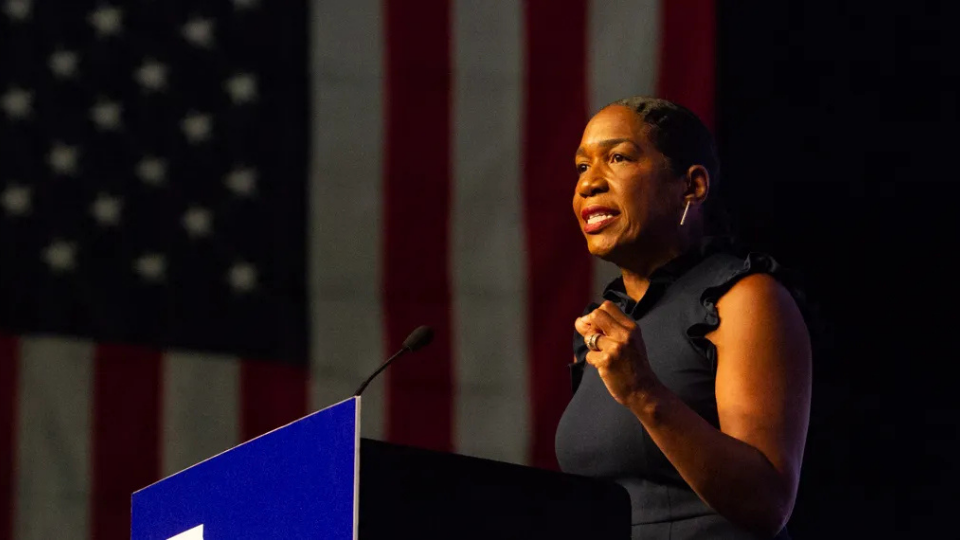
Pritzker’s lieutenant governor, Juliana Stratton, is one of three top-tier contenders for the party nod to succeed Durbin, along with Reps. Robin Kelly and Raja Krishnamoorthi. Pritzker will have to announce a new running mate.
In two candidate sessions—one a debate and the other a Zoom call where each spoke separately—Stratton stood out as the most progressive of the major U.S. Senate hopefuls.
She championed Medicare For All, says raising the federal minimum wage would be one of her top three legislative priorities, and promised to continue to be a tough fighter against tyrannical GOP President Donald Trump.
Stratton also told both debates she refuses to take corporate campaign cash–unlike Kelly and Krishnamoorthi–and touts her statewide campaigning for a labor-backed and successful constitutional amendment inserting the right to organize into the state’s basic charter. The amendment also bans right-to-work (for less) laws, a first nationally.
Democrats Kelly, Krishnamoorthi, and Reps. Danny Davis, Jesus “Chuy” Garcia, and Jan Schakowsky are all leaving the U.S. House, setting off mad scrambles for five of Illinois’ 17 congressional seats. All five are reliably Democratic. The delegation overall is 14-3 Democratic.
The Illinois AFL-CIO decided in December on no endorsement in the Senate contest and four of the House races. The exception was Schakowsky’s district, covering Chicago’s North Shore and northern and northwestern suburbs. The AFL-CIO endorsed Evanston Mayor Daniel Biss.
All of this, plus five lesser-known senatorial hopefuls who appeared at a second panel in the second of two recent candidate forums, makes for a lively joust in the Land of Lincoln.
The state and city AFL-CIO hosted the first forum, a live session in early December at the Electrical Workers (IBEW) hall on South State Street in Chicago. Stratton, Kelly, and Krishnamoorthi spoke and took questions.
The Northwest Suburban branch of Indivisible, the progressive organization, hosted an all-Zoom session on December 17. It drew 1,000 viewers, those three candidates, and five lesser-known senatorial hopefuls.
“I ran for state representative 10 years ago,” starting her political career, “because my [Republican] state rep supported” a plan by then-Gov. Bruce Rauner, a right-wing Republican, “to eliminate health care for seniors,” including her father, in a nursing home with Alzheimer’s, Stratton said. She won.
At the second session, Stratton also stressed “affordability,” like other Democrats who have run and won on that issue this year. But while others talk about higher prices and inflation under the GOP Donald Trump regime, Stratton’s priorities were “I want to raise the [federal] minimum wage, and enact Medicare for All. Health care is getting too expensive.
“Too many people are deciding between going to the hospital and paying the rent,” she said.
At the second session, she also promised to be a constant fighter against Trump and his vicious and violent ICE agents sweeping the city in “Operation Midway Blitz.”
The agents round up even citizens, adults, and kids, and ship them off to a detention center in suburban Broadview, or to prisons in Florida and Louisiana, and to foreign deportation—all without hearings, due process, or even contact with families and lawyers.
Trump’s overall threat to democracy and freedom got short shrift, again, except for Stratton. She raised it in her closing statement at the second forum. After pledging to “fight the status quo,” she added: “We see Donald Trump attacking all our freedoms while Gov. Pritzker and I have defended them for seven years. I’ll bring that [attitude] to Washington.”
Stratton not only swore off corporate campaign contributions, but noted Kelly and Krishnamoorthi don’t. OpenSecrets.org, which tracks campaign and lobbying finance, reports 61% of Kelly’s funding in her 2024 congressional race was from special interest campaign finance committees, or PACs, with drug company and health care PACs in the lead—and labor far behind.
When Stratton raised the issue at the first forum, Kelly shot back that “I’m not a cheap date.”
The bulk of Krishnamoorthi’s money–$16 million last time around–came from individual big givers, headed by $333,000 from partners and others at the white-shoe Loop law firm of Kirkland and Ellis,
He’s transferred the funds to his Senate campaign account.
In both forums, Krishnamoorthi emphasized his immigrant roots and his up-from-poverty story as reflecting “the American Dream.” He said he’s thankful to wake up daily in a nation that accepts him and his family. At IBEW, he catered to what he thought would be a key interest to manufacturing workers: Cracking down on unfair Chinese trade. He also pledged “to make sure ICE is reined in.”
He ignored Stratton’s point about the corrupting influence of big corporate money coming into pols’ campaign coffers.
But at the second forum, Krishnamoorthi stated he “would hold Trump accountable” for the ICE roundups and other abuses. He was not specific about how. “I’ve stood up to bullies before, and I plan to stand up to the biggest bully of them all,” he said. “Donald Trump is a weak man, who tries to cozy up to our adversaries…We need change at 1600 Pennsylvania Avenue.”
And while Krishnamoorthi gave lip service support to Medicare For All, he said lawmakers must repeal Trump’s so-called “Big Beautiful Bill” first. That law cut Medicare, Medicaid, and food stamps, all to help give a $4.5 trillion 10-year tax break to the 1%.
After the Medicare For All comment, he advocated a “crackdown on anti-competitive pharmacy benefit managers and insurance companies.” Neither the repeal nor Medicare For All is possible with Trump in the White House.
Kelly took the same tack, but said “we have to extend the tax credits first” for the millions of people who get health care coverage via the Affordable Care Act, aka Obamacare. Just before that second forum, the GOP-run House, on a virtual party-line vote, rejected the extension.
At both forums, Kelly, 69, emphasized her long tenure in the U.S. House and that she could get things done in a bipartisan manner, the way Congress used to operate and doesn’t anymore.
She didn’t mention her support for Medicare For All until, briefly, in the second session. She did, however, propose increasing taxes on billionaires “to pay for education, health care and housing.”
Earlier in December, no Senate hopeful got the state AFL-CIO endorsement. A statewide candidate needed 2/3rds of the 120 delegates for it, state federation Communications Director Alyssa Goodstein told Press Associates Union News Service.
In that race and in others, Goodstein added, multiple candidates were qualified, but none reached the threshold. A state federation endorsement unleashes money and people to help unions, especially those with smaller political operations, she explained. The state federation has allotted $2 million for such aid.
At the second, zoomed, session, sponsored by the Indivisible branch, the lesser-known Senate contenders—Steve Botsford, Chicago criminal defense lawyer Shawn Brown, Christopher Swann, solar energy entrepreneur Jonathan Dean, Dr. Bryan Maxwell, and Marine-turned Chicago school teacher Kevin Ryan–joined the fray in a separate panel.
Since it was totally via video, those five didn’t get a chance to debate Stratton, Kelly, and Krishnamoorthi, or each other.
All but Brown supported Medicare for All. “It’s interesting, but will it pass?” he asked. “Eliminating private health insurance is a problem.” He said he has his own plan, but did not go into detail about it.
Maxwell recited a platform of measures which, he admitted, are reruns of legislation the then-Democratic Congress enacted under President Joe Biden. Trump is trying to repeal them all.
“I’m terrified by economic inequality,” Dean exclaimed. “I want to change the structure and priorities of members of Congress” to deal with it. “For 40 years, we’ve been prioritizing the billionaires and trickle-down economics. I’ve never seen anything trickling down.”
Swann touted creating “a guaranteed federal jobs program” for young people, who face a job market closed to them, except for low-paying employment. “In the Great Depression, we had guaranteed federal jobs” under FDR’s Works Progress Administration. “We need that.”
Botsford, an economist, blasted Trump’s seesawing on tariffs. “We need to repeal them,” he said. And Ryan asked, “Why haven’t we raised the minimum wage?” His answer: “Because our government is working for those who exploit labor.”
And most blasted not just Trump but also the national Democratic Party leaders for being weak in their responses to the tyrannical president. The moderator did not ask any Senate hopeful if they would back Senate Minority Leader Charles Schumer, D-N.Y., viewed by many progressives as weak, if he seeks re-election to the party’s top Senate job after the national elections next November.
The most caustic comment on that came from Dean. The GOP is held in low regard, he said, but the Democrats are even lower. The party’s establishment faces what he called “the Republican media machine, and they run laps around our elected Democrats. Everybody loves Democratic policy, but not the actual Democrats. They see Democrats folding, not fighting.”
We hope you appreciated this article. At People’s World, we believe news and information should be free and accessible to all, but we need your help. Our journalism is free of corporate influence and paywalls because we are totally reader-supported. Only you, our readers and supporters, make this possible. If you enjoy reading People’s World and the stories we bring you, please support our work by donating or becoming a monthly sustainer today
CONTRIBUTOR