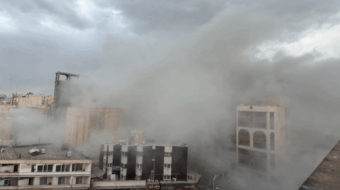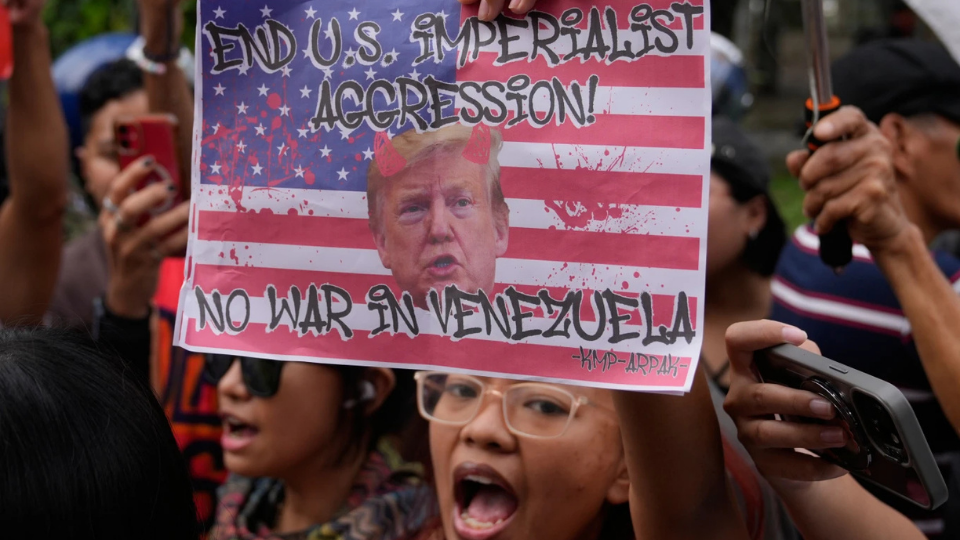
As masses of people turned out worldwide to protest the Trump attacks on Venezuela, some of that energy was reflected Monday at the UN when several Security Council members issued strong statements.
At the meeting in New York, Brazil condemned the U.S. attacks on Venezuela. “The bombing attacks on Venezuela have crossed a line,” the Brazilian representative declared. “This is a very serious affront to the sovereignty of Venezuela and is an extremely dangerous matter facing the entire world now.”
China and Russia supported the Brazilian statement and added their own strong remarks.
China’s foreign ministry said it was “deeply shocked and strongly condemns the use of force by the U.S. against a sovereign country and the use of force against the president of a country.
“China firmly opposes such hegemonic behavior by the U.S, which seriously violates international law, violates Venezuela’s sovereignty, and threatens peace and security in Latin America and the Caribbean. We urge the U.S. to abide by international law and the purposes and principles of the UN Charter and stop violating the sovereignty and security of other countries,” it said.
Russia condemned what it called an “act of armed aggression” against Venezuela committed by the U.S. The Russians said, “We reaffirm our solidarity with the Venezuelan people and our support for the leadership’s policy of defending the country’s national interests and sovereignty.”
The Russians also said they were “extremely concerned” about the kidnapping of Nicolás Maduro and his wife, Cilia Flores, adding it “constitutes an unacceptable violation of the sovereignty of an independent state.”
The UN Security Council meeting came just before Trump declared that he may launch another attack on Venezuela if the acting president, Dulcy Rodríguez, does not “go along with us or stops cooperating.”
The outcry around the world continued Tuesday after Trump’s announcement that he intends to have American taxpayers “reimburse” U.S. oil companies for any costs they incur while stealing Venezuela’s oil.
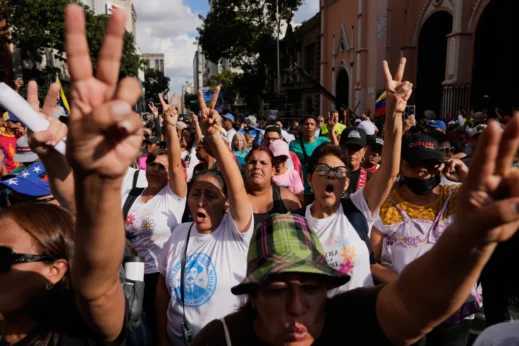
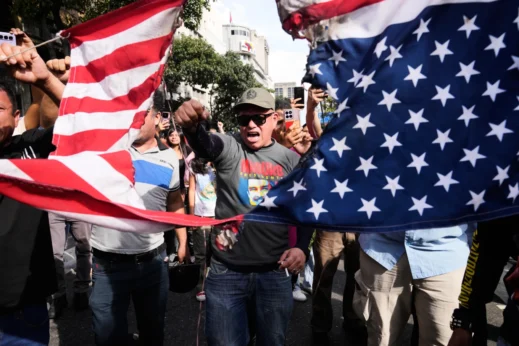
While diplomats from several countries are condemning the kidnapping and attack on Venezuela, the loudest opposition is coming from the streets. People have been flocking to demonstrations in the U.S., Latin America, Europe, Africa, and Asia to voice their outrage.
In Istanbul, Turkey, huge crowds gathered at the U.S. embassy. In the Philippines, which has seen quite a bit of U.S. interference in its internal affairs over the years, people are protesting daily at the U.S. embassy in Manila.
In Seoul, South Korea, where the U.S. has continued building up its military presence, people have also demonstrated daily. Across India, tens of thousands have marched, organized largely by the country’s two large communist parties.
In Greece, the UK, Germany, and elsewhere in Europe, it’s the same story: people taking to the streets in protest.
Emergency demonstrations have been held in cities and towns in Ohio, Illinois, Michigan, Texas, California, New York, and other U.S. locales since Saturday. Peace organizations and allies expect perhaps millions to turn out at demonstrations planned in the U.S. for Jan. 20.
While masses of people are rising up in opposition everywhere, the leaders of several EU countries have been reluctant to condemn Trump’s actions in Venezuela. This hesitation follows their silence on Israeli war crimes in Gaza and on the recent U.S. bombings of Iran. With few important exceptions—Spain, the Netherlands, and Norway—most EU leaders have come out with convoluted responses that don’t say too much.
Spain, one of the exceptions, actually joined several Latin American countries in clearly condemning the U.S. attacks. Most of the other EU countries have had no problem criticizing Maduro as a “dictator” but have difficulty in bringing themselves to say that his kidnapping and the U.S. bombing of Venezuela were violations of international law.
French President, Emmanuel Macron, British Prime Minister Keir Starmer, and European Commission President Ursula von der Leyen did make reference to international law but were quick to fudge the main issue by emphasizing how bad Maduro is. German Chancellor Friedrich Merz was even more vague, saying only that he was “looking into the legality of the U.S. military action.”
Worst of all, perhaps, was the reaction of the Italian Prime Minister Giorgia Meloni, who described Trump’s actions as “legitimate self-defense against narco-trafficking.”
These unprincipled responses from Europe’s so-called liberal democracies, which supposedly believe in international cooperation and the core principles of international law, show the weakness of their leaders.
One explanation for their holding back, of course, is their fear of Trump. His damaging economic tariffs and musings about annexing Greenland, among many other threats, leave them nervous. The militarists and corporate interests in Europe, meanwhile, have used that fear to push their countries into the historic military buildups now underway—buildups which also threaten the peace of the world.
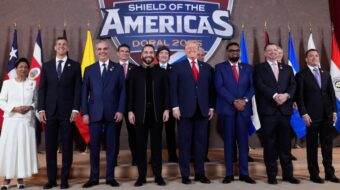
Many countries have posted official reactions on the internet or have delivered those reactions in public statements at public events.
In a post, the Colombian government said it “rejects the aggression against the sovereignty of Venezuela and of Latin America.” Trump has said he may “deal with” Colombia next. The country has deployed 30,000 troops to its border with Venezuela in anticipation of a refugee crisis should U.S. attacks escalate.
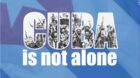
President Miguel Diaz-Canel of Cuba accused the U.S. of conducting a “criminal attack” and called for an “urgent international response.” Cuba is widely seen as a direct victim of the attack on Venezuela. The Trump administration’s blockade against Venezuelan oil is expected to inflict additional harm on Cuba, which has been getting discounted oil from that country.
In a statement posted on X, outgoing Chilean President Gabriel Boric expressed his government’s “concern and condemnation” of the U.S. military actions in Venezuela. “We call for seeking a peaceful solution to the serious crisis affecting the country,” he said.
Mexican President Claudia Sheinbaum declared, “Mexico condemns the military intervention in Venezuela.” She noted that the UN charter forbids the type of actions that the Trump administration has carried out in Venezuela.
Trump has declared that it is drug dealers, not Sheinbaum, who run her country and that Mexico is on his “list of problems to solve,” as he put it. “We need to be surrounded by friendly, happy, and productive countries,” he said.
The right-wing Ecuadorian President Daniel Noboa Azin called on Venezuelan opposition leaders and the public to “reclaim your country. The time is coming for all the narco-Chavista criminals. Their structure will finally collapse across the entire continent,” he wrote on X.
Another right-wing leader, Argentina’s President Javier Milei, hailed what he called “the collapse of the regime of a dictator that was rigging elections, that in the last election was badly defeated and, despite that, he clung on to power.”
We hope you appreciated this article. At People’s World, we believe news and information should be free and accessible to all, but we need your help. Our journalism is free of corporate influence and paywalls because we are totally reader-supported. Only you, our readers and supporters, make this possible. If you enjoy reading People’s World and the stories we bring you, please support our work by donating or becoming a monthly sustainer today. Thank you!
CONTRIBUTOR