BALTIMORE—Trade unionists and community activists, 1,100 of them, are gathered here at the AFL-CIO’s annual Martin Luther King Jr. Civil Rights Conference not just to remember history, but, as many here say, to intervene in it.
“We are gathered to honor Martin Luther King’s sacrifices as we fight for our future,” said Alex Rias, AFL-CIO Director of Civil, Human, and Women’s Rights, framing the conference as a needed response to a historic moment. “There are attacks on our unions, collective bargaining rights, federal workers, LGBTQ workers, and our history.”
Many here want to see the labor movement play a major role in all the key struggles of the day, including the fights for civil rights, workers’ rights, the push to end poverty, the movements to build alliances across lines of race and nationality, and the struggle for peace and an end to President Trump’s war mongering. Rev. Martin Luther King Jr. cannot be honored only in word, they believe, but must be honored also in action. As King said in Beyond Vietnam: A Time to Break Silence:
”It seemed as if there was a real promise of hope for the poor—both Black and white—through the poverty program. There were experiments, hopes, new beginnings. Then came the buildup in Vietnam and I watched the program broken and eviscerated as if it were some idle political plaything of a society gone mad on war, and I knew that America would never invest the necessary funds or energies in rehabilitation of its poor so long as adventures like Vietnam continued to draw men and skills and money like some demonic destructive suction tube.”
King’s struggle, as Rias said, can help point a united direction of struggle against the anti-labor, anti-worker violence of the fascistic, war-mongering Trump administration.
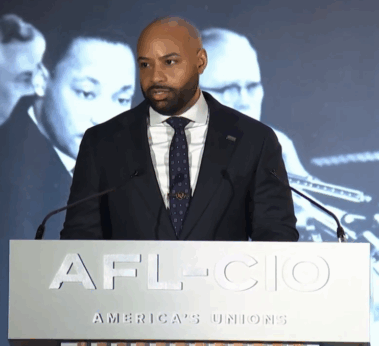
Indeed, this conference comes amidst a storm of crises for the U.S. working class: a civil rights counter-revolution, sweeping attacks on the freedom to assemble and the freedom of the press, and an all-out war on union rights and collective bargaining. It comes as ICE terror targets immigrant workers and entire cities, as jobs disappear and DEI and affirmative action is dismantled, and as imperialist wars drain resources from communities here at home.
“They are scrubbing away diversity and inclusion like dirt,” Rias said. “They are cracking down on immigrant communities, racial profiling, and asking people for papers on our streets. They are using force to squash our rights to observe and to assemble. And they are taking a sledgehammer to our central tenets of voting rights and the right to organize a union.”
The economic situation facing workers is just as dire. In March 2025, the largest union-busting campaign in recent history, by a Trump executive order, stripped collective bargaining rights from nearly 1.3 million federal workers, a “shot across the bow” that saw unemployment among those workers more than double to 2.7%. Nationally, the unemployment rate has also climbed to 4.4%, with Black unemployment reaching 8.3% and youth unemployment hitting a staggering 16.3%, as nearly one million full-time jobs have vanished.
Rikki Westmoreland, a shop steward with the American Postal Workers Union Local 181, detailed the struggle to defend the Post Office from privatization schemes pushed by the billionaire class and the Trump administration. She said the survival of the public Post Office is a matter of protecting a bedrock of civil and democratic rights.
“Vote by mail is under attack and privatization of the U.S. Post Office will only make it that much worse,” Westmoreland said, alluding to potential interference by the Trump administration in the 2026 midterms, which is handled by the USPS. “Privatization will only prioritize profits which will just lead to layoffs and hurt many APWU members like myself.”
She also brought up yet another problem organizers and even shop stewards like her face: Younger people “want immediate gratification,” and we have to relate to that, with patience, so that we can bring them into our movement.
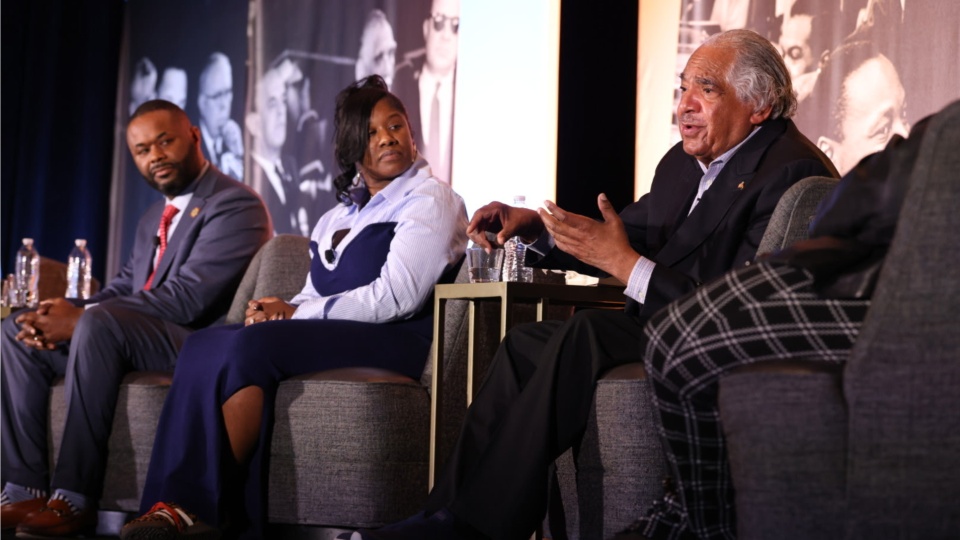
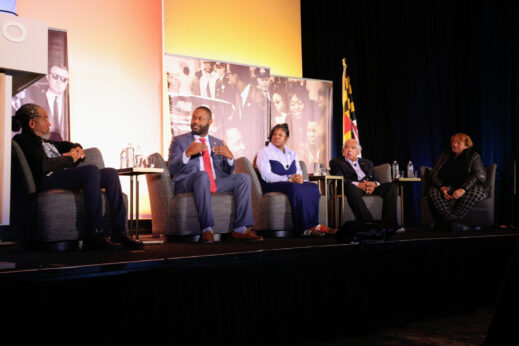
The Trump administration’s billionaire-backed assault on the working class and oppressed people binds the fate of democracy and the labor movement inextricably together. Historically speaking, the path forward is in mobilizing a united, fighting coalition of the labor and civil rights movements, as was built to mobilize masses similar to the AFSCME Memphis Sanitation strike and bus boycotts of the 1960s, said 80-year-old civil rights veteran Michael Mitchell.
He mentioned the victories that the coalition was able to achieve, such as the Civil Rights Act of 1964, the Voting Rights Act of 1965, the Fair Housing Act of 1968, and, before that, the massive civil rights marches that energized the country and awakened its conscience, he said. Without labor’s active support, Mitchell said, all would have failed.
The other panelists, plus the city’s young African-American Democratic mayor, Brandon Scott, offered additional ideas. Scott said union-built job creation projects, including those with Project Labor Agreements, can bring jobs and help recreate the coalition. The city of Baltimore just signed its first four PLAs with the Laborers.
What can also help rejuvenate the labor-civil rights coalition is showing that unions are the road to good-paying jobs for youths of color who would otherwise be—or have been—out on the streets, said State Sen. Cory McCray, D-Baltimore, a member of Electrical Workers (IBEW) Local 24.
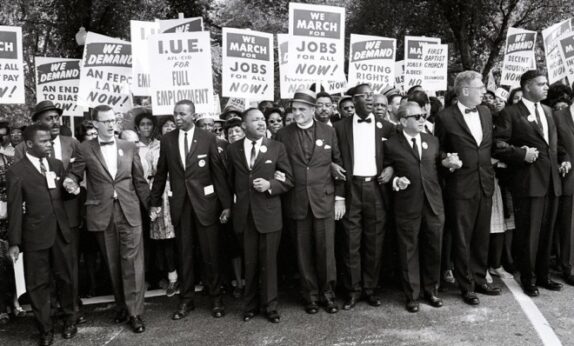
The wisdom of veteran organizers, recalling past struggles, pointed to a potential way forward, too. Dr. Loretta Johnson, Secretary-Treasurer Emerita of the American Federation of Teachers, shared how the 1963 March on Washington for Jobs and Freedom had been a pivotal, springboard moment for her own political development, even recounting the impact of meeting the great labor leader A. Philip Randolph.
“Solidarity is the only way to organize,” she urged the crowd, her voice carrying the weight of that history. A big lesson she learned from the civil rights movement, she said, was unity. “We have to unite—stop fighting each other—and get mad at the boss.”
The opportunity exists to do something similar for the current generation of trade unionists and civil rights organizers. For example, the Coalition of Black Trade Unionists at their 54th International Convention passed a resolution calling for a National Union Day of Solidarity and Rally—a labor-led march on Washington to demonstrate the organized force of the entire movement in opposition to the MAGA agenda.
And Dr. Johnson drove that point home, though she didn’t mention the CBTU call to action. “The Constitution talks about ‘We the People’ – the 99% of us are ‘We the People’ – and the 1% of them we allow to rule us,” she said.
That call hangs in the air now as a key test for the resistance. What is clear is that the trade union movement, the civil rights movement, and the whole working class need to be brought directly into this fight.
“But if that 99% stays glued together, we will sweep them all out and never have to do this again,” Johnson concluded.
We hope you appreciated this article. At People’s World, we believe news and information should be free and accessible to all, but we need your help. Our journalism is free of corporate influence and paywalls because we are totally reader-supported. Only you, our readers and supporters, make this possible. If you enjoy reading People’s World and the stories we bring you, please support our work by donating or becoming a monthly sustainer today. Thank you!
CONTRIBUTOR