French director/co-screenwriter Oliver Laxe’s Oscar-nominated road trip movie Sirāt is a real trip. It is one of those movies where mood surpasses plot points in importance, but as far as story goes, on the surface this is what happens: A father and son apparently from Spain, Luis and Esteban (played by Sergi López of Pan’s Labyrinth and youngster Bruno Núñez Arjona), are searching for their daughter/sister Mar, who has been missing for months, at a rave in Morocco’s desert.
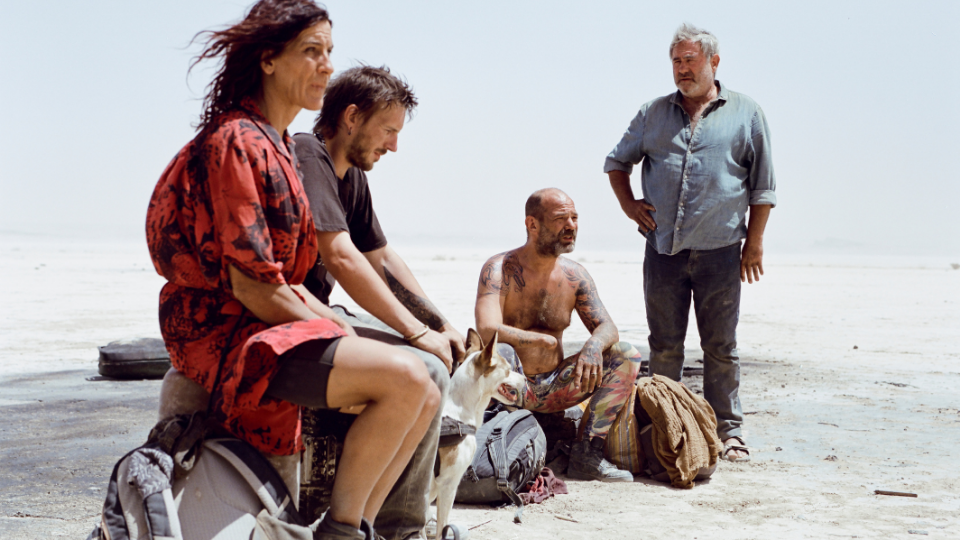
Unable to find Mar, the father/son fall in with a ragtag countercultural Eurotrash bunch who indicate familiarity with Mar and suggest she may be attending the next rave they’re off on the road to in the outback of Morocco. These puckish, punkish desert types are Jade (Jade Oukid), Bigui (Richard Bellamy), Steff (Stefania Gadda), Tonin (Tonin Janvier), and Josh (Joshua Liam Henderson). Two of them are missing limbs (this clearly isn’t Special FX).
According to Rolling Stone, “Laxe recruited these nonprofessionals from the actual desert-rave circuit,” but while the newly minted thespians and their characters share the same names, this doesn’t necessarily mean that they are playing versions of their real selves. The brazen band of aging “gypsies” seems to float from rave to rave in the far-flung hinterlands of North Africa, so Luis and Esteban join their caravan in hopes of finding long-lost Mar at the next site of these remote desert parties. But their quest is nothing like the 1942 Tinseltown comedy Road to Morocco, with Bob, Bing, and Dot.
A looming war of an unspecified nature impacts the ravers, forcing the peripatetic tribe to drive on what might be poet Robert Frost’s “the road less traveled” on steroids, which, like brave Ulysses’s odyssey, is full of uncharted travails and dangers, a veritable minefield of lurking disaster. I suspect that the warfare—which plays an increasingly important role in Sirāt, is an oblique reference to the Polisario Front, which is waging a war of national liberation against the Kingdom of Morocco to free the Western Sahara.
Sirāt evoked for me a psychedelic sensibility of what “Burning Man” might be like if it took place in the Sahara, crossed by Samuel Beckett’s 1953 Waiting for Godot, Dennis Hopper’s 1969 Easy Rider, Nicolas Roeg’s 1971 Walkabout, the Mad Max movies, David Lean’s 1962 Lawrence of Arabia and John Huston’s 1975 The Man Who Would Be King. The latter two epics were filmed, in part, in Morocco, and in Sirāt, the brooding, forbidding, stark North African landscape becomes one of the film’s dramatis personae.
The Arabic word “sirāt” can be translated into English as “path” or “way,” and as a bridge connecting paradise and hell that is “narrower than a strand of hair and sharper than a sword,” as an opening title for the film explains. (The film is in Spanish, French, and Arabic with English subtitles.)
Laxe’s philosophical film is certainly cinematically stylish; Sirāt won four prizes at the Cannes Film Festival and is nominated for the Best International Feature Film Academy Award (and was nominated for the Golden Globes’ counterpart to that category). The movie’s existential ambiance is greatly enhanced by its pulsating, throbbing sonic soundtrack. Electronic-music composer Kangding Ray was Golden Globe-nominated for Best Original Score – Motion Picture, and Sirāt is also Oscar-nominated for Best Sound.
It’s interesting to note that two of this year’s contenders for the Oscar for best foreign film were shot on location in Arab, North African nations. The other, The Voice of Hind Rajab, was lensed in Tunisia, although it is set in Palestine. (A third nominee, It Was Just an Accident, was filmed in Iran.) While Voice’s writer/director Kaouther Ben Hania is Tunisian, its cast is Palestinian. Sirāt may be the more cinematic film, but The Voice of Hind Rajab is the far more meaningful movie and the one I pray strikes Oscar gold. By saying that, I don’t mean to suggest that Sirāt isn’t worth seeing; it is, although this shocking film isn’t for the weak of knees or faint of heart.
Sirāt theatrically opens in Los Angeles on Feb. 6.
We hope you appreciated this article. At People’s World, we believe news and information should be free and accessible to all, but we need your help. Our journalism is free of corporate influence and paywalls because we are totally reader-supported. Only you, our readers and supporters, make this possible. If you enjoy reading People’s World and the stories we bring you, please support our work by donating or becoming a monthly sustainer today. Thank you!
CONTRIBUTOR