VIENTIANE, Laos—Onlookers wishing to get an “inside look” into the world’s least-known socialist country are unlikely to find a better starting point than the proceedings of the Lao People’s Revolutionary Party, which recently concluded in the capital city, Vientiane.
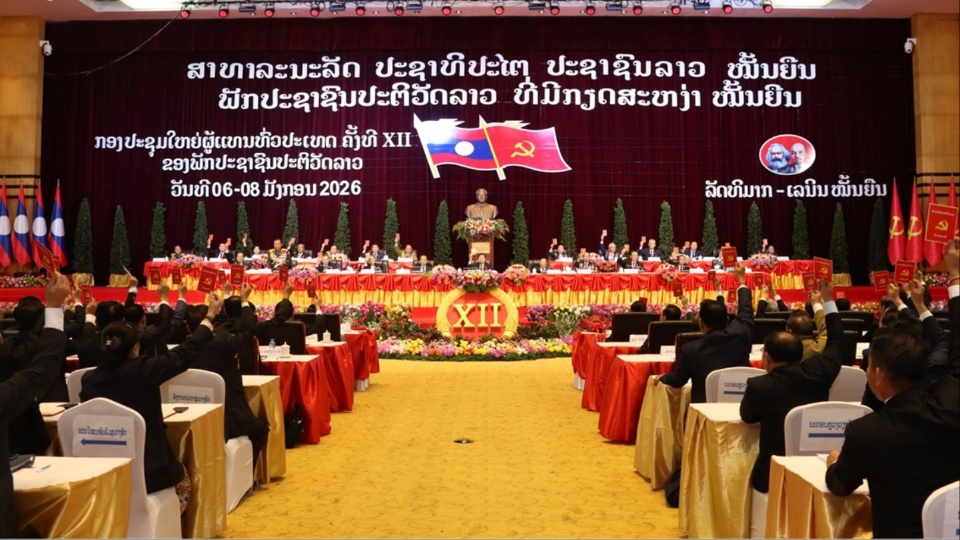
Since its founding in 1955, the LPRP has routinely held congresses to review the party’s work, adopt new policies, and to elect new leadership. It is, for all intents and purposes, one of the most important events in the political life of the country. The most recent national congress, the 12th, concluded on Jan. 8, marking a historic waypoint in the country’s continued development.
The First National Congress of the LPRP, then known as the Lao People’s Party, was convened in 1955 in the mountains of Laos’ remote northeastern Houaphanh province. Attended by 20 delegates, representing some 400 members, it marked the official birth of the party as the legitimate successor of both the Free Laos (Lao Issara) movement that had formally begun in 1945, as well as the broader legacy of national struggle reaching back into the 18th century.
Perhaps even more importantly, that initial congress successfully united the progressive and patriotic cause of Lao independence represented by the Lao Issara with the struggle for revolutionary socialism and the birth of people’s democracy represented by the Indochinese Communist Party that had been officially dissolved in 1945. The ensuing movement, and its democratic-revolutionary heroes, came to be known as the Pathet Lao (literally “Lao Nation”).
The modern country of Laos looks quite different from the embattled semi-colony that was subjected to indiscriminate U.S. bombing from 1964 to 1973. As the most heavily bombed country in history, the Lao People’s Democratic Republic bears the scars of its past, but it refuses to be defined by them.
Just as the First National Congress raised the call for national democratic revolution from the forces of French colonialism and U.S. imperialism, each subsequent congress has played a pivotal role in shaping the development of the nation and the peoples’ long march toward socialist development.
The 4th National Congress of November 1986 marked a key moment in the country’s development, with the adoption of the “New Economic Mechanism,” corresponding generally with neighboring Vietnam’s Đổi Mới reform process, launched one month later in December 1986, and China’s reform and opening up, initiated in 1978.
Under the leadership of the LPRP, Laos has pursued a policy of “building socialism without going through a period of capitalism,” whereby the country attempts to forgo the capitalist stage of socioeconomic development altogether and instead transition directly from colonialism to a socialist market economy.
The 12th National Congress
The 12th National Congress convened on Jan. 6 with an opening speech delivered by Thongloun Sisoulith, general secretary of the party and president of the Lao People’s Democratic Republic.

In his remarks, Thoungloun said that world history is at a decisive moment, with profound changes occurring in all areas, particularly science and technology.
“These changes bring major advances that open new horizons for global development while also presenting unprecedented challenges that directly impact our country,” he said. “At the same time, our party continuously seeks development paths that align with the nation’s unique conditions and adapts to the changing circumstances of the era.”
That principled pragmatism, according to Thongloun, is aimed at consolidating “independence, ensuring the people’s democracy, and advancing toward socialism.” In line with that goal, the congress reviewed the third edition of the LPRP’s political program. The document establishes broad goals for national development from now through 2055, setting a path toward what it calls a “firm, independent, and socially advanced nation.”
It was solidly endorsed by the congress delegates. There were 835 of them, including 123 women, representing some 421,865 party members from all ethnic groups across the country. They also chose a new Central Committee of 73 members to lead the party and re-elected Thongloun to new five-year term as general secretary.
The main political report delivered by Thongloun reviewed the previous five years of Laos’ development, citing the country’s overall political stability and economic progress despite major challenges, with inflation and the COVID-19 pandemic at the top of the list. Laos persevered through the crisis, and GDP (gross domestic product) grew roughly 4% in 2025.
The new five-year National Socio-Economic Development Plan (2026-30) adopted by the Congress plans to accelerate growth to 6% in the coming period and aims for a total GDP growth of around 25% by the end of the new term. Reducing debt and increasing government revenue are identified among the nation’s top priorities, as well the continuation of the party’s ongoing strides in maintaining strong anti-corruption measures.
Fresh advances toward socialism
The socialist-oriented market economy, which is how the LPRP characterizes Laos’ economy currently, will strive for “industrialization, modernization, and digital transformation along with strengthening education and social welfare.”
With its strategic regional location, the plan envisions Laos becoming the “battery of Southeast Asia,” supplying green energy throughout the region, while simultaneously seeking to transform its position from a “landlocked” country into a “land-linked” one, through continuing joint-development projects with neighboring China, Vietnam, Thailand, and Cambodia.
This notably includes work on the long-awaited Laos-Vietnam Railway, which is expected to enter operation in 2030, providing Laos direct access to oversea logistics via joint development of Vietnam’s Vung Ang seaport in Ha Tinh province.

Another important marker of ongoing development progress is the nation’s anticipated 2026 graduation from “Least Developed Country” (LDC) status as defined by the United Nations. This highly anticipated step into middle-income status is based on advancements made in national income per capita, human development, and economic and environmental indexes.
In light of the country’s rapid development, the LPRP’s assessment is that the decision to pursue the New Economic Mechanism for socialist-oriented development in 1986 is bearing fruit. The rise to lower middle-income status will likewise entail a transition from foreign aid and towards greater national self-reliance, as well as co-financing with regional and international partners.
Succeeding the Vision 2030 goals set by the Ministry of Planning and Investment in 2016, the party’s newly ratified third political program sets an ambitious vision for the country by 2055: becoming an upper middle-income economy with elevated living standards and environmental protection. This likewise coincides with an anticipated baby boom that will see the young country’s population continue to rise in the coming years from 7.9 million today to likely over 10 million by 2045.
The congress also affirmed the party’s leading foreign policy orientation of independence, peace, and multilateralism. Socialist neighbors Vietnam and China were among the countries sending warm congratulations, as well as fraternal parties from around the world, including the Communist Party USA.
Laos welcomes the world
The congress also celebrated the 50th anniversary of the peaceful transfer of power that marked the birth of the Lao People’s Democratic Republic on Dec. 2, 1975, and noted that it was a perfect time for those who’ve never seen the country to start planning a visit.

With the astounding success of the “Visit Laos 2024” campaign, tourism is emerging as a new strategic industry for the country. The Lao PDR was named one of the top five most attractive countries for tourism by Lonely Planet in 2025, and the Lao people are eager to welcome more foreign friends and guests to visit and enjoy the country’s abundant natural beauty.
Concluding the congress, Thongloun thanked participants for their hard work and dedication and tasked the incoming Central Committee with upholding the lofty aspirations of the whole Lao nation.
“Our Party still has a long way to go,” he said. “The socialist ideology and aspiration cannot be realized in practice without Party members who are pure, strong, and steadfast, serving as the core and the vanguard.”
He urged the party’s leaders to “forge and discipline themselves comprehensively” and to improve their leadership style and working methods.
Thongloun said that the lessons of practical experience gained during the reform process “have been tested and have yielded good results.” Looking ahead, he predicted that the LPRP, “fully aligned with the aspirations of the Lao people of all ethnic groups, will lead the nation forward to its destination” of socialism.
We hope you appreciated this article. At People’s World, we believe news and information should be free and accessible to all, but we need your help. Our journalism is free of corporate influence and paywalls because we are totally reader-supported. Only you, our readers and supporters, make this possible. If you enjoy reading People’s World and the stories we bring you, please support our work by donating or becoming a monthly sustainer today. Thank you!
CONTRIBUTOR