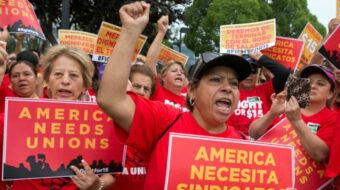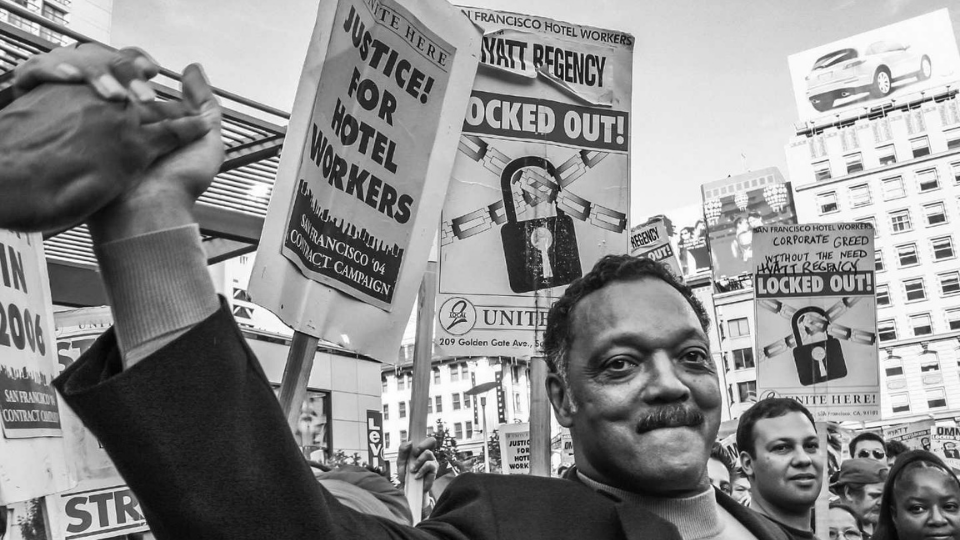
WASHINGTON—Union leaders, with the AFL-CIO in the vanguard, are lauding the Rev. Jesse Jackson for his leadership on civil rights and for his unique ability to connect those struggles with the day-to-day concerns of the U.S. working class. Jackson died of a rare neurological disease on February 17 at the age of 84. He was surrounded at home by his family.
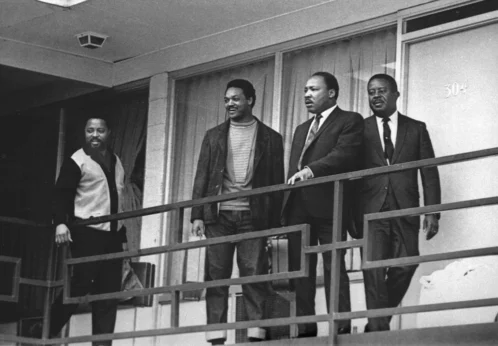
Jackson became famous as a close aide to Dr. Martin Luther King Jr. during the 1960s civil rights revolution. He was one of several civil rights leaders and aides talking with Dr. King when white supremacist James Earl Ray shot King to death in Memphis, Tenn.
King, with Jackson and the others, at the urging of AFSCME President Bill Lucy, was leading the famous “I am a man” marches for oppressed Black sanitation workers in Memphis who demanded recognition of their right to organize with Lucy’s union.
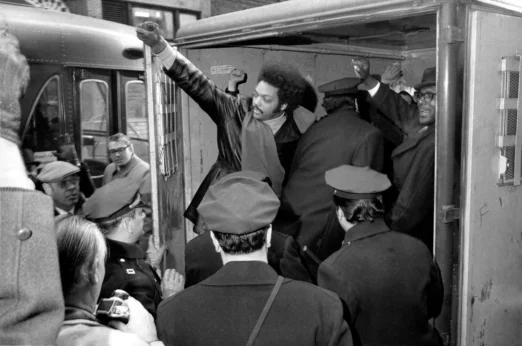
After King’s death, Jackson, who, at the direction of King, had directed Operation Breadbasket—designed to push firms into expanding job opportunities for Blacks—branched out into his own pro-civil rights, pro-worker, and pro-economic empowerment organization, Chicago-based People United to Save Humanity, which became known as Operation Push.
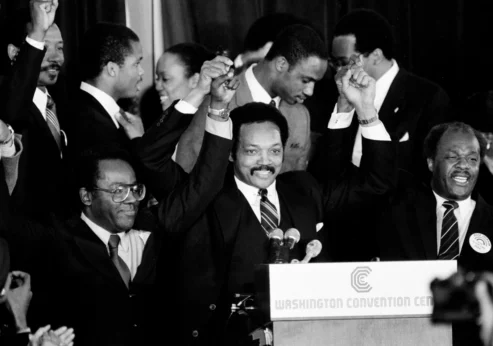
He also entered the political arena, running on strong campaigns twice for the Democratic presidential nomination, while exerting a heavy progressive—and pro-worker—influence on the party’s platform.
Among the many in whom his legacy lives on is former President Barack Obama. Barack Obama, a Chicago South Sider like Jackson, says Jackson helped blaze the trail that eventually landed him (Obama) in the White House.
AFL-CIO President Liz Shuler and Secretary-Treasurer Fred Redmond, a Steelworker and the highest-ranking African-American in the labor movement, lauded Rev. Jackson as “a towering moral force whose lifelong commitment to justice reshaped both the labor and civil rights movements and left a lasting mark on the nation.”
Operating for Dr. King, “Rev. Jackson led boycotts and campaigns that secured thousands of new jobs for Black workers. His two presidential campaigns would break barriers and expand the political imagination of our country. Through Operation PUSH and the later Rainbow PUSH Coalition, he brought communities together with a simple, powerful truth: Economic justice and civil rights are inseparable,” the AFL-CIO leader said.
“Throughout his life, Rev. Jackson fought tirelessly for workers, both at home and around the world. He upheld the labor movement’s highest ideals: Walking picket lines, supporting workers at the bargaining table, and insisting that women and people of color be fully included in union protections. He stood with the AFL-CIO at major mobilizations and worker rallies, from the coalfields to campaigns for janitors and public-sector workers.
“In 2002, he joined the AFL-CIO and local unions in organizing laid-off Enron workers to secure fair severance pay. On the international stage, he confronted global corporations to defend the dignity and rights of workers… At every turn, he reminded us the fight for good jobs, living wages, and union rights is inseparable from the fight for justice and equality…We reaffirm his belief that ‘The American worker is not asking for welfare, he’s asking for a fair share—not for charity but for parity.’”
Excerpts from other union leaders’ statements praising Rev. Jackson included:
Communications Workers President Claude Cummings Jr. focused on Rev. Jackson’s fights for expanding the right to vote, another area very important to workers. Jackson was “a warrior for workers’ rights and civil rights. CWA members have stood shoulder to shoulder with the Reverend as we fought to protect the vote in Alabama, or on picket lines and campaigns going back decades.”
“Rev. Jackson understood that the fight for civil rights is also a fight for the right to organize, to bargain collectively, and to share in the prosperity that working people create. Jackson spoke out for the dignity of every working person who demanded a fair share—not welfare—for their labor. He called on the nation to see that racial justice and workers’ rights are inseparable and that true freedom requires economic opportunity for all.”
“We honor Jackson’s legacy by recommitting ourselves to the work he championed: Building solidarity across all races, regions, and immigration status to ensure every worker is treated with dignity and respect; and defending the vote against any politician who would try to take power away from the American people.”
National Education Association President Becky Pringle declared, “We celebrate the life and legacy of a pioneering giant who will be forever remembered as a pillar of justice for labor, education, and communities across this nation. Rev. Jackson lived a life committed to civil rights and economic justice for all people. His courage and compassion inspired millions. Thank you, Rev. Jackson, for your unwavering belief in the worth of every person. May we carry forward the hope you kept alive and remember—always—that justice is a collective responsibility.”
Service Employees President April Verrett remembered seeing Jackson years ago, because she, too, grew up on Chicago’s South Side, and saw him there, at churches, community meetings, and even at people’s dinner tables. Jackson’s ideals were “rooted in justice. He reminded us our differences are not our weakness—they are our strength when we choose to stand together,” said Verrett.
“His historic runs for president changed the story of what leadership in America could look like. They widened the circle of who gets to be seen, who gets to be heard, and who gets to dream big enough to claim the highest offices in the land. Because of Reverend Jackson, generations of Black leaders found the courage to step forward—and in doing so, helped this country see itself more clearly.”
“At a time when it feels easier to tear one another down than to stay in the work of building together, Reverend Jackson’s life offers us a better way. He reminds us we are bound together. That none of us gets free alone. That the work of justice is not about who gets the credit, but about who gets lifted.”
Teachers/AFT President Randi Weingarten, Vice President Evelyn DeJesus, and Secretary-Treasurer Fed Ingram put out a joint statement saying, “We mourn the loss of a titan of justice whose life was a testament to the belief that every voice matters and real change requires relentless moral courage. For decades, the AFT stood shoulder to shoulder with him. He walked our picket lines and lifted up our members, knowing labor rights and civil rights are inseparable. He fought tirelessly for education funding and justice, and he spoke out with urgency against the scourge of gun violence devastating our communities.”
“His powerful affirmation—‘I am somebody’—gave generations of young people a sense of dignity and possibility. Rev. Jackson was always dreaming, always fighting. He believed in the audacity of hope long before it was fashionable. He believed in multiracial coalitions, in the power of organized labor, and in the promise of democracy, and he never stopped pushing this country to be better.”
“We are better because he walked with us. We are stronger because he believed in us. May we honor his life not only in words, but in continued action.”
Chicago Teachers Union, AFT Local 1 President Stacy Davis Gates said, “The downtrodden, the dispossessed, and the marginalized lost our most fierce and brilliant champion, the revered Jesse Jackson. Our superhero. Our civil rights leader. Our moral compass. Our giant. Our American Patriot.”
Davis Gates cited Rev. Jackson’s extensive ties to her city, Chicago, which became his operating base via the Kenwood-Oakland Community Organization, Operation Breadbasket, Operation PUSH, and later the Rainbow PUSH Coalition. Through all, “Rev. Jackson understood justice required a multiracial coalition, organization, strategy, and an unshakable belief in the dignity of workers everywhere.”
“He carried forward the vision of A. Phillip Randolph’s Freedom Budget and bequeathed to Sen. Bernie Sanders the progressive presidential platform. He never wavered from the truth that democracy must work for all of us.”
“Here in Chicago, that same unwavering commitment to justice and equity made Rev. Jackson a fierce champion for our city’s public school communities and the students and workers that inhabit the four walls of its classrooms,” Davis Gates, a social studies teacher, said.
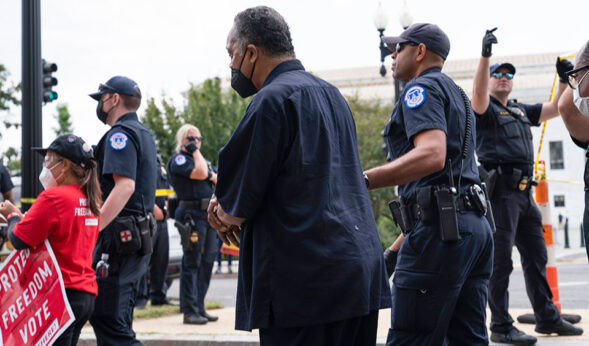
Davis Gates recalled Rev. Jackson walking picket lines during four CTU strikes from 2012-19, fighting “for the schools our children deserve.” Jackson gave “leadership and legitimacy to our struggle when wealthy, powerful interests tried to dismiss and dismantle it. He reminded us, again and again, the fight for public education is inseparable from the fight for racial and economic justice.”
Davis Gates also said Rev. Jackson also inspired the late Chicago Mayor Harold Washington, then a state senator, to seek that post and become the city’s first elected Black mayor. Jackson’s 1984 and 1988 presidential campaigns “rewrote the rules of American politics and paved the pathway for the leadership of President Obama, Vice President Kamala Harris, and Mayor Brandon Johnson,” the current Chicago mayor who is a former shop steward for Local 1.
Rev. Jackson “demonstrated to Black children, working families, and poor communities that we were not spectators in democracy, we are most central to it. He walked more picket lines than most leaders will ever see. He believed deeply in labor solidarity, multiracial coalitions, and the power of organized people to challenge organized wealthy interests.”
“We must recommit ourselves to the work he modeled, to move, not mourn, to march, not mope, to choose service over sorrow and to pursue dignity even in the face of despair…His life reminds us hope is not a slogan, it is a discipline…built in church basements, union halls, educational communities, and chanted on picket lines and on the streets. It is sustained through coalition, struggle, and solidarity…We say what he taught us to say—Keep hope alive.”
The Machinists issued a statement that said, “Jackson’s solidarity with our members extended beyond words. During the historic Eastern Airlines strike, he walked arm-in-arm with striking IAM members, proudly wearing an ‘On Strike’ sign on the picket line. His presence offered courage, his voice provided hope, and his moral clarity affirmed the fight for economic justice is inseparable from the fight for human dignity.”
“That moment remains one of the most powerful demonstrations of his unwavering commitment to workers’ rights. Throughout his life, Rev. Jackson established a vital link between the labor movement and the civil rights movement. He deeply understood the quest for racial justice cannot be separated from the struggle for fair wages, safe workplaces, and the right to organize. His leadership strengthened our movement, inspired our members, and broadened the coalition fighting for a more equitable society.”
National Nurses United posted on social media, “In 1992, when 1,700 workers went on strike for seven weeks at Oakland’s Summit Medical Center, Rev. Jesse Jackson walked the picket line with us. He stood shoulder to shoulder with five unions fighting for justice. Rest in power, Rev. Jackson, we’ll keep fighting from here.”
The Autoworkers recalled that three years ago, when he was over 80 and ailing, Rev. Jackson still walked on their picket lines in front of a Ford factory on the South Side during the union’s historic and successful Stand Up! strike against the Detroit-based car companies, Ford, GM, and Stellantis.
“Rev. Jackson knew exactly which side he was on: that of the working class,” UAW said. “He spoke out against the hollowing out of manufacturing…and the damage done to communities when jobs were shipped overseas, calling for fair trade deals that put workers first. He carried that conviction across the globe, traveling to South Africa to investigate the firing of 700 Black workers from a Ford plant in 1979 and helping to lead the international movement to end apartheid.”
“In 2010, he joined UAW President Bob King on a multi-city tour calling for jobs, justice, and peace, a message he embraced across decades of work. He stood with workers in the streets from Detroit to cities nationwide, demanding industrial policies that create jobs, enforce workers’ and civil rights, and put people before profit.”
The union said Rev. Jackson’s roots ran “deep in the intertwined traditions of civil rights, labor organizing, anti-apartheid activism, and the global peace movement—all grounded in the same belief: That dignity, fairness, and opportunity belong to all of humanity. May we honor him not only in memory, but in action.”
Culinary Union Local 226, Unite HERE’s largest local, issued a statement that read, “In 1990, when I was a bartender at the Horseshoe in Las Vegas,” during a 9-month strike, “almost no one would stand with us, but Rev. Jackson did,” said Executive Secretary-Treasurer Ted Pappageorge. “We were told we couldn’t march in the street, and if we did, there would be arrests. Rev. Jackson came to Las Vegas, stood shoulder to shoulder, led us on that march, and not one worker was arrested.”
“At a time when our fight felt uphill, he gave us courage and hope. And he kept showing up there,” Pappageorge added. “His legacy lives on in every picket line, organizing drive, and contract fight where workers demand respect and a better future. We will honor him by…doing what he always told us: Keep hope alive.”
We hope you appreciated this article. At People’s World, we believe news and information should be free and accessible to all, but we need your help. Our journalism is free of corporate influence and paywalls because we are totally reader-supported. Only you, our readers and supporters, make this possible. If you enjoy reading People’s World and the stories we bring you, please support our work by donating or becoming a monthly sustainer today. Thank you!
CONTRIBUTOR