
At a time when working-class families are already facing a weakened job market, high prices, and general economic uncertainty due to erratic federal policy, Republicans in Congress seem committed to worsening their economic anxieties. The enhanced ACA premium tax credits, instituted with the American Rescue Plan (ARPA) and extended through the Inflation Reduction Act (IRA), were not extended through the Republican-led reconciliation budget. These credits have led to the largest increase in health insurance coverage since the ACA’s Medicaid expansion, and saved enrollees on average $705 annually in 2024.
Working-class families across the country will feel the implications of this policy failure as health insurance premiums rise. However, Black families, who face higher rates of poverty and uninsurance even under “normal” circumstances, are positioned to be hit especially hard by the loss of the enhanced subsidies. The loss of the premium tax credits is also set to economically drain the cities where lots of Black families live, especially those cities in states that neglected to expand health coverage through the ACA.
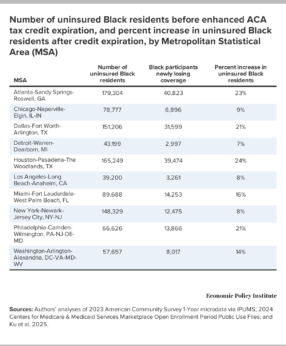
This analysis will focus on 10 major metro areas: Atlanta, Chicago, Dallas, Detroit, Houston, Los Angeles, Miami, New York, Philadelphia, and Washington, D.C.
Impact on Black families across 10 major metro areas
The Affordable Care Act, largely through its Medicaid expansion in 2014, set in motion a decade-long trend of falling rates of uninsurance throughout the country. However, some states, particularly those throughout the South where the majority of Black Americans live and work, refused to expand Medicaid through the ACA. Southern states’ refusal to expand access to Medicaid has meant lower coverage rates in those states and that a large share of Black Americans fall into what is known as the health insurance “coverage gap”; that is, they qualify for neither Medicaid nor traditional ACA subsidies. Even outside the coverage gap, many individuals who do qualify for ACA subsidies remain uninsured due to cost and enrollment difficulties.
The enhanced ACA premium tax credits do not eliminate racial disparities in health insurance coverage, nor do they close the coverage gap faced by Black Americans. However, the tax credits do make insurance more affordable, and thus practically more accessible, for those individuals who qualify. This increase in accessibility has led to the largest increase in Marketplace enrollment since the Medicaid expansion, with outsized increases among low-income individuals and in states that did not expand Medicaid. The loss of the tax credits would reverse hard-won progress made in reducing racial disparities in uninsurance rates.
Younger and healthier individuals are more likely to forgo coverage when faced with a sharp increase in the price of insurance compared with those who are less healthy and for whom coverage is less optional. The expiration of the tax credits will therefore likely bring a knock-on increase in premiums as younger enrollees forgo coverage, since insurance premiums are cheaper for everyone when there is a large pool of healthier enrollees.
The remaining enrollees in the insurance pool of each metro area will also see premiums, and thus their health care spending, increase. Given that the states where larger shares of the Black population live are those set to be hit hardest by increased rates of uninsurance, we anticipate that the impact on consumption in metro areas in those states will be more severe.
Access to health care in the United States is largely mediated by health insurance coverage. As a result, losing coverage in most cases means losing access to adequate and necessary care. Indeed, though access to health insurance does not guarantee affordability, uninsured adults are nearly twice as likely to report some difficulty in affording health care compared with those with insurance, with three-quarters either skipping or postponing needed care due to cost (Sparks et al. 2025).
Over time, a lack of access to adequate health care contributes to excess mortality. Black Americans are more likely to be uninsured, more likely to face difficulties in affording health care, and are thus more likely to postpone or skip care due to cost. To the extent that the expiration of the enhanced premium tax credits does lead to reduced health care access, it will likely also lead to excess mortality
The loss of the enhanced premium tax credits will have knock-on economic costs, in addition to the public health costs resulting from excess mortality and increased health care costs for remaining marketplace enrollees. We assume a multiplier of 1.8 for health care spending, meaning that every lost dollar in premium tax credits reduces economic activity in a given metro area by $1.80 (estimates range from a multiplier of 1.5 to 2; see methodology section). Metro areas with large Black populations in states that lack Medicaid expansion will face significant losses in economic activity from this reduction in federal spending.
Metro areas with large Black populations will also suffer significant productivity losses due to diminished worker health, assuming a productivity loss of $1,650 per newly uninsured Black worker. Finally, we assume employers in these metro areas will pay an additional $4,000 annually due to increased costs associated with each newly uninsured Black worker. Each of these impacts is felt most acutely in places where losing the enhanced premium tax credits is most costly—that is, those MSAs with the largest Black populations facing precarity in their coverage status.
Why is this happening?
The Republican reconciliation bill passed last summer gives a clear distillation of conservative priorities: They prioritize the well-being of the wealthiest households and corporations over that of working-class families. As such, the new budget contains several provisions that provide disproportionate tax relief to the wealthiest households, at the expense of social programs designed to benefit working- and middle-class families.
Allowing the premium tax credits to expire also repeats an unfortunate pattern associated with pandemic-era expansionary policy aimed at easing economic conditions for American families. Through several provisions in the American Rescue Plan Act (namely the expansion of the Child Tax Credit), the scourges of poverty, child poverty, and child hunger were all drastically reduced in 2021. When those expansionary provisions were allowed to expire in 2022, these measures snapped back to their previously higher levels, erasing the progress that was made. The ARPA and IRA policies provide clear evidence that policy can be used to effectively reduce poverty, hunger, and uninsurance rates in ways that close racial disparities; it is a matter of prioritization, not practicality.
Why does this matter for public health?
The loss of the premium subsidies will almost certainly lead to a reduction in insurance rates, concentrated amongst those with the least ability to pay. Even for those with more income, having to face increasing health care costs amid a broader affordability crisis will also likely lead those families to go uninsured at the margin. This reduction in insurance will lead to a reduction in families’ access to adequate and timely care. Writ large, reduced access to preventative, adequate, and timely care leads to a less healthy population overall. Moreover, when more individuals and families access health care on an emergency rather than preventative basis, it puts greater strain on the entire health care system, contributing to overcrowding in emergency departments and longer wait times, and reducing the quality of care possible for a broader population.
Whether health care is a necessary or luxury good within an economy is partially shaped by the extent to which health care is publicly subsidized. This is because the income elasticity of demand for health care changes with income. With public support, many more individuals and families can purchase health services as they become necessary than would otherwise. In the absence of public support, and at lower income levels, many view health care much more as an optional purchase when weighed against other pressing costs like shelter and food. Structural changes to the social provision of health care, like allowing subsidies to expire, lead to direct changes in consumption of health services by families, and much more so by working- and middle-class families.
Why does this matter for racial health disparities?
Even among the working class, Black families are more likely to be uninsured compared with white families. Black families are more likely to live in states that did not accept the ACA’s Medicaid expansion, and they are less likely to work for employers that provide insurance coverage. Black families will therefore be impacted more heavily by policies that reduce access to insurance at the margin. This matters because, again, Black families are more likely than their white counterparts to forgo or delay access to adequate health care for financial reasons. Losing access to the enhanced tax credits will result in increased health costs, loss of coverage, diminished health, and excess deaths, concentrated amongst the most disadvantaged. This is in keeping with the Trump administration’s stance that racial equity is not a policy goal worth pursuing.
What will this mean economically for workers and their families?
Families facing economic precarity—those for whom even a relatively small negative economic shock could lead to a crisis—stand to lose the most from the expiration of the ACA premium tax credits. More families are in a precarious financial position than live below the poverty line, and the ongoing affordability crisis being exacerbated by erratic and harmful economic policy decisions increases that number. Black and brown families are more likely to be in the position in which losing the subsidies would be impactful because they are more likely to lack financial assets, even after earning a college degree and escaping income poverty.
The cities where Black workers and families reside will also face a negative shock due to the loss of the subsidies, resulting from lost worker productivity and a drop in revenue, as those families shift more of their spending toward maintaining health insurance and less on other locally purchased consumer goods. Reduced economic activity from Black workers and families will have a broader impact on economic growth and activity throughout these cities.
What should we do about it?
The enhanced ACA premium tax credits are a prime example of a policy used to address the income side of the affordability crisis. The credits work as an income transfer from the federal government to families, making purchasing health insurance more affordable; enhancing the credits allowed more families to access timely and adequate health care. Allowing those enhanced credits to expire imposes a major cost on American families and their local economies, especially those in states where Medicaid was not expanded through the ACA.
But temporary tax credits are weak policy tools for addressing structural affordability crises. When the credits inevitably expire and those federal dollars are taken away, families will face the same issues of affordability; only now their consumption will have adjusted around having the credits. The new “increase” in the cost of health insurance means families must decide whether to risk going without coverage or reduce spending elsewhere— a tough choice with no good outcomes for local economies.
A better policy strategy for addressing an affordability or accessibility problem with health insurance is to make structural changes to the program ( i.e., permanent changes that expand affordability and accessibility). In this case, extending the premium subsidies to become standard policy would be the strategy that creates the least harm for workers and their families.
Extending the tax credit subsidies would still leave millions of Americans and their families without access to health insurance, and thus facing diminished access to timely and affordable health care. The ACA, even in the expanded form adopted by many states throughout the country, is an imperfect system for achieving the goals of health equity. Moving our health care system in the direction of single-payer health insurance in which access to affordable and high-quality health care is given as a right not contingent on wealth, income, or employment is the strategy most consistent with reducing economic and health disparities across race and improving our overall economic and public health.
Allowing the ACA premium tax credits to expire would make it harder for American families to access health care, worsen an ongoing affordability crisis, and have a knock-on negative impact on local economies. Black workers and their families would feel these shocks most acutely because even under normal circumstances, Black families are less likely to live in states with expanded access to Medicaid, less likely to work in jobs that provide access to health insurance, and more likely to forgo or delay health care due to financial challenges.
The Trump administration has continually shown its disdain for the pursuit of equity as a policy goal through dismantling institutions committed to reducing disparities, rescinding executive orders and federal commitments to set higher standards for equity, and failing to maintain policies that brought us closer to those goals. The pursuit of equity in this moment requires us to hold fast to the progress we have made thus far, both so that we limit the suffering of as many American workers and families as possible, and so that when we do have the opportunity to build toward further progress, those families will be in the best position to help us do so.
Economic Policy Institute
The full report, along with citations, can be found at EPI.org.
We hope you appreciated this article. At People’s World, we believe news and information should be free and accessible to all, but we need your help. Our journalism is free of corporate influence and paywalls because we are totally reader-supported. Only you, our readers and supporters, make this possible. If you enjoy reading People’s World and the stories we bring you, please support our work by donating or becoming a monthly sustainer today. Thank you!
CONTRIBUTOR