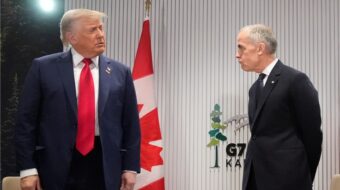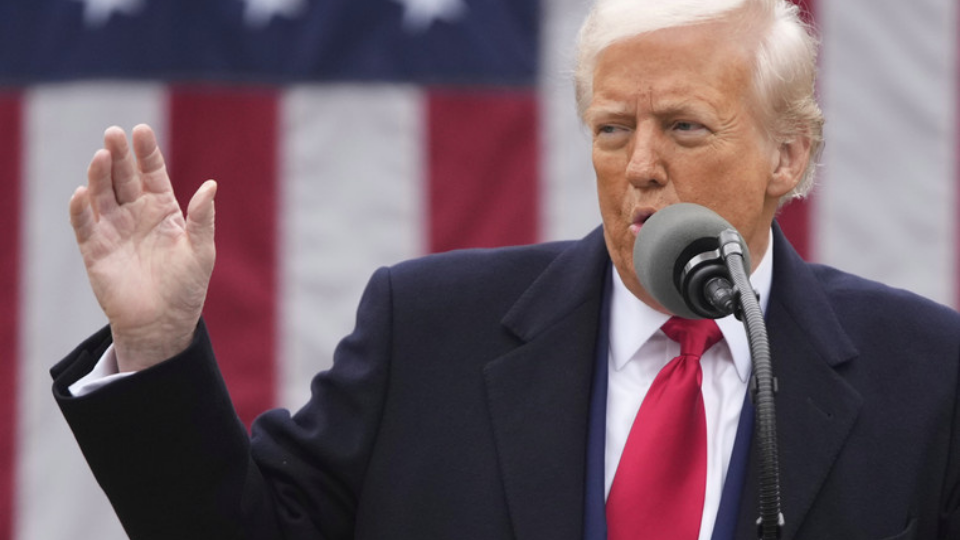
WASHINGTON—Determined foes of dictatorial GOP President Donald Trump cheered the 6-3 U.S. Supreme Court vote to outlaw his constitutional overreach in imposing—or taking away—tariffs when he likes and where he likes.
Democratic Gov. Pritzger demanded that the U.S. Treasury send every American household a reimbursement check of $1,700. He said that was the average amount of additional costs of necessary goods paid by each household as a result of the Trump tariffs. Many other Democratic lawmakers, consumer groups, and unions are also demanding the reimbursements to the people rather than checks only being sent to businesses.
The Treasury Department shows no inclination to reimburse the people or anyone else, with the Trump administration saying litigation about this could take years.
On the court ruling itself, people and organizations concerned about the future of the constitution and democracy itself lauded the six Justices who voted against Trump: Chief Justice John Roberts, Democratic-named Justices Elena Kagan, Sonia Sotomayor, and Ketanji Brown Jackson, and Trump-named justices Amy Coney Barrett and Neil Gorsuch.
Those justices, the commenters said, upheld the rule of law and the balance of power between Congress and the president, thus checking a complete Trump takeover of everything.
Those in organized labor emphasized the practical impact of the ruling, while demanding Trump return the $200 billion he’s collected in tariffs to the U.S. people—who were the ones who really paid that bill. And some said tariffs can still be useful.
But the court was silent on when, and whether, the U.S. people would ever see refunds of the money Trump collected from them, passed through to them by companies hit by Trump’s tariffs. Or whether the greedy capitalists would pocket the proceeds.
Trump, of course, hailed the three justices who sided with him: Samuel Alito, Brett Kavanaugh, and Clarence Thomas. Kavanaugh is the third Trump-named justice. Thomas said in his separate dissent that a president has unlimited power to raise and lower tariffs. The Constitution gives it to Congress.
If all this sounds a little familiar, it should, because Trump seeks ultimate power over elections, too. He’s urging Congress to cede to his regime complete control there, again countering the plain language of the U.S. Constitution, which gives that power to the states. Yielding it to the federal government is the point of the GOP-pushed “SAVE Act” now headed for the U.S. Senate floor.
On the tariffs, there were a few “crossover” commentaries, such as from the Machinists, which hit both the economic impact and the constitutional defense against Trump.
“The Supreme Court decision reinforces the U.S. Constitution’s clear assignment of authority to Congress to impose tariffs on foreign imports. Trade policy must be grounded in that framework and carried out with care,” the union said. And then IAM, too, pivoted to the practical impact Trump’s tariffs have on all of us.
“It is deeply troubling that throughout this process, it has been our members and everyday consumers who shouldered the burden of these illegally imposed tariffs, while the very corporations that bankrolled this administration may now be first in line for rebates. Workers paid the price, so they should be the first ones to see relief.”
The Constitution, Chief Justice Roberts wrote, bars Trump’s seesawing tariffs, using “emergency” powers. The nation’s basic charter bluntly says Congress, not the president, “has the power to lay and collect taxes, duties, imposts and excises,” the old description for tariffs.
Trump claimed the 1977 International Emergency Economic Powers Act (IEEPA) gives him power “to deal with any unusual and extraordinary threat, which has its source in whole or substantial part outside the United States, to the national security, foreign policy, or economy…if the president declares a national emergency with respect to such threat.”
That includes slamming tariffs on imports, Trump claimed. Roberts’s ruling for the majority said in essence, “No, it doesn’t.” That was Trump’s constitutional overreach.
The constitutional commentators, such as Public Citizen and the American Constitution Society, hailed the majority’s ruling. The most-complete analysis was from Elizabeth Gotein, senior director for liberty policy at NYU’s Brennan Center for Justice. The center sided against Trump in a friend-of-the-court brief:
“The Constitution assigns Congress—not the president—the power to ‘lay and collect duties’ and to regulate foreign commerce,” Gotein wrote. “Over time, Congress has delegated parts of that authority to the executive through various laws that expressly authorize tariffs under specific conditions, often with time limits” or capping amounts.
“President Trump, however, is trying to bypass these laws and their carefully crafted limitations by declaring a national emergency and invoking a law, IEEPA, that does not even mention tariffs.
Trump also claimed “courts cannot review whether an emergency exists or whether the condition for invoking IEEPA—the existence of an unusual and extraordinary threat–has been met. It is clear why the administration is demanding absolute deference from the courts.” That argument also destroys the separation of powers.
“By no stretch of the imagination can long-standing trade relationships be considered an emergency…And there is nothing unusual and extraordinary about a ‘threat’ posed by our trade relationships with nearly every country on earth.”
Had the court sided with “Trump’s use of IEEPA for tariffs, it could cement a broad precedent for governing by emergency. Future presidents could claim nonexistent emergencies to act unilaterally on any number of issues, from climate policy to technology regulation.”
Added Skye Perryman, CEO of Democracy Forward, the attorneys who have helped and argued dozens of anti-Trump cases, defending unions, workers, and democracy: “The Supreme Court today rightly affirmed the constitutional role of Congress in tariff policy. This is not just a victory for the American consumer; it is a victory for American democracy. In the United States, there is no king. And, under our Constitution, it is Congress, not the president, that has the authority to establish tariffs. We are grateful to the renowned historians who offered the court important perspective and information about the authority of Congress to establish tariffs, and are committed to continuing our work to protect our democracy from the harmful actions of the Trump-Vance administration.”
What few noticed—until Trump called their attention to it in his press conference after the ruling—is that he intends to plow ahead with the tariffs, but implied he’d do it legally rather than by usurping emergency powers.
Which he proved this the next day by announcing 15% tariffs on everything coming into the U.S., but postponing the implementation to craft details and receive comments.
And Trump can still use targeted tariffs in current trade-specific laws to get his way and impose his tariffs, the labor-backed Economic Policy Institute noted. One is Section 232, which the Steelworkers have used for years to challenge foreign dumping of below-cost goods on the U.S. market.
“For too long, American workers have borne the brunt of bad trade policies that did nothing to stem the tide of global overcapacity, illegal dumping and other unfair trade practices that eroded good jobs and undermined our communities,” union President David McCall said after the court’s ruling.
“In the meantime, Congress has repeatedly refused to support American workers displaced by unfair trade, letting Trade Adjustment Assistance (TAA) lapse and failing to advance meaningful legislation that would institute broader reforms to our broken trade system.
“It’s an excess of short-term thinking and free trade ideology that got us into this mess. Now, we need sustainable solutions. We call on policymakers to prioritize revamping our trade system.
“This includes using tariffs and other trade remedies strategically, not to punish trusted allies like our Canadian partners, but to ensure American workers are able to compete on a level playing field now and for generations to come.”
As McCall pointed out, that’s not what Congress has done. Corporate clout and campaign contributions, plus corporate and presidential lobbying since 1962, shifted that balance of power.
After all, as Open Secrets, which tracks both campaign contributions and lobbying spending, reported, Elon Musk led all dollar campaign donors in the 2023-24 election cycle, with $295 million. All but $7 million went to Trump. The Adelson Clinic ($147 million) and the office products manufacturer Uline Inc. ($146 million plus $110 million on lobbying) ran second and third. All that money went Republican.
Now, as even Trump admitted in the press conference, he’ll have to impose tariffs “by the book,” allowing workers, consumers, and anyone else affected time to notice, comment, and object. Left unsaid: Trump appointees in the relevant federal agencies, such as the Commerce Department, can reject the objections.
Either way, the “cost” of Trump’s tariffs would be passed along to consumers through higher prices, just as Trump’s tariffs on goods from China, India, Mexico, and elsewhere were, under the overreach the justices overruled, the labor-backed National Consumers League noted. John Breyault, its vice president for public policy, hopes Trump learned his lesson and doesn’t try again to impose tariffs.
Breyault called the High Court’s majority ruling “a major victory for American consumers and a rebuke of a costly experiment that functioned as a hidden tax on families…For months, shoppers have been forced to shoulder tariff-related junk fees, price hikes, and supply chain disruptions that had little clear economic justification. These tariffs didn’t protect consumers. They punished them.
“The court’s ruling should close the door, permanently, on this anti-consumer tariff regime. These tariffs operated as a nationwide price hike affecting everything from household goods to everyday essentials. American families should not be collateral damage in an ideologically driven trade policy,” he added.
Don’t count on it. Congress has already given Trump too many tariff tools to use, even without exercising the sweeping power the justices outlawed.
Though the justices ruled against Trump constitutionally, they left two other big questions unanswered: Companies were hit with $200 billion and counting by the outlawed Trump tariffs. They’ll get the money back, but when?
And will they pass that refund on to the ultimate payers of the tariffs, U.S. consumers?
The justices were silent on the timeline and consumer points. So were the legally oriented groups.
The International Longshore and Warehouse Union, whose members handle all the overseas cargoes on the West Coast and especially the nation’s busiest port, Los Angeles-Long Beach, called Trump’s tariffs “an economic war on working people.”
And Lana Payne, president of Unifor, the Canadian Auto Workers, had already learned from Canadian officials that the Trump tariffs the justices swept away were not the tariffs he imposed on Canadian vehicles, steel, aluminum, and other auto-related parts.
“U.S. officials have already signaled their intent to reinstate or replace them”—the Trump tariffs—”using alternative legal authorities,” Unifor said.
“The most damaging tariffs Canada faces were never IEEPA tariffs”—the Trump tariffs—”in the first place, because the Trump administration chose to exempt goods that comply with our trade agreement,” Payne elaborated. “However, so-called ‘national security’ tariffs under Section 232, targeting auto, steel, aluminum, and wood products, remain fully in force and could be expanded at any time.”
The “abusive and legally flawed” Trump tariffs are gone, but Trump will continue a “trade war against Canada” and its unionized Auto Workers, she added.
While not commenting specifically on the court’s ruling, the United Auto Workers—who are minus Canadians—have actually been cheering Trump’s tariffs on. They claim, as he does, that the tariffs are forcing the Detroit 3 automakers to return production to the U.S.
The catch is that firms, especially Stellantis (formerly FiatChrysler) have been returning auto and SUV production from Canada, which upsets Unifor. But the Detroit 3 are still moving plants to Mexico, tariffs or no tariffs.
It was left to the labor-backed Economic Policy Institute to list and explain specific tariff law sections where Congress has yielded to presidents since 1962—and which Trump could leverage to triumph, despite the court majority’s ruling:
- Section 232 lets the president “impose tariffs on imports that threaten national security, following an investigation. While effective for sector-specific actions, it cannot easily support broad, across-the-board tariffs.’
- Section 301 “empowers the U.S. Trade Representative to investigate and remedy unfair trade practices, including through tariffs. These actions are country-specific where there is evidence of trade violations, offering flexibility but not universal coverage.”
- Section 338 “enables the president to impose additional tariffs on imports from countries that discriminate against U.S. commerce.”
This section comes from the original Smoot-Hawley Trade Act of 1930, EPI reports. Mainstream economists say that one Republican-sponsored law shot U.S. tariffs up so high that other nations retaliated, and the Great Depression became worldwide. “Its lack of precedent makes it a risky but potentially powerful tool,” EPI comments.
- Section 122 “allows imposition of temporary import surcharges or quotas to address serious trade deficits, subject to caps of 15% and 150 days.”
“Together, these authorities form a ‘plan B’ for maintaining tariff leverage,” EPI says. “The administration could deploy Section 232 for strategic sectors, use Section 301 to target specific countries and practices, explore Section 338 for counter-discrimination, and activate Section 122 for short-term coverage. However, none of these statutes permit the kind of sweeping, universal tariffs attempted under IEEPA.”
Many countries, especially in Asia, are now sorry they moved too fast to make deals with Trump unsender thereat of the tariffs he said he would impose if they did not turn over certain sectors of their economy to U.S. companies.
The New York Times reported that those countries, including Japan, Indonesia, India, and others, are suffering under Trump policies now declared illegal by the U.S. Supreme Court. Some of those countries are increasingly preferring trade with China rather than the U.S. since China is not bullying and pressuring them the way the U.S., under Trump, is doing.
We hope you appreciated this article. At People’s World, we believe news and information should be free and accessible to all, but we need your help. Our journalism is free of corporate influence and paywalls because we are totally reader-supported. Only you, our readers and supporters, make this possible. If you enjoy reading People’s World and the stories we bring you, please support our work by donating or becoming a monthly sustainer today. Thank you!
CONTRIBUTOR