

PALO ALTO, Calif.—The U.S. faces “a tsunami of lost jobs”—100 million over the next decade—to the rapid development of artificial intelligence and robotics taking over a wide range of occupations, ranging from accounting to fast food, the AFL-CIO, Sen. Bernie Sanders, Ind.-Vt., and other members of the Senate Labor Committee warn.
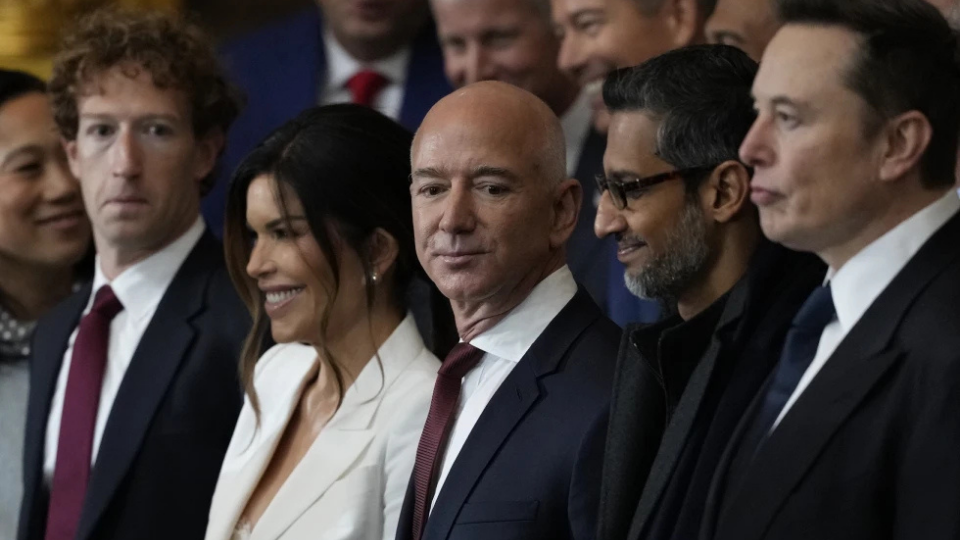
And the potential damage includes further undermining of democracy, Sanders told a crowd at Stanford University in Palo Alto, Calif., as multibillionaires such as Elon Musk and Jeff Bezos use AI to seize and perpetuate control of the political system and infrastructure.
Sanders, the former chair and now top minority member on the Senate Labor Committee, drew on a report the committee’s minority staff recently researched and assembled with the cooperation of the AFL-CIO. He also warned that the U.S. is woefully unprepared for a job market revolution, which is moving at 10 times the speed and 10 times the breadth of the Industrial Revolution.
That fast track could not only make millions of workers obsolete, with no alternative jobs to turn to because AI has replaced them all, but also provide a bleak outlook for today’s graduates, the mostly student audience in his speech was told. The speech is on YouTube.
That’s a horrifying threat, Sanders said. In his speech, the senator even quoted several of the oligarchs, including Musk, as making that forecast. The multi-billionaire Bezos has already said he wants to partially, if not fully, automate the Amazon warehouses, costing 600,000 jobs.
“Super intelligent AI could become smarter than humans,” he said. “That’s not a very high bar,” he ad-libbed, to laughter.
AI “could become an existential threat to the human race. Human beings could actually lose control over the planet Earth.”
The multibillionaires don’t care about that, as evidenced by their rush to use AI to rake in the profits. Four AI companies are spending $670 billion this year building data centers, ten times greater in GDP than what was spent on the moon landing.

“The question we should be asking day after day is ‘Who is pushing this revolution? Who benefits from it? And who gets hurt?’” It’s the age-old question asked about all technologies that Sanders was talking about—Who controls the technology and for what purpose?
So far, Sanders said, AI benefits the ultra-rich, and that will widen not just the income and wealth chasm between the rich and the rest of us, but also produce a large mental health crisis, as workers who lose their jobs to AI can’t find replacements—thanks to AI—and the college grads can’t either.
“Neither AI nor robotics are good nor bad,” intrinsically, Sanders admitted. But the “who benefits” question “is the debate we have to undertake.” But politicians duck it so far.
While Sanders didn’t say so, disillusionment and despair that the political system does not work for working people drove hordes of them to the siren song of “I alone can fix it” from Donald Trump.
Sanders is not the sole voice in the wilderness warning about the threat of AI. The AFL-CIO has laid out a program where its unions should now bargain about AI with their bosses.
The object is not to curb development of AI but to harness it so workers—not just bosses and especially not the multibillionaires—help determine how it is used, to ensure it’s for workers’ benefit and not for that of the ultrarich.
The federation set such standards in writing when it reached a joint AI development oversight agreement with Microsoft—including company neutrality in organizing drives among AI workers.
The Teachers/AFT have linked up with a major Silicon Valley firm to jointly develop a teacher training institute on AI and its use in the classroom. The institute will be housed in lower Manhattan.
And AFL-CIO Secretary-Treasurer Fred Redmond warned about AI’s threat to jobs, and how the multibillionaires were manipulating AI to enrich themselves at the expense of the rest of us, when he introduced the AFL-CIO’s annual Paywatch study in 2023.
Redmond noted Hertz Rent-A-Car “invested in a self-service rental car system that uses AI technology.” Since then, the technology has proliferated in fast-food restaurants. It also now summarizes articles and other materials posted on computers.
And private equity czar Stephen Schwarzman of Blackstone gave millions of dollars to MIT and to Oxford University in the United Kingdom “to advance the ethical study of computing and artificial intelligence, and its implications on industries and business,” Redmond added.
“He’s betting on the AI revolution, and it’s happening now,” Redmond said of Schwarzman. ”It’s going to affect how we work and live, and nearly every company is starting to grapple with its potential to transform our economy.
“The AI revolution has the potential to unleash broad-based prosperity that improves working conditions and lifts us all up. But if left unchecked, AI can increase economic inequality and undermine job security. An estimated 300 million jobs are at risk of automation by AI, including nearly half of all jobs in the United States.
“In some industries, AI is making HR decisions about hiring, scheduling, task assignment, performance reviews, and even terminations.”
Some municipalities see the huge data centers being constructed and proposed for providing the computing power for AI, fear the local consequences, and are moving to curb or ban them. The plants consume so much water and electricity—draining aquifers and overloading the creaky U.S. power grid—that local fears of high prices and scarce water lead to such legislation.
And Govs. J.B. Pritzker, D-Ill., and Josh Shapiro, D-Pa., have also reversed course on AI, after hearing from their constituents about huge jumps in electricity bills and huge drops in water supplies. In Illinois’ case, however, Pritzker may have tried to halt the data center spread after they’ve already become ubiquitous in the Chicago suburbs.
In 2019, Pritzker signed legislation authorizing tax breaks for data centers, Axios reported. “AI took off, and Chicago became one of the nation’s biggest data center hubs. But households’ electricity bills went up, and some faulted data centers. “Pritzker hit the pause button in his State of the State speech, proposing a two-year moratorium on the tax incentives,” it added.
Shapiro signed a bill removing environmental roadblocks to the data centers in 2024. He also touted a $20 billion investment statewide—by Amazon. Now, in his state budget presentation, he asked lawmakers for “additional oversight” powers.
The GOP Trump administration, of course, is moving in the other direction: Non-regulation, combined with lip service to workers and job prospects. That was one point which Michael Kratsios, the GOP President Donald Trump’s director of the White House Office of Science and Technology Policy, emphasized at a February 20 AI summit in New Delhi, India.
After repeating Trump’s declaration that the U.S. would continue to lead the world in AI, Kratsios added in part, “Ideological, risk-focused obsessions, such as climate or equity, become excuses for bureaucratic management and centralization. In the name of safety, they increase the danger that these tools will be used for tyrannical control.” That could happen with AI, too, he warned.
“If we embrace AI and exercise its power well, it will advance human flourishing and drive unprecedented prosperity. Focusing AI policy on safety and speculative risks, however, rather than concrete opportunities, inhibits a competitive ecosystem, entrenches incumbents, and isolates developing countries from full participation in the AI economy.”
We hope you appreciated this article. At People’s World, we believe news and information should be free and accessible to all, but we need your help. Our journalism is free of corporate influence and paywalls because we are totally reader-supported. Only you, our readers and supporters, make this possible. If you enjoy reading People’s World and the stories we bring you, please support our work by donating or becoming a monthly sustainer today. Thank you!
CONTRIBUTOR




MOST POPULAR TODAY

Warnings sound: Trump ready to stage what amounts to a full-fledged coup

Redistricting leader Louise Lucas indicted as Trump’s revenge campaign widens

NEA, AFT, SEIU join Colorado to fight discrimination against LGBTQ people


Cuba solidarity: HotHouse delegation to combine cultural exchange with humanitarian aid