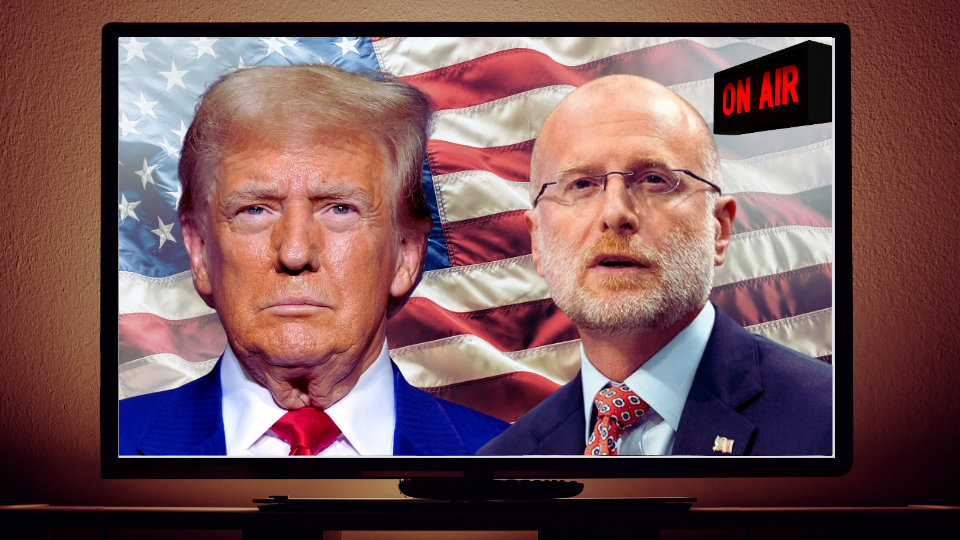
WASHINGTON—As the United States heads towards its 250th anniversary on July 4, the Federal Communications Commission (FCC) is telling broadcasters to air more “patriotic, pro-America” content. The announcement was made the same week FCC chairman Brendan Carr faced ongoing accusations of using his position to intimidate and censor those seen as opponents of the Trump administration.
The February 20 statement explained that the Pledge America Campaign was being made in conjunction with President Trump’s Salute to America 250 Task Force (Task Force 250), and called on “broadcasters to pledge to provide programming that promotes civic education, national pride, and our shared history.” Examples of the kind of patriotic programming Carr refers to include, starting each broadcast day with the “Star Spangled Banner” or Pledge of Allegiance, providing daily “Today in American History” announcements, and partnering with community organizations “already working hard to bring America’s stories of unity, perseverance, and triumph to light.”
And while the statement took the time to highlight a recent study that found civics education to be in rapid decline, recent maneuvers and previous statements by the president and FCC chairman Carr himself have many wondering what kind of history and civics is allowed—especially when it comes to diversity and inclusion, and those not seen in alignment with the Trump administration’s politics.
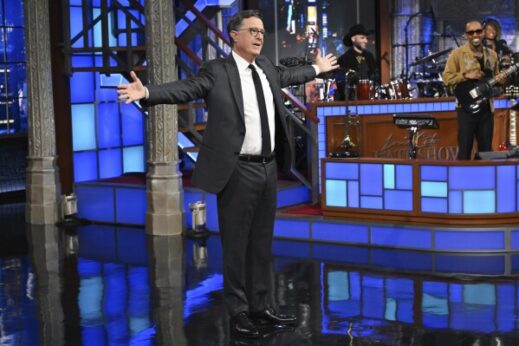
On February 17, late-night talk show host Stephen Colbert told his live studio audience that his network, CBS, had forbidden him from airing his interview with Texas State Rep. James Talarico, a Democratic candidate for the U.S. Senate, because of new Trump administration guidance on equal airtime for political candidates. Talarico is competing against Jasmine Crockett to be the state’s Democratic nominee to run against Senator John Cornyn, a Republican. Many eyes are on the race as political experts believe Crockett and Talarico have a real chance of winning, thus turning a longtime GOP red seat blue.
Colbert said the network told him that airing his interview with Talarico might trigger the FCC’s equal time rule, which requires broadcasters to give political candidates equal access to the nation’s airwaves. The late-night host countered that, for many years of late-night television, there was not a single example of the rule being enforced against a talk show interview. To note, the accepted exemption to the FCC’s equal-time rule is given to “bona fide news” programming—such as evening news programs. In 2006, in relation to interviews on “The Tonight Show with Jay Leno,” the FCC ruled that interviews on programs such as these were considered bona fide news.
And while Colbert did post the interview on the show’s YouTube channel (garnering over seven million views), the late-night host didn’t mince words when he asserted that “Let’s just call this what it is. Donald Trump’s administration wants to silence anyone who says anything bad about Trump on TV because all Trump does is watch TV.”
Carr later responded to the allegations on the “The Ingraham Angle” show, claiming that Colbert engineered a “hoax” and that he (Colbert) could have aired the interview if he wanted to, but would have to “comply with equal-time.” The FCC chairman would claim that he had no knowledge of the incident until he saw the topic trending on social media. He went on to agree with host Laura Ingraham that Colbert had instigated a “full-blown authoritarian fever dream.”
Yet many Carr detractors would claim that the FCC and the Trump administration’s maneuvers are not a dream, but rather a nightmarish reality for the First Amendment.
Massive media shift under Trump
Trump is no stranger to publicly ranting against television networks when he feels slighted by them, and even taking it to court for what he considers retribution. Last year, Paramount, which owns CBS, settled a lawsuit filed by the president over an interview broadcast by 60 Minutes in October 2024. The president had sued CBS for $10 billion, alleging that the network deceptively edited an interview that aired on its news program with then-Vice President and presidential candidate Kamala Harris to “tip the scales in favor of the Democratic Party” in the election. While Trump’s lawsuit was denounced by many as an obvious attack on press freedom, Paramount executives paid over $16 million to settle the suit.
Coincidentally—or some would argue not so coincidentally—coming on the heels of this settlement was the cancellation of CBS’s “The Late Show with Stephen Colbert.” While CBS claimed it was a financial decision, many saw it as another concession to the Trump administration, as host Colbert has been a consistent critic of the president. Soon after, the FCC approved Skydance Media’s $8 billion bid to acquire Paramount.
Since being promoted to his position by President Trump in 2024, Carr has been at the center of several controversies over late-night talk shows, news programs, the Super Bowl halftime show, and the aforementioned network merger. The chairman, who is one of the authors of the infamous Project 2025 manual, has gone on record stating that the FCC is “fully aligned with the agenda that President Trump is running.” In an interview with the Wall Street Journal, Carr claimed that “President Trump ran directly at the legacy mainstream media, and he smashed a facade that they’re the gatekeepers of truth.”
When Trump accused Comcast, the parent company of NBCUniversal, of bias toward Democrats, Carr launched two probes into the company. One investigation focused on the company’s diversity, equity, and inclusion (DEI) policies. In April 2025, Carr alleged that NBC News and MSNBC were “misleading the American public” with their coverage of the high-profile deportation case of Kilmar Abrego Garcia.
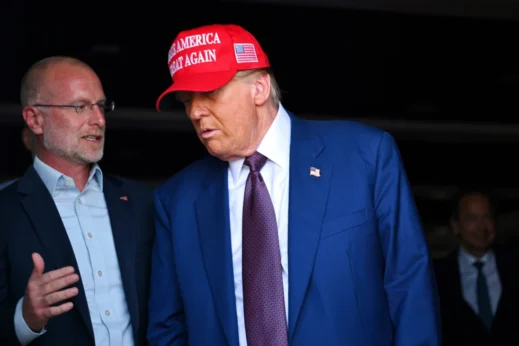
Carr has said he has no problem pulling broadcast licenses from any outlet he believes has engaged in misconduct against the “public interest”—a term the chairman has invoked often when justifying FCC investigations.
“Broadcast licenses are not sacred cows,” Carr said during the Wall Street Journal interview.
When another late-night host and known Trump critic, Jimmy Kimmel, gave a monologue on air discussing the assassination of right-wing podcaster Charlie Kirk—much to Trump’s chagrin—Carr went online, stating that “We can do this the easy way or the hard way. These companies can find ways to change conduct and take action on Kimmel, or there’s going to be additional work for the FCC ahead.”
Following this, ABC, the network on which Kimmel’s show is on, announced that it would suspend the show “indefinitely.” Carr seemingly supported the network’s move, saying that the FCC was not “done yet,” and that the country was in the “midst of a massive shift in dynamics in the media ecosystem for lots of reasons, again, including the permission structure that President Trump’s election has provided.”
After this year’s Super Bowl, conservative and Republican officials like Congressman Randy Fine posted on social media, calling the halftime performance of Puerto Rican artist Bad Bunny “disgusting,” “illegal,” and in violation of federal public decency regulations, thus writing a letter to Carr on the matter. Trump called Bad Bunny’s performance “absolutely terrible” and “an affront to the Greatness of America.” Reuters would later report that the FCC requested transcripts of the halftime show—although the agency would later say it found no violations.

And while Carr called Colbert’s outrage a “hoax,” in the same week, the FCC chairman announced that the agency would investigate the daytime talk show “The View” under the equal time rule for an interview with James Talarico, which aired on February 2.
This year, the FCC issued updated guidelines specifically pushing back against its own 2006 decision regarding “The Tonight Show with Jay Leno,” stating that “for years, legacy TV networks assumed that their late-night and daytime talk shows qualify as ‘bona fide news’ programs—even when motivated by purely partisan political purposes.”
Critics assert that these incidents and Carr’s own words are creating a dangerous environment for freedom of speech and the press.
How a free society operates
On January 14, during the Communications and Technology Subcommittee hearing on oversight of the FCC, Energy and Commerce Committee Ranking Member Frank Pallone, Jr. (D-NJ) stated that with “Trump’s ongoing crusade to chill free speech, punish news networks, and vilify American journalism, there has been no greater ally than Chairman Brendan Carr.”
“He [Carr] has weaponized the agency to benefit Trump and punish anyone who challenges him,” Pallone said. “He opened sham investigations into small, local media outlets for simply reporting on publicly available information about ICE raids. He weaponized the FCC’s public interest principles to bully news organizations. And he repeatedly violated the First Amendment by threatening and intimidating broadcasters who aired speech that the President does not like.”
After Carr’s remarks about Colbert and “The View,” the lone Democrat on the FCC panel, Commissioner Anna M. Gomez, released a statement condemning Carr’s actions.
“The FCC has no lawful authority to pressure broadcasters for political purposes or to create a climate that chills free expression,” she stated. “I once again urge broadcasters and their parent companies to stand firm against these unlawful pressures and continue exercising their constitutional right to speak freely and without government interference,” she stated.
Gomez called Carr’s investigation into “The View” a “sham.”
“Let’s be clear on what this is. This is government intimidation, not a legitimate investigation… The real purpose is to weaponize the FCC’s regulatory authority to intimidate perceived critics of this Administration and chill protected speech. That is not how a free society operates.”
So while Carr, in relation to the Pledge American campaign, states that he looks forward to broadcasters “taking the Pledge and fulfilling their public interest mandate,” there are many who worry that the behavior of the FCC under his control shows the growing restrictions on editorial independence—imposed by government threat or corporate fear. Behavior they believe is not in the best “interest” of society.
We hope you appreciated this article. At People’s World, we believe news and information should be free and accessible to all, but we need your help. Our journalism is free of corporate influence and paywalls because we are totally reader-supported. Only you, our readers and supporters, make this possible. If you enjoy reading People’s World and the stories we bring you, please support our work by donating or becoming a monthly sustainer today. Thank you!
CONTRIBUTOR