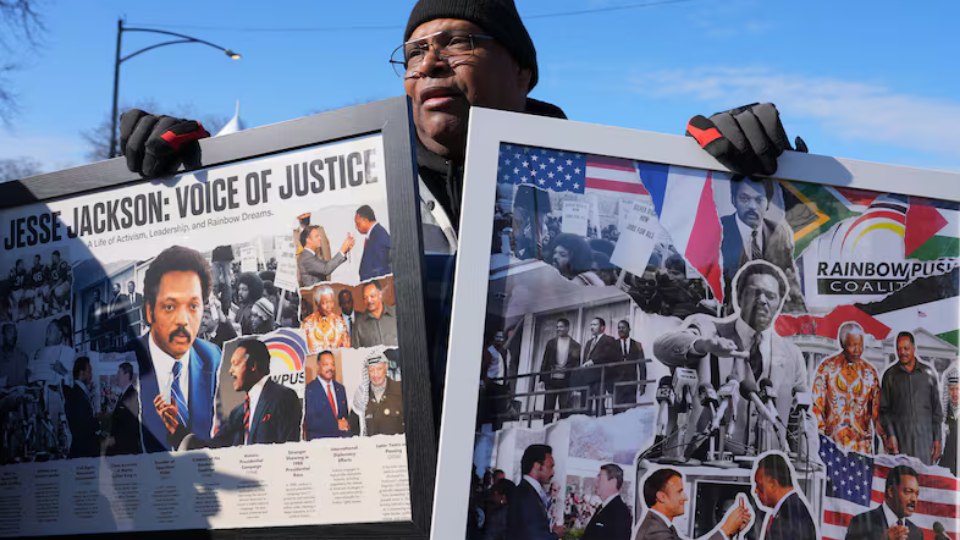
CHICAGO—Thousands paid their respects to the late Rev. Jesse Jackson as his body lay in repose in Chicago, in what served as a testament to the impact his progressive activism had on generations of people.
People from across Chicago and the United States gathered at the Rainbow/PUSH Coalition’s headquarters on February 26 and 27 to celebrate the civil rights icon before his body was moved to the South Carolina State House. Jackson’s body is set to then travel to Washington, D.C., for continued celebrations of his life, before returning to Chicago for a public service at the House of Hope, a 10,000-seat Baptist church, on March 6.
“You take a look outside, you can see the impact,” said Spencer Leak, Jr., the vice president of Leak and Sons Funeral Home, which has been tasked with planning Jackson’s funeral services. His grandfather, Andrew Leak, welcomed Jesse Jackson and his family into their South Shore home after the family moved from South Carolina in 1964.
“When I’m standing at the casket, you see people in there that don’t know Rev.Jackson, but they’re crying because they are thinking about 30, 40 years ago. ‘Keep Hope Alive,’ ‘I am somebody,’ that just resonates in your mind. And since he passed away, I can’t stop thinking about ‘I am somebody,’” Leak said, in reference to Jackson’s oft-quoted poem.
Jackson, a protege of the Rev. Martin Luther King, Jr., who twice ran for president in the 1980s, died last month at the age of 84. Through his activism, Jackson was able to connect the struggles for civil rights and racial justice with the everyday struggles of working-class people and the poor.
Jackson participated in sit-in protests, took part in the Selma to Montgomery marches of 1965, and was tasked in 1966 with leading the Southern Christian Leadership Conference’s Operation Breadbasket. He founded what today is the Rainbow/PUSH Coalition, a civil rights organization that pressured companies to hire Black workers and registered massive amounts of voters in Chicago and across the country.
Jackson’s political impact on African-Americans can hardly be overstated, including his 1988 presidential run in which he received 7 million votes and won seven state primaries and four caucuses, all in the face of racist talking points about his campaign and cold shoulders from those in his own party. Despite his advocacy for the poor and marginalized of all backgrounds, he was labeled as being a self-promoter, with then-Vice President George H. W. Bush referring to him as a “hustler from Chicago.” Many of those who visited Rainbow/PUSH to pay their respects credited Jackson’s 1988 campaign with helping to pave the way toward Barack Obama’s election as the first African-American president two decades later.
“He meant a lot back then in the ‘80s when he first ran for president,” said Cher Phillips, a Chicago resident who visited Rainbow/PUSH on Friday. “He impacted my neighborhood, empowered us, made us feel proud of being Black, made you think that you can achieve more.”
“He was able to collectively work with both sides. There wasn’t this fine divide of ‘I can only talk to Black people.’ I mean, he was for everybody, but he was our Jesse Jackson,” Phillips said. “I really think he’s one of the last greats, like we don’t have that leadership that we used to have.”
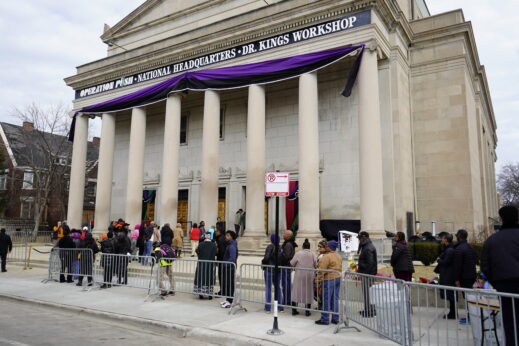
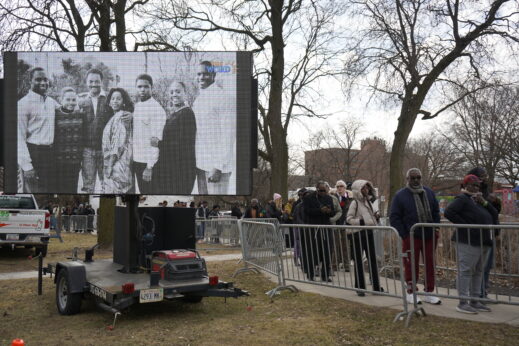
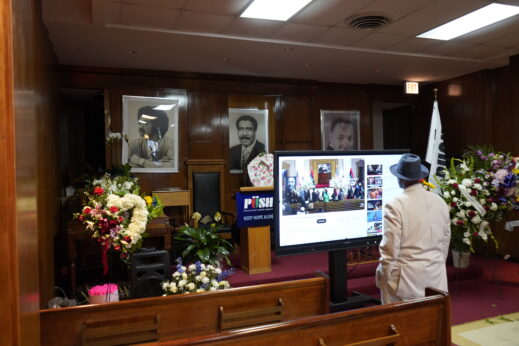
As people lined the sidewalks and waited to be let inside Rainbow/PUSH, a large video screen played a documentary on Jackson’s life as well as excerpts from his speeches. The screen was provided by Thomas Finch, the president of Finch and Associates Video Productions and a long-time friend of Jackson’s, who also helped to provide live-streamed video of the services.
Finch told People’s World he helped provide video production services for several Rainbow/PUSH events over the decades, as well as at events like the Million Man March in 1995 and Obama’s election night rally in Chicago’s Grant Park in 2008.
Finch said when he first moved to Chicago from New Jersey, it was “very difficult for African-Americans to get into the Hilton, the Hyatt, McCormick Place Convention Center” because “they couldn’t use people that looked like me.” Finch credited Jackson’s activism that he’s now “welcomed into these places” for his business.
“Rev. Jackson did so much and came so far. I grew up looking up to him. He went through some areas that we were afraid to go through,” Finch said. “He’s gotten threats, his family’s been threatened, there’s a lot of things that he’s gone through that we don’t see. I’m so proud of him, and that’s why I’m here to support the family.”
Jackson’s activism also extended to international issues as well, from protesting against apartheid South Africa in the 1980s to supporting resolutions in 2024 calling for a ceasefire and an end to Israel’s military attacks on Gaza. Jackson went so far as to act as an unofficial diplomat for the United States on several occasions and negotiated the release of hostages and prisoners in multiple countries.
“Rev. Jackson has a footprint that covers the globe,” said Robin Robinson, a Chicago journalist and former WFLD news anchor who knew Jackson personally. “You have leaders of countries all over the world [who] have asked for his advice. You had conflicts that he has stepped in and resolved all over the world. He defined a new role of unofficial diplomacy. Where an elected person couldn’t fully go in because of protocol, he could.”
Robinson also credited Jackson for popularizing the term “African-American” in the U.S.
Robinson told how Jackson once entered an editorial news meeting and said, “‘We as Black people don’t want to be described as a color. We would like for you in the future to refer to us as African-American. Chinese-American for Chinese-Americans, Italian-American for Italian-Americans, nobody calls them by their color.’”
“Over the years, the term African-American became embedded in the language, and language matters,” Robinson said. “It matters when you say out loud to yourself and others that ‘I am somebody.’ Sounds kind of silly, but for people who’ve been treated as nobodies for generations, it’s pretty powerful. So I’m an African-American somebody.”
Those who spoke with People’s World also talked about the example Jackson’s activism leaves in light of the current Trump administration’s policies, especially with regard to voting rights. While Jackson’s body was lying in repose, the Washington Post reported that President Donald Trump had reviewed a draft executive order that seeks to mandate voter ID and ban mail ballots in November’s midterm elections.
“I’d like to turn to the young people, because I think they need the message that he taught and talked over the decades,” said Arnette Hubbard, a former Cook County Circuit Court judge who also served as the first woman president of the National Bar Association.
Hubbard said she knew Jackson was going “back to [Operation] Breadbasket, when we were meeting in church basements and wherever else we could,” and said she worked alongside Jackson on the campaign trail.
“Everywhere he went, all across the country, he was able to ignite energy and young people to make them want to do something. ‘Where you are now, you can make a difference,’ he always said, and they could,” Hubbard said.
“He made people engaged, made them believe that democracy can be made real, and I mean that because it has its issues,” Hubbard said. “Everybody can enjoy the fruits of democracy, that was his message.”
Jackson authored numerous articles that have been featured in People’s World, which can be read here.
We hope you appreciated this article. At People’s World, we believe news and information should be free and accessible to all, but we need your help. Our journalism is free of corporate influence and paywalls because we are totally reader-supported. Only you, our readers and supporters, make this possible. If you enjoy reading People’s World and the stories we bring you, please support our work by donating or becoming a monthly sustainer today. Thank you!
CONTRIBUTOR