WASHINGTON—The post office has been around since before the signing of the Declaration of Independence. In its early years, no one ever asked how much profit it would make. The need of the people to have a means of cross-country communication and of businesses small and big to have the same was paramount.
So, over the centuries, a public entity, the Post Office, was built and expanded. It met that need and, in so doing, made the U.S. a more democratic nation by providing everyone equal access to a vital service. The USPS is totally unlike FedEx or UPS—private entities that lay off thousands of workers when the profits of top executives are not high enough.
All of that is irrelevant, apparently to new Postmaster General David Steiner. Speaking to a House Oversight subcommittee on March 17, Steiner said cuts are coming. The USPS is deep in red ink, he said, and has hit its credit limit, which hasn’t risen in more than 30 years. Unless Congress moves quickly on a short-term fix—doubling the credit limit to $30 billion—the post office will supposedly run out of money and close within a year, Steiner adds.
But the doubling would give USPS a financial lifeline and breathing spell, and let lawmakers work on a comprehensive solution to its fiscal ills, Steiner said. He had a few suggestions: Cutting unprofitable routes, which are 71% of the total, and closing unprofitable post offices, for starters.
The red ink that Steiner claims is afflicting the USPS, however, is caused not by its inherit unprofitability, but rather by unfair rules imposed upon it by legislative bodies who would prefer that USPS be privatized.
The Postal Service’s own Inspector General has complained to lawmakers that USPS must overpay pension contributions to cover future retirees, as well as past workers who began their careers before the USPS became semi-independent in 1971.
That overpayment costs the Postal Service $3 billion yearly, on top of other very large retirement payment obligations to which the USPS is uniquely subjected. The Postal Service is denied the ability to act like any other public or private entity when dealing with future pension responsibilities.
What Steiner did not mention when talking to Congress was the most important issue: The Postal Service, and its ancestor the Post Office, dating before the American Revolution, was never intended to make a profit. The Constitution gives Congress the power to “establish post offices and post roads.” There’s no mention of profits or losses. The framers’ intent was to help knit the country together.
Nor did he mention the Trump administration requesting a further $200 billion for the war in Iran at a time when many public services—not only the USPS—are desperate for cash in the United States.
Steiner, with his tunnel vision, sees doubling the credit limit as the main way to give the USPS a financial lifeline while letting lawmakers work on a comprehensive solution to its fiscal ills. His “comprehensive” solutions, however, involve cutting routes that don’t turn a profit and closing allegedly “unprofitable “post offices. It’s the approach of banks and businesses in the private sector: Offer more credit rather than higher income.
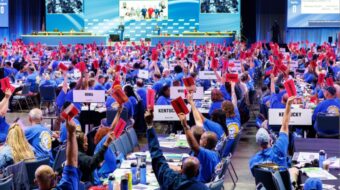
Steiner’s suggestions lay the groundwork for getting rid of the USPS altogether and privatizing it entirely, according to labor leaders in the mail industry. Also speaking to Congress the same day, Letter Carriers (NALC) President Brian Renfroe and Postal Workers (APWU) President Jonathan Smith agreed with Steiner on the short-term fix but said it is not a long term solution.
In his own statement, Renfroe criticized some of Steiner’s proposals, such as reducing long-time retirees’ pensions, hiring more part-time contract carriers, and unspecified revisions in how workers’ comp claims are handled. After all, Renfroe pointed out, workers are forced to file for compensation due to unsafe working conditions which management causes. And those workers’ comp payments range from $400 million-$800 million a year, Steiner admitted.
Smith, the new APWU president, repeated prior union opposition to privatizing the Postal Service, turning it and its 600,000 workers—more than 80% unionized—over to Wall Street investors.
Steiner told lawmakers that while the Postal Service has made some progress in cutting costs, that wasn’t enough. He said that in the last 20 years, first-class mail volume, which is the main revenue raiser for the USPS, has dropped by 48%.
So revenue from that source has crashed, too. If first-class volume had stayed the same but at the current 78-cents-an-ounce stamp price, the Postal Service would have been $81 billion richer in those two decades, Steiner calculated.
Meanwhile, the Postal Service can’t raise its rates on its own and can’t adjust rates to cover the often-long distances a first-class letter or package must travel. The postal rate is the same if the letter travels from D.C. to suburban Alexandria, Va., or all the way to Honolulu. Other nations both have higher rates and charge more by distance. Only two other nations—one of them Malta—charge less.
Steiner also said that while his predecessor, Louis DeJoy, a longtime advocate of privatization, began improvements which cut costs, they weren’t enough. DeJoy’s “Delivering for America” plan also envisioned huge workforce cuts. DeJoy, a former private package company CEO, also slowed down first-class mail delivery—by closing sorting centers—and emphasized package delivery over letters.
In some of his statements, Steiner admitted that he really does not know that much about the USPS and its importance to the American people. “I am not sure the American public is aware the Postal Service is at a critical juncture,” Steiner stated. “I know I wasn’t aware of the extent of it before I took on this role, but at our current run rate and if we continue to pay our required obligations in the same manner as we have done in recent years, then we will be out of cash in less than 12 months,” he said, gloomily.
“We will fiercely fight limiting Letter Carriers’ workers’ compensation benefits in any way or increasing usage of non-career employees in our craft as some in the hearing suggested,” NALC President Renfroe said in his statement, without naming names or political parties. “Even suggesting such foolish actions is insulting to America’s hardworking Letter Carriers.
“Local postal management’s lack of contract compliance costs the agency hundreds of millions of dollars. An agency that struggles to uphold the basic tenets of a mutual agreement”—the union contract—“should not have sole control over something as critical as workers’ compensation claims. And the current non-career workforce in the city letter craft is a failed experiment.” Steiner wants to expand that workforce.
“But let’s be clear,” APWU’s Smith said: “America’s postal workers are not prepared to pay for decades of Washington’s stalling on doing what’s right to help address the Postal Service’s finances. We will work with anyone who shares our commitment to providing the prompt, reliable, and efficient service promised under the law.
“The APWU will continue the fight for good jobs at the post office, and a Postal Service that continues to meet the needs of the public we are so proud to serve.”
What Smith did not say is government in general, especially the federal government, and the USPS in particular has also been a common route to well-paying union jobs for workers of color, including himself. Those jobs have had more protection, and less discrimination, than private sector employment—yet another expansion of democracy in that would be lost if the nation loses the Postal Service.
We hope you appreciated this article. At People’s World, we believe news and information should be free and accessible to all, but we need your help. Our journalism is free of corporate influence and paywalls because we are totally reader-supported. Only you, our readers and supporters, make this possible. If you enjoy reading People’s World and the stories we bring you, please support our work by donating or becoming a monthly sustainer today. Thank you!
CONTRIBUTOR