WASHINGTON—The U.S. Supreme Court’s right-wing Republican-named majority, including three justices named by Donald Trump, is preparing to hack at your voting rights again.
And this time, they’ve chosen a favorite Trump target: Mail-in ballots.
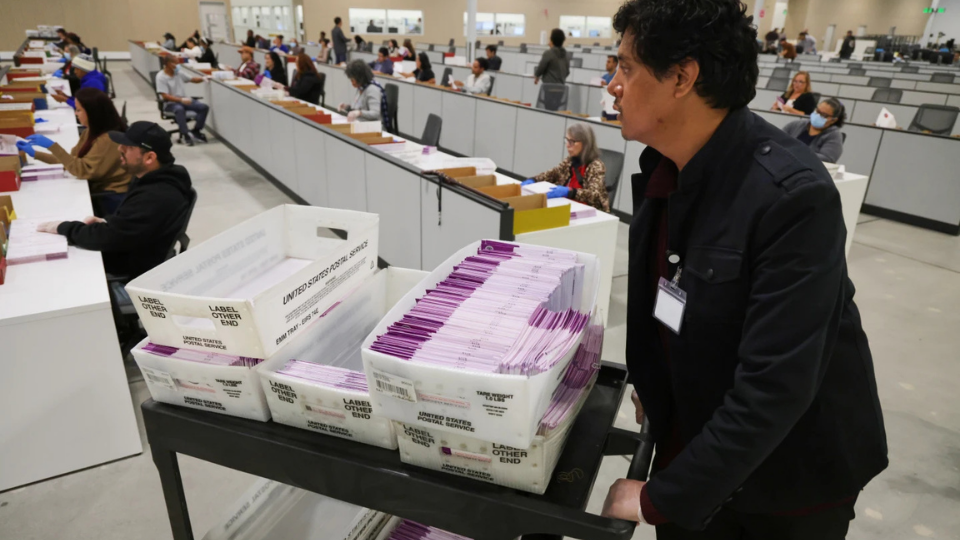
The two-hour oral argument on March 23 pitted the deep-red state of Mississippi, which is normally known for its racist discrimination against Black voters, against the Republican National Committee. The justices wrestled with what to do about mailed-in ballots that were postmarked on or before Election Day but arrived at counting centers after it. The GOP-named majority appeared ready, from their questions, to toss them.
Mississippi argued for counting them. The GOP and the Republican Trump lawyers argued against it.
Mississippi argued that its five-day “grace period” for such late arrivals should stand, as should similar laws in at least 12 other states, plus Washington, D.C. The Nation’s Capital mails ballots to all voters but still keeps polling places open on Election Day. The West Coast states of Oregon, Washington, and California, plus Colorado, Utah, Nevada, Hawaii, and Vermont, have gone totally vote-by-mail.
But what happens if mailed-in ballots arrive after Election Day at the election boards? Count them in, according to each state’s law, says Mississippi. Throw them out, says the Republican Party.
“Throw them out” was a key Trump theme in his 2020 campaign and its aftermath against Democratic nominee Joe Biden. It’s also a part of the GOP’s super-repressive throwback to Jim Crow, the Safeguard American Voter Eligibility (Save) Act, now stalled on the GOP-run Senate floor.
Ironically and hypocritically, as much as he rails against mail-in voting, Trump voted by mail in the Florida special election yesterday in the district that encompasses his Mar-a-Lago estate. He probably wasn’t happy when it was announced that the Democrat, Emily Gregory, flipped that seat, long-held by Republicans.
The mail-in ballots’ fate, like the fate of the Save Act, is important to workers. That’s because many workers cannot take time off from their jobs to stand in long lines to vote. And, because, traditionally, pro-worker voters have a greater tendency to vote by mail than anti-worker Republicans, especially MAGA Republicans.
But mail-in ballots are often counted late, producing late surges for pro-worker candidates. Often, that is because Republicans block attempts to start counting those votes early. Such late surges gave Democrat Joe Biden the key swing states of Arizona, Michigan, Pennsylvania, and Wisconsin in 2020. He defeated Trump who, more than five years later, still hates vote by mail despite the fact that he voted that way yesterday.
In the oral argument, five of the six GOP-named justices, notably Samuel Alito, appeared to be strongly for throwing out mailed-in ballots that arrive “late” and the voters who cast those ballots.
And it was one of the three Democratic-named justices, Ketanji Brown Jackson, who made obvious the link between the case before the court and the Save Act.
Justice Jackson emphasized the key point is not what the “Election Day” law meant when Congress passed it in 1845, but what that deadline means now. The development of modern campaigns, scholars say, added to mail-in voting. Most elections are now “Election Week” or “Election Month,” Justice Samuel Alito complained.
Justice Jackson said the point the court must decide is the deadline for receiving ballots, and whether the 1845 federal law overrides all the state laws, including Mississippi’s, and their grace periods for receiving mail-in ballots. “We’re trying to figure out, what Congress meant when it included ‘Election Day’ in its federal statutes,” she said. There are no past cases to cite.
Justice Alito, leading the court’s Republican phalanx in opposition to Mississippi’s—and other states’—mail-in ballot laws, said Mississippi’s logic could lead to long-drawn-out election outcomes, uncertainty, and distrust of the election system. Left unsaid: Among Trump’s MAGA legions, fueled by his hate, such distrust is already high.
Mississippi Solicitor General Scott Stewart, arguing the state’s case, said that’s logically unlikely. But, he contended, setting such post-election deadlines for mail-in ballot receipts is within a state’s power, according to the Constitution, not Congress’s. That irked Justice Alito.
Though Justice Alito didn’t say so, a long-drawn-out outcome—which included whether to count mail-in ballots—occurred in the epic battle over Florida’s popular votes in 2020. Courts had to decide which ballots, and from where, should be counted in the George W. Bush-Al Gore presidential race.
That included delayed mail-in ballots, which were postmarked on time, sent to Miami-Dade and Broward Counties. Most were from U.S. Jewish voters living in Israel.
Three of the current justices—Chief Justice John Roberts, and Justices Amy Coney Barrett and Brett Kavanaugh–were part of Bush’s election team that year, ProPublica reported just before Election Day 2020. All kept a low profile in Florida. By 2018, as a federal judge, Justice Kavanaugh dissented from counting postmarked-but-late mail-in ballots from Wisconsin. Trump later named Justice Kavanaugh to the High Court.
Justice Alito was not part of the Bush-Gore fight, as he was already a federal court judge. The U.S. Supreme Court voted 5-4 on party lines to stop the ballot counts from Miami-Dade and Broward Counties, which Gore wanted to count, including axing those late mail-in ballots from Israel. The justices awarded Florida and the presidency to Bush.
It was after the dialogue between Justice Alito and Stewart that Justice Jackson made the link to the Save Act. Deciding where states draw the line on which late-arriving mail-in ballots to count, Justice Jackson said “are only problems to the extent that Congress thought they were problems.”
The Save Act would ban the counting of the late-arriving mailed-in ballots, even if they’re postmarked before Election Day. The only exceptions are for military and diplomatic personnel. Their ballots would still be counted, as long as they’re postmarked by Election Day, and subject to state count deadlines.
The court is expected to decide the mail-in ballot case by the end of June or early July. That’s early enough, apparently, for states to adjust to a ban before this November’s election, the justices noted.
We hope you appreciated this article. At People’s World, we believe news and information should be free and accessible to all, but we need your help. Our journalism is free of corporate influence and paywalls because we are totally reader-supported. Only you, our readers and supporters, make this possible. If you enjoy reading People’s World and the stories we bring you, please support our work by donating or becoming a monthly sustainer today. Thank you!
CONTRIBUTOR