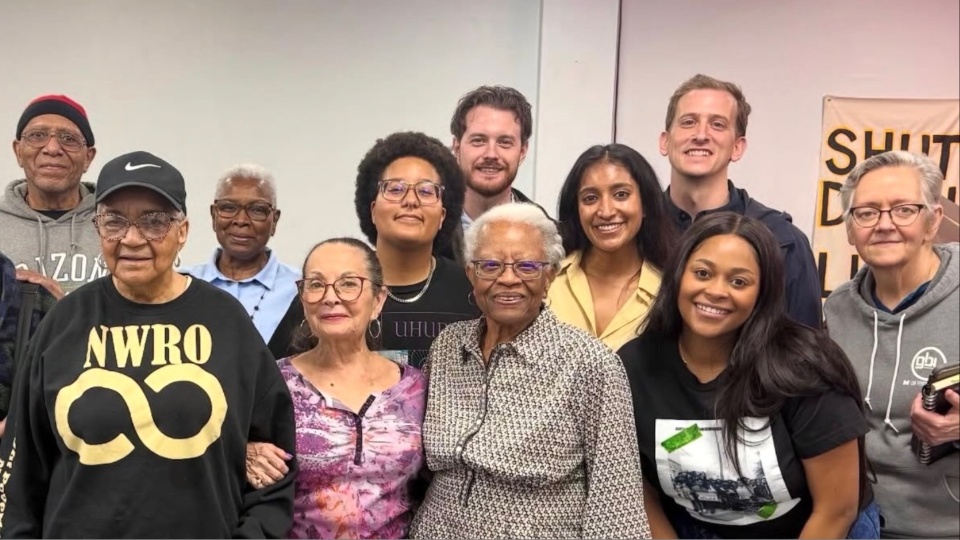
DETROIT—Carrying forward Detroit’s revolutionary working-class legacy, the General Baker Institute (GBI) launched its Rooted Resistance Educational Series this past weekend, the first iteration of the event since 2020. The meeting connected longtime organizers with young activists eager to learn from decades of struggle and carry the movement forward.
The packed room featured activists young and old, multi-racial, and multi-gendered, seated beside the institute’s red mural depicting revolutionary leaders like Fidel Castro, Angela Davis, Harriet Tubman, Thomas Sankara, Che Guevara, Marsha P. Johnson, and Vladimir Lenin. GBI is named after the late Gordon “General” Baker, Jr., leader of the League of Revolutionary Black Workers and longtime United Auto Workers member.

Rooted Resistance is part of the growing effort in Detroit to organize workers and communities amid worsening conditions under the second Trump administration. The impact of U.S. imperialist wars is felt locally through food scarcity, failing infrastructure, unaffordable housing, deplorable working conditions, rising gas prices, and ICE violence against immigrants.
GBI aims to draw connections between Detroit’s working class and international struggles, as well as intergenerational fights against racism and political repression, to contribute to the unity and education of the movement against fascism and war. More events are to be held in the near future.
Crystal Bernard, General Baker’s youngest daughter and key organizer of the event, told People’s World the series seeks to unite organizers across Detroit to build collective power. “We are starting the process of turning thinkers into fighters, and fighters into thinkers,” she said, quoting her late father.

The event featured a panel of youth and veteran organizers fighting the MAGA billionaire agenda and fascism across fronts including youth organizing, Black liberation, immigrant rights, and the trade unions.
After the audience identified key issues, featured panelists discussed past political landscapes as well as how to sustain today’s movement.
Marsha Battle Philpot, a veteran Detroit organizer, writer, and educator, recalled joining the movement at 13.

“I spent time before school passing out literature at Dodge Main with General Baker,” she said. Dodge Main was the large Detroit auto plant where Black workers formed the Dodge Revolutionary Union Movement (DRUM) in May 1968 in response to racist working conditions.
“It was a time of extraordinary social upheaval,” she continued, citing anti-war, women’s, and post-1967 rebellion movements in Detroit and around the country. She reflected on hardships movement leaders faced—shattered homes, addiction, mental illness—noting, “We are the survivors, and there are many who did not survive.”
Philpot stressed the importance of literacy: “When I was a part of the League of Revolutionary Black Workers…we were encouraged—no, made—to read. Reading about liberation in Northern Ireland, in the Congo, Nigeria, Vietnam.”
Ebony Elmore, a community and environmental justice organizer, emphasized learning from past lessons. “It’s up to us to take those lessons and immerse ourselves in that knowledge, because the times are repeating themselves.” She called on “connectors” to unite generations and keep stories from being erased by the capitalist media.
Kylie “Kye” Lynne, a young organizer focused on digital life and economic instability, noted social media’s double edge. “Oftentimes, people interact with short-form content and get limited context. They still care, but political education is removed from any deeper context, especially locally.” They added that direct action now often overshadows community-building.
Cameron Harrison, with the Detroit Club of the Communist Party USA, spoke to individualism and a seeming loss of faith in mass organizing. “Instead of doing the tactful and strategic thing, people may see an Instagram meme and think this is what revolutionaries are supposed to do.

“When those tactics or slogans don’t align with reality, that leads to frustration and nihilism.” He added, “The class struggle is a process…that’s what actually gives us hope—the process of struggle itself.”
Gregory Hicks, a veteran Detroit organizer, tied education and community to building power. “People are seeing what ICE is doing…and they’re trying to see whether or not they’re next,” he said. “There was a wide variety of activities…people could get involved in any area, creating an activist community that was reinforcing.”
As the event closed, Maureen Taylor of the Michigan Welfare Rights Organization addressed the audience. “I want young people to understand how quickly things can turn on a dime,” she said, referencing the U.S. anti-fascist fighters of the Abraham Lincoln Brigade who fought in the Spanish Civil War against Franco.
“Now, [the capitalists] took your food stamps, they took your rent, and now you’ll have to call a lawyer…. Figure it out, as the resistance of the day, and explain it to other folks—this gets real bad, real fast! Let’s get ourselves organized!”
We hope you appreciated this article. At People’s World, we believe news and information should be free and accessible to all, but we need your help. Our journalism is free of corporate influence and paywalls because we are totally reader-supported. Only you, our readers and supporters, make this possible. If you enjoy reading People’s World and the stories we bring you, please support our work by donating or becoming a monthly sustainer today. Thank you!
CONTRIBUTOR