

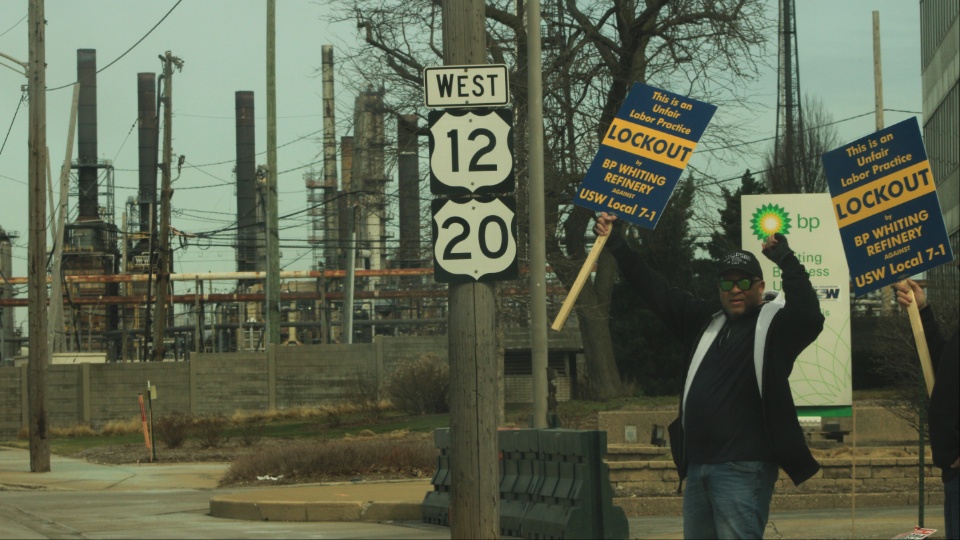
WHITING, Ind.—A fire is burning in Whiting, Indiana. At midnight on March 19, some 800 Steelworker union members at the largest inland oil refinery in the United States were locked out of the expansive facility south of Chicago on the shore of Lake Michigan.
The lockout was the culmination of a months-long negotiation between USW Local 7-1 and multinational energy giant BP. United Steelworkers represents workers across various industries including oil, steel, glass, and other energy producing industries.
Since the lockout, picket lines are positioned at each entrance to the facility. Every 25 seconds, cars drive past, honking their horns and raising fists to the workers standing outside. Men and women stand with signs around every entrance to the sprawling plant.
This isn’t the first time workers at the Whiting refinery have been on the picket line. In 2015, more than 5,200 USW oil workers nationwide, including those from the Whiting facility, struck for three months. Union leadership at that time cited understaffing, grueling hours, and unsafe working conditions as the reason for the strike. Now, 11 years later, the union has similar issues.
People’s World spoke to several members of the union on the morning of March 20.
Workers cited an overall decline in working conditions, such as being required to work overtime, and safety issues with aging equipment and unenforced safety regulations. Other employees describe an increase in responsibility without corresponding pay. Over 300 union jobs have been cut since that 2015 strike, and the remaining workers say they are expected to do responsibilities outside of their given job description.

“In 21 years, this is the least safe I’ve ever felt on the job. They let stuff go. They can’t claim this is for safety,” said Fred, the lead process safety representative, a veteran of the industry. He vocalized his concerns for the safety of the plant. “It’s not a matter of if something breaks, but when. This is 50- to 60-year-old equipment. You don’t see it unless you’re here. It takes five to six years to even get a grasp on this stuff.”
Another safety concern is that the refining process produces highly toxic hydrogen sulfide, exposure to which is a leading cause of industrial fatalities. The National Library of Medicine cites high exposure to hydrogen sulfide leading to the death of cells in the cerebral cortex of the brain, with “low-level long-term exposure being associated with various adverse ocular, nasal, and respiratory effects.”
With round-the-clock shifts, overtime can be grueling. A married couple, one a machinist and the other a maintenance worker at the plant, spoke to People’s World on the picket line. They declined to give their names out of fear of retaliation.
“We’re married…. sometimes I see her 15 minutes a day…. They’ve had me work 14-hour days, 19 days straight, with two days off,” the husband said.
Atop all of that, the six-year agreement insisted on by BP would remove the facility from the current alignment of contract expiration dates among the various oil refinery locals. This would set the foundation to break the union one refinery at a time, said Eric Schultz, president of Local 7-1.
BP says it’s just trying to be ‘competitive’
BP’s vice president of the plant, Chris Dellafranco, claims that “While this lockout is a difficult decision, with very challenging circumstances, the changes we are seeking are necessary to advance the safety and competitiveness of our refinery for decades to come.”
“How is cutting jobs remaining competitive? Competitive for who?” Jabrill, a machinist at the plant, countered. “It pisses me off—the greed. They’re fighting us over what? One to two percent of their profit? They’re trying to take away my PTO and sick days.”
To continue fulltime production at the plant during the lockout, BP has brought in scab workers and contractors, posing another safety risk due to inexperience with the archaic equipment.
Schultz, Local 7-1 president, told People’s World there have been two refinery evacuations since 2009. “They’ve both been in the past year,” he said. “There’s a run-to-failure mentality with the equipment. It’s a large complex refinery. We have highly trained, highly skilled workers that are not there right now because the company chose greed over safety.”
Despite cutting union positions, refusing to invest in safety measures for employees of the plant, and increasingly cruel work hours, BP continues to generate billions in profit amid global instability. It is expected to grow its net income by $2.8 billion to $12.9 billion this year. In 2022, the company reported record earnings as oil prices surged following Russia’s invasion of Ukraine.
Since the war on Iran began, there has been an even broader windfall that has seen major oil companies bring in hundreds of billions in profit. With the U.S. and Israel continuing their bombing of Iran and the resulting closure of the Strait of Hormuz, this instability that has skyrocketed profits has intensified. Since the invasion, The Telegraph estimates BP and ExxonMobil have already netted upwards of $5 billion in profit.
For workers on the picket line in Whiting, fighting for safety measures, fair hours, and better staffing, that contrast is impossible to ignore.
“They can’t say they’re losing money, we’re already competitive. But we can’t give in on our right to fight for ourselves.”
We hope you appreciated this article. At People’s World, we believe news and information should be free and accessible to all, but we need your help. Our journalism is free of corporate influence and paywalls because we are totally reader-supported. Only you, our readers and supporters, make this possible. If you enjoy reading People’s World and the stories we bring you, please support our work by donating or becoming a monthly sustainer today. Thank you!
CONTRIBUTOR



MOST POPULAR TODAY

Credible sources say Trump readies to steal the midterm elections

Leonard Peltier, longest serving U.S. political prisoner, should be free

How the bad science of AI doomerism is good for big business

Dark day for Hollywood labor: Paramount-Warner Bros. mega merger approved

Controversial ‘God made Trump’ campaign ad produces bipartisan uproar