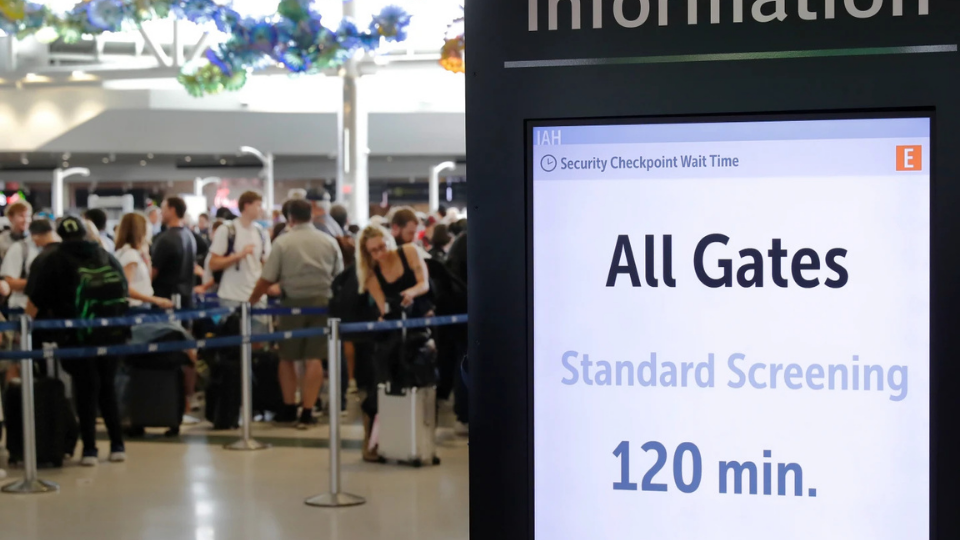
WASHINGTON—What’s it like for a worker with a family to go one week on the job…two weeks… three…four…five…six…and counting, forced to go to work but not getting a paycheck?
The answer from a group of Transportation Security Officers, better known as the airport screeners, can be summed up easily. Life is filled with fear and anxiety, and is often a living hell.
The screeners’ union, the Government Employees (AFGE), convened a gathering where they described that hell on March 24. It is part of AFGE’s campaign to pressure Congress to approve a money bill for the Department of Homeland Security (DHS).
After that session, Republicans, worried about their chances in the Midterm elections, claimed they were concerned. President Donald Trump, with great media fanfare, said he told his new DHS Secretary, Markwayne Mullin, to find a way to pay the 47,000 screeners.
Then in the early morning hours of March 27, Senate Republicans passed a DHS money bill but without funds for “immigration enforcement.” In other words, they were conceding to Democratic senators who want no money for Trump’s bullies in ICE and the Border Patrol.
That sent the mess back to the House, which meets next week. But the ultra-right “Freedom Caucus,” whose 40 members are the tail that often wags the ruling Republicans’ dog, promptly, at 11 a.m., said “no.” They demand that ICE and Border Patrol agents, despite their murders of two U.S. citizens, be paid, too.
In short, the screeners are still without any relief. And the obvious question is why, Trump and his GOP followers, in the Senate, if they are really serious, did not act sooner.
The DHS employs 47,000 screeners, 9,000 Coast Guard workers, plus workers for the Federal Emergency Management Agency and more than a dozen other agencies. All have been unpaid.
AFGE President Everett Kelley and TSO local union leaders from around the country tried to break through this impasse by describing what it’s like to work, no paycheck to no paycheck.
“What happens at the end of the month?” asks Hydrick Thomas, president of AFGE Local 100 and of the union council for all the TSOs. A military veteran, he’s been a TSO since the agency was created after the Sept. 11, 2001, al-Qaeda attacks on New York City and D.C., he’s close to retirement.
“Your rent is due, your car payments are due, your child’s birthday is coming up, and you have to tell them we can’t even afford to get them cookies” for a party. “And what about going home when there are no meals at home?”
And when TSOs, who must still come to work despite being unpaid, arrive late because they can’t afford gasoline for their cars—and must take public transportation, often for long distances—the agency docks them with demerits, he adds.
“We have parents, single parents, grandparents, and caregivers all living under financial strain” because of the lack of paychecks, said LaShonda Palmer, of Local 333, who represents TSOs at Philadelphia and southern New Jersey airports. “Morale is low and stress is high.
“Make us whole when this shutdown” of DHS “is over.” That may take a while. The last shutdown Trump engineered lasted 43 days, but it went through two paycheck cycles, so the TSOs didn’t get paid until the third one, 10 days after the shutdown ended.
“Every day we have to pay late fees” to lenders for overdrawn bank accounts, added Johnny Jones, head of the AFGE local, which includes the TSOs in Dallas-Fort Worth and their busy airports. “It’s $37 that we owe the bank” for each overdraft.
His members are “head over heels in debt,” and if and when they get paid, they should also get “excessive compensation” to repay them for those expenses, Jones said. “Back pay alone won’t cover those fees.”
Matt Johnson, president of Local 449, which includes TSOs at airports stretching from Maryland through North Carolina, said some of his members seek and take other permanent jobs “because they do not have the financial means to provide food for their families.”
The Democrats, long before yesterday’s claims by Trump and Republicans in the Senate that they care about the screeners, have been ready to fund the department and pay the TSOs, the Coast Guard, the FEMA workers, and the others, but not ICE and the Border Patrol without conditions.
And Kelley also took issue with the deployment of ICE agents at airports. He said having ICE agents, who are untrained in how to handle passengers but trained in violence, backup the TSOs at understaffed airports, “is like giving a teaspoon of cough syrup to someone who is dying of pneumonia.
The DHS also includes ICE—the Immigration and Customs Enforcement Service—and the Border Patrol. Most of the country castigates and hates those agents for their violent and vicious roundups of people, including the cold-blooded murder of two U.S. citizens in Minneapolis.
The shootings of Renee Michelle Good and Alex F. Pretti and other agents’ illegal actions set off a confrontation between the right-wing GOP Trump regime and congressional Democrats over funding DHS. That’s even though the ICE and Border Patrol agents, who are not members of the Government Employees any more, draw money from Donald Trump’s “Big Beautiful Bill,” passed last year.
And, of course, it’s Trump who’s turned the ICE and Border Patrol agents loose on migrants. Now he’s turned the ICE agents loose in U.S. airports, too, to allegedly “back up” the screeners. The ICE agents have been paid. The Transportation Security Officers—the screeners—haven’t.
Congressional Democrats demand reins on ICE as a condition for a new money bill for DHS: No masks, no sweeps, no sudden searches of homes, hospitals, businesses, schools, and religious institutions. Regular search warrants are sworn out in court. And no unprovoked violence.
Rank-and-file Democrats go even further: 91% want to abolish ICE, the most recent opinion poll says. So do more than half of independent voters. Trump and Republican followers want no strings on ICE.
Meanwhile, a video recently posted on Facebook shows an ICE agent grabbing an Asian-American mother who was getting off a plane in San Francisco, shackling her, throwing her to the ground, then hauling her off. No warrant and no reason given. She’s hysterical, and her daughter is crying.
“We heard about optimism for a breakthrough” in the impasse between Trump and the GOP on one hand and the Democrats on the other, Kelley said, but declared, “You can’t eat optimism.”
Trump’s alleged instructions to find a way to pay the screeners would not include the other DHS workers, including Federal Emergency Management Agency workers and 9,000 Coast Guard workers, who would still go unpaid.
Kelley did not comment on why Trump didn’t pay the screeners before, but Trump and the Republicans held the entire DHS money bill hostage to lawmakers knuckling under and approving his savage voter repression law, the Save Act. The Save Act is marooned in the Senate.
The Senate agreed in the wee hours of March 27 to pay the screeners, the Coast Guard, FEMA, and everyone else but the violent ICE and Border Patrol agents and their “immigration enforcement.” That too needs House approval. The House will return Monday to face the hot potato of DHS funding.
We hope you appreciated this article. At People’s World, we believe news and information should be free and accessible to all, but we need your help. Our journalism is free of corporate influence and paywalls because we are totally reader-supported. Only you, our readers and supporters, make this possible. If you enjoy reading People’s World and the stories we bring you, please support our work by donating or becoming a monthly sustainer today. Thank you!
CONTRIBUTOR