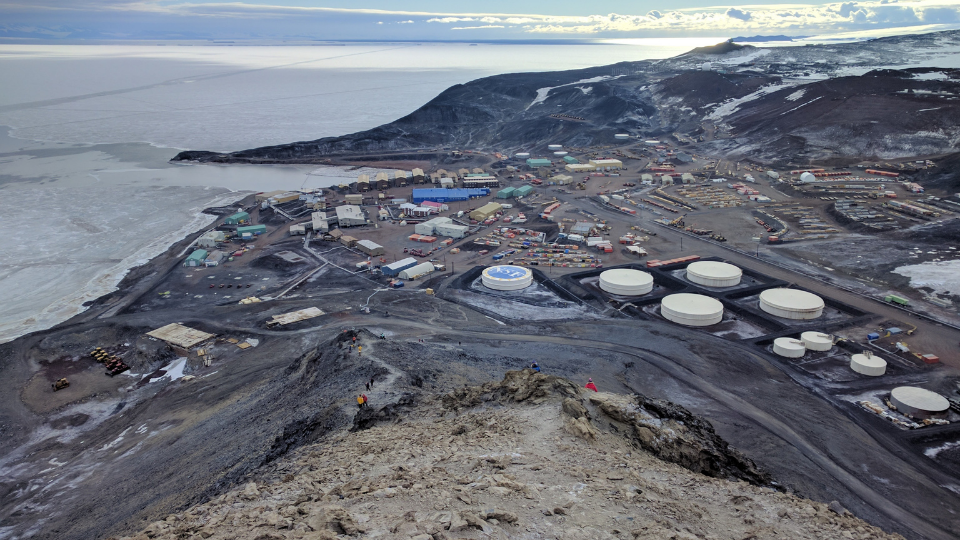
McMURDO STATION, Antarctica—It’s often said that Seafarers “sail the seven seas,” and a recent voyage—all the way to Antarctica—proves it.
Why? To transport needed supplies, especially fuel, to the U.S. South Polar research station there on McMurdo Sound. It’s a decades-long resupply mission named, appropriately, Operation Deep Freeze (ODF).
It’s quite a long ocean-going trek down to the ice-clad continent. But Seafarers union members are used to such long voyages. Antarctic cold, even in that continent’s “summer,” is another matter.
Before the Christmas holiday, the Stena Polaris loaded up fuel cargo in Greece to deliver to McMurdo Station. This was the vessel’s first time in ODF, and with the assistance of Navy Cargo Battalion One, the Stena Polaris supplied five million gallons of AN8 diesel fuel—a blend made specifically for the Antarctic region—more than 400,000 gallons of aviation fuel, and 126,000 gallons of gasoline.
According to the Military Sealift Command (MSC) Pacific’s McMurdo Station representative, Lieut. Emily Spath, everyone worked together in advance to facilitate the delivery process.
“The National Science Foundation contracts fuel specialists who operate the terminal at McMurdo Station, the Coast Guard provides ice escort services for the vessel, and MSC coordinates closely with the ship’s crew and personnel ashore to ensure a safe and successful operation,” she said.
The first ODF took place in 1955. American-flag ships have supported the mission every year. Ablebody Seaperson Harriet Groenleer, who was participating in ODF for the first time, assisted with basic tanker duties on the Stena Polaris, including lookout, steering, maintenance, and cargo ops.
“We left Piraeus, Greece, around Thanksgiving, and then we went to Rota, Spain, for a couple of days,” she told Seafarers Log. “We left Rota and went to Cape Town, South Africa, and we were there just before Christmas. Then from Cape Town, we went to McMurdo Station, and we arrived at the Winter Quarters Bay on, I believe, January 19.” Traveling between ports took around a month, and then the shipboard personnel spent a week or so in Antarctica.
Seafarers face several challenges when journeying to the South Pole. The big one is extreme cold. Antarctica’s mean annual temperature is -18°C (0°F), but it can reach as low as -50°C (-58°F) during the winter months—which happen to be the summer months in the U.S., and vice versa.
Antarctica/s environment is one of the coldest on Earth, but also can be dry and windy, which complicates the fuel transfer process. To meet the conditions of the environment, mariners must plan ahead and make additional coordination and operation decisions to ensure safe and successful delivery.
So by design, the ODF occurs during the Antarctic “summer,” when temperatures can reach as high as 8°C (46°F). Because of this, Groenleer said, the weather conditions were not so bad.
“I’m going to be honest with you. I have done two winters on the Great Lakes, and they were way worse,” she stated.
Antarctica has six months of day and six months of night, which are referred to as the austral summer and winter, respectively. Also, regions located below the equator experience seasons at opposite times from locations in the northern hemisphere, like the U.S.
“It’s going to be night on March 20,” the date of the spring equinox, “so we [completed the mission] in 24-hour daylight,” Groenleer noted. “It wasn’t really that windy most of the time, and the temperatures were in the 20s and 30s. So, it was cold, but it wasn’t horrible.
“We had to carry additional crew members to keep a better lookout for ice, so that’s why we had the ice pilot and the ice captain. Somebody was always on watch that had polar certification.”
Seafarers also used a special radar on the Stena Polaris to navigate around icebergs, which could sometimes take several days. Icebergs often are surrounded by fog, which can lead to further delays.
Seafarers took special precautions to maintain the environmental cleanliness of the region. “We couldn’t throw food waste over the side of the ship below 60 degrees latitude, out of concern for bird diseases,” Groenleer recalled.
“Even aside from the oil, we were careful. At a certain point, you couldn’t even run the incinerator because of the air pollution and impacts on the ice.”
60 degrees South latitude crosses open ocean all around the globe outside the Antarctic continent, and that line is considered the northern boundary of what is now known as the Southern Ocean, separate from the Atlantic, Pacific and Indian Oceans.
The Stena Polaris crew also kept an extremely thorough watch on the ship’s hoses, flanges, and connections to preserve the sensitivity of the Antarctic ecosystem because many species are found there that exist nowhere else in the world.
And the crew was issued polar survival gear in case of an abandon-ship situation, and participated in additional drills that were specific to the environment.
But after the hard work was done, ODF participants enjoyed the singular experience of being in Antarctica. One highlight for Groenleer was receiving an opportunity to visit Hut Point. There’s more than a bit of history there.
“Immediately adjacent to the dock is a hut on what’s called Hut Point, which was used by the Scott expedition and the Shackleton expedition to store supplies,” she explained. “Those supplies remain untouched in the hut from over 100 years ago, including just-dead seals they were burning for heat, or the box of biscuits that Ernest Shackleton left, and they’re just on the ground.”
Norwegian explorer Roald Amundsen reached the South Pole in 1911 and planted the Norwegian flag there. He bested British explorer Robert Scott by a month and returned safely. Scott didn’t.
“It’s just there,” Groenleer said of the hut. “There’s no barrier between you and history. The director of the Recreation Department opened the hut specifically for us and gave us a tour, and that was amazing. I was very, very excited, because it was an untouched slice of history, and it’s still there in its exact condition.”
Seafarers Union members aboard the Stena Polaris included Bosun James Gregory and three Ablebody Seapersons: Groenleer, Eden Dulin, and Dylan Wright. Other crew members were Tyler Brown, Rayshawn Buksha, Adam Ferkula, Tahj Ligon, and Diamond Jackson, Abdelhamid Dika, who was a Wiper, Steward/Baker Xavier Burgos, and Chief Cook Anthony Jackson.
The McMurdo Station base reminded Groenleer of college. “You go there, and there’s dorms, you’ve got the gym, you’ve got a little coffee shop, you’ve got a couple of bars, you have the cafeteria. It was like cold, grad school,” she said.
The 900 or so people living and working at the base at McMurdo Station treated the ODF participants with the utmost hospitality. “Some people work for the Air Force, and some work for the National Science Foundation, and some were maintenance workers, or PhD students,” Groenleer said. “Everyone lives in a big dorm, and they have what looks like a college cafeteria, and the people in charge of supplying that concession do a great job.”
In return for their kindness, the Stena Polaris crew gave several tours of the ship to those who were interested.
“I’m just really grateful to the people that worked at McMurdo for having us and treating us so well, and that the operation was a success,” Groenleer concluded.
We hope you appreciated this article. At People’s World, we believe news and information should be free and accessible to all, but we need your help. Our journalism is free of corporate influence and paywalls because we are totally reader-supported. Only you, our readers and supporters, make this possible. If you enjoy reading People’s World and the stories we bring you, please support our work by donating or becoming a monthly sustainer today. Thank you!
CONTRIBUTOR