“Great Carthage waged three wars. It was still powerful after the first, habitable still after the second. Gone without trace after the third.” With this 1951 quotation, Bertolt Brecht encapsulates a fate that seemed all too plausible in the mid-20th century—and which has again become disturbingly relevant today. It is precisely this vision of annihilation that Samuel Beckett’s Waiting for Godot confronts. Opening on a bare stage—“A country road. A tree. Evening”—the play asks what is left of humanity when a third war is unleashed.
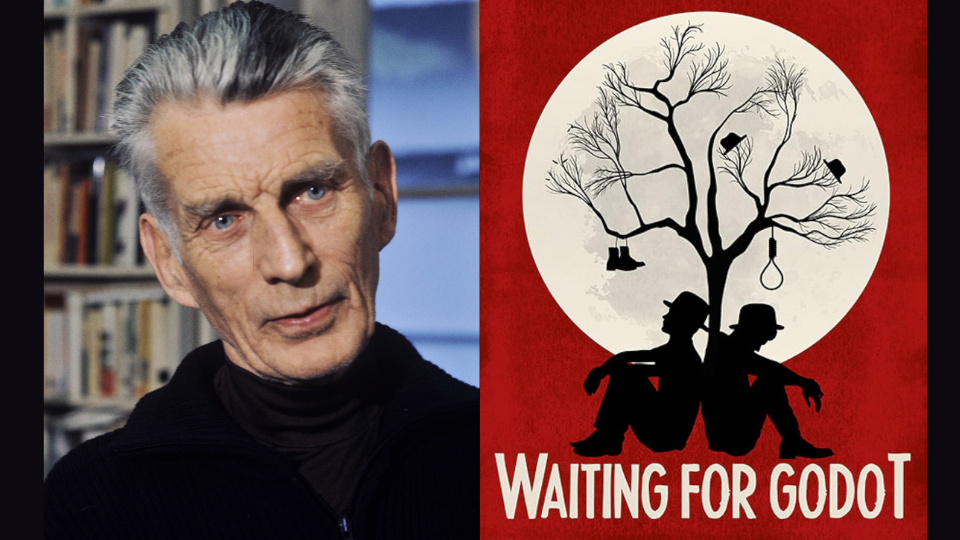
To fathom this, one must understand the man who wrote it. Born in 1906 into an upper-middle-class, Protestant, and Anglo-Irish family, Samuel Beckett would go on to become one of the most influential writers of the 20th century. Beckett first went to Paris in 1928 as an English lecturer, where he was introduced to the city’s avant-garde circles by his fellow Dubliner James Joyce—an encounter that would profoundly influence his future writing.
After years of moving between Ireland, London, Germany, and France, he settled permanently in Paris in 1937, where he met his future wife, Suzanne Deschevaux-Dumesnil. When the Second World War broke out, he decided to stay. In his words, he preferred “France at war to Ireland at peace.” Following the Nazi invasion, he joined the French Resistance, working clandestinely as a courier and interpreter. He narrowly escaped the Gestapo on several occasions. When members of his resistance network were arrested, Beckett and Suzanne were forced to flee to the village of Roussillon in the unoccupied zone in the South of France, where he continued to support the fight against fascism. For his dangerous work against the Nazis, the writer was later awarded both the Croix de Guerre and the Médaille de la Résistance.
Following the war, Beckett returned to Paris and entered his most productive phase. He made the switch to writing in French, a choice that would define his artistic voice. Writing in a language not his own allowed him to achieve a sparser, more direct style. This period produced his most significant works: the novel trilogy (Molloy, Malone Dies, The Unnamable) as well as his first major play, Waiting for Godot. Written in 1948, the play is a prime example of this pared-down aesthetic, its language reduced to an essential, functional core.
The premiere of Godot in 1953 brought him sudden fame. Further masterpieces followed, including Krapp’s Last Tape (1958) and Happy Days (1961). In 1969, he received the Nobel Prize for Literature—an honor he accepted reluctantly, largely to avoid the even greater media spectacle of a refusal. He continued to live reclusively in Paris, writing increasingly shorter, radically minimalist texts and often directing his plays. Samuel Beckett died in Paris on 22 December 1989 and was buried beside his wife at the Montparnasse Cemetery.
Beckett’s experience of living under occupation—the constant fear, the ever-present threat of betrayal, and the profound fragility of life—would seep into the very fabric of his later work, informing the atmosphere of waiting, dread, and precarious existence that defines Waiting for Godot. The play’s bleak landscape is entirely consistent with the man who had risked his life for others in the Resistance, and who would, in his art, lay human life bare to ask what, if anything, remains when everything else is gone.
Typically, when the play is performed today, the emphasis falls on its comic elements and its label as an ‘absurdist’ masterpiece—a work suggesting that life is inherently meaningless. Yet, this interpretation overlooks a crucial context. World War II had barely ended; the horrifying nuclear annihilation of Hiroshima and Nagasaki had left an indelible mark on the collective memory of humanity.
Although Beckett never explicitly states it, Waiting for Godot effectively presents its audience with a scene after a nuclear inferno. He gives us an all but empty stage: a country road and a single, bare tree. Into this landscape he places two characters, Vladimir (Didi) and Estragon (Gogo), who do not live here so much as just about exist. These two men struggle to perform the most elementary of actions—removing a shoe, for instance, becomes an ordeal. They sleep rough and are regularly beaten by gangs at night. The violence is so commonplace that they barely remark upon it.
In this world, human experience has been reduced to a minimum: simply staying alive and performing, with immense effort, the simplest of tasks. Homo sapiens, it seems, has been stripped of the “sapiens” part. The tree of life stands almost barren; in this play, it has become a possible prop on which to hang oneself.
Traditionally, plays begin with an exposition that leads to action, or they plunge us directly into the middle of one. In Waiting for Godot, however, there is no prospect for action whatsoever. The play’s first utterance—“Nothing to be done”—functions as a thesis: Didi and Gogo spend the entire duration waiting in vain. They have replaced the protagonists of the past—those who struggled against adversity and injustice, or who attempted to forge a meaningful life. The narratives that once served to endorse human goodness have been deprived of their meaning, including the vain hope for a savior, God(ot), to arrive. In fact, the very act of waiting for God(ot) is what prevents any movement out of this state of paralysis.
In Irish, “go deo” means “forever,” adding a hidden layer to the title: Waiting Forever. Past certainties are not just questioned, but fundamentally undermined. Theatre as we know it has come to an end. Without action, there can be no plot. Without the possibility of progress, there can be no climax or resolution. Beckett does not simply write a play about meaninglessness; he forges a new dramatic form from meaninglessness itself. The audience, like the characters, is forced to endure the “nothing to be done” in real time, sharing in their experience of empty duration.
The idea of human perfectibility is finished. The parables of the Bible, once a source of moral guidance, have become useless; Didi and Gogo barely remember them. When Pozzo arrives and asks Estragon his name, he replies, “Adam.” It is a fleeting, almost throwaway identification, but its resonance is profound. Humankind has been reduced to what Shakespeare’s King Lear, in his madness, calls a “poor, bare, forked animal.”
Our two protagonists are not defined in class terms; they appear to be vagrants. Yet, they are not entirely alone. Not only do we hear of random violence against them, but at two points in the play —once in each act—Pozzo passes through, dragging a slave named Lucky on the end of a rope, treating him like an animal. Pozzo is a nod to the remnants of a “master” class, one who still (or once again) possesses wealth and holds slaves. Lucky, in turn, echoes Shakespeare’s Caliban in The Tempest—the indigenous native of the island, kept ignorant and enslaved by the colonizer Prospero.
In the single, all-but-incomprehensible speech Lucky is allowed, he delivers a torrent of words that contains the play’s darkest truths. He speaks of “of a personal God … outside (of) time . . . who . . . loves us dearly . . . and suffers . . .with those who . . . are plunged in torment . . . it is established beyond all doubt . . . that man . . . wastes and pines … for reasons unknown . . . fades away.” He concludes with the image of “labours abandoned left unfinished.” The essence of his tortured monologue might be distilled to this: God—or man—has left his labors unfinished.
This devastating core, however, is not delivered as a straightforward lament. Lucky’s speech, the longest in the play, is a chaotic collision of high rhetoric and low farce. Statements of cosmic collapse are constantly interrupted by the banal and the trivial. The world-ending “great cold” is juxtaposed with the utterly mundane —“in spite of the tennis.” The names of the academic authorities Lucky invokes are pure nonsense: “Fartov and Belcher,” among others. So, even as Lucky articulates the end of all meaning, the silly, petty details of daily life stubbornly persist. The universe may be dying, but there is still a tennis match to be played.
This seemingly absurd contrast is what makes the speech both hilarious and deeply unsettling. It suggests that total collapse and ordinary life are not opposites; they strangely, terrifyingly coexist. In this sense, Lucky’s speech is the entire play in microcosm. It uses the wreckage of Western academic rhetoric to build a powerful and absurdly funny case for the perseverance of mundane existence, only to have that very case collapse under the weight of its futility. The speech ends with a final “unfinished.”
When Pozzo first encounters Gogo and Didi, he observes: “You are human beings none the less. … Of the same species as myself. … Made in God’s image!” The line is delivered as a simple statement of fact, but its implications are devastating. Any aspiration to godlike form and intellect has been annulled—or perhaps the reverse applies: God is this stumbling, bewildered, half-existent creature.
When Pozzo and Lucky reappear in Act II, the decline has accelerated. Pozzo has gone blind, Lucky mute. Thinking itself has become an effort. On one occasion, Didi and Gogo contemplate suicide by hanging themselves from the bare tree. One reason they do not go through with it is that one of them might remain alive and therefore face existence alone. That, they conclude, is a fate worse than death. This seemingly small decision offers a glimmer of hope. Two characters, after all, form a small community, and they do help each other survive.
Beyond this mutual dependency, there is another, more profound example of common humanity. When Pozzo cries out for help in rising to his feet, Didi and Gogo hesitate, bicker, but then Didi declares: “It is not every day that we are needed.” The statement is quietly profound. It acknowledges that Pozzo’s call for help is not addressed merely to two individuals, but to “all mankind.” And as Didi recognizes, “at this place, at this moment of time, all mankind is us, whether we like it or not.” In that instant, the tramps become the sole representatives of human responsibility. Yet, Beckett undercuts even this fragile epiphany. Ironically, all four men end up on the ground, their cries for help going unheeded. Standing upright has become impossible. Purposeful labor and action no longer define us. Pozzo’s final words on the subject are bleak: “They give birth astride of a grave, the light gleams an instant, then it’s night once more.”
Beckett’s play remains of immediate relevance to the world today. Like his contemporary Brecht, the Irishman warns of the ultimate destruction of human life. Yet, he leaves open the possibility that all is not lost. His characters still help each other in moments of need; that flicker of humanity persists. The tree bears a few leaves at the end of the play—it is not dead. The bond between Didi and Gogo, their refusal to abandon one another, is a fragile green shoot in the wasteland. Pozzo’s cry for help momentarily reminds them that they are, however reluctantly, “all mankind.” These tiny embers of compassion keep the play from descending into nihilism. Whether they are enough to make them—or us—finally “move on” is the question Beckett leaves to his audience.
We hope you appreciated this article. At People’s World, we believe news and information should be free and accessible to all, but we need your help. Our journalism is free of corporate influence and paywalls because we are totally reader-supported. Only you, our readers and supporters, make this possible. If you enjoy reading People’s World and the stories we bring you, please support our work by donating or becoming a monthly sustainer today. Thank you!
CONTRIBUTOR